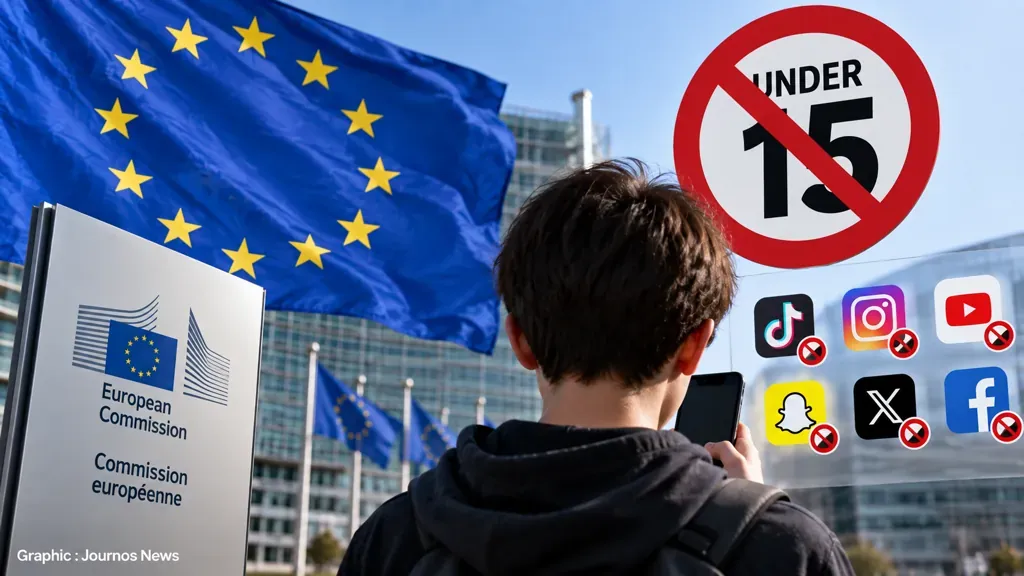
BRUSSELS, Belgium – The European Union is moving toward common restrictions on children’s access to social media, with the European Commission preparing an EU-wide framework that would introduce age-based rules for social networks and other online services.
The proposed EU Kids Act is expected to set 15 as the age at which teenagers could independently hold accounts on major social-media services. Younger users would face progressively stronger restrictions and parental controls under the draft framework being prepared by the Commission.
The proposal has not yet become EU law. The Commission is expected to formally present the legislation this week, after which it would have to be negotiated and approved by the European Parliament and EU member states.

The initiative reflects growing pressure across Europe to limit children’s exposure to harmful content, addictive platform features and other online risks.
Proposed age-based access
The draft framework would use different levels of access depending on a child’s age rather than applying a single rule to every minor.
Children under 3 would have no access to the covered services. Those between 3 and 12 would be directed toward child-friendly services with parental controls, while 13- and 14-year-olds could receive limited access under strict parental supervision. Independent accounts would generally begin at 15 under the proposal.
The measures are expected to cover more than traditional social networks.
The Commission’s proposed framework could also apply restrictions to video-sharing platforms, online games and AI chatbot services. Major platforms potentially affected include Facebook, Instagram, TikTok and YouTube, while AI services such as ChatGPT could also fall within the wider framework.
■ Related News




The exact scope remains subject to change before the legislation is formally presented.
Platforms would face new obligations
The proposed rules would also shift more responsibility toward technology companies.
Platforms would be expected to introduce reliable age-verification systems, strengthen parental controls and provide mechanisms for reporting harmful material. The draft also includes requirements aimed at limiting design features considered particularly addictive.
The EU has already been developing technical tools for age verification.
The European Commission says its age-verification approach is intended to allow users to demonstrate that they meet legal age requirements while protecting unnecessary disclosure of personal information. A technical blueprint was made available in 2025, and a feature-ready version of the system became available in April 2026.
That technology could become important if the EU introduces mandatory age thresholds across a large number of online services.
Pressure has grown across Europe
The EU initiative comes as individual European countries have pursued their own approaches to restricting children’s access to social media.
France has considered legislation establishing a minimum age of 15 for certain social-network services, while Norway has notified the European Commission of a draft law that would prevent children from using social media until the year they turn 16.
Those national measures have created pressure for a more consistent European approach.
A common EU framework could reduce differences between national rules and give technology companies a single set of requirements to follow across the bloc. But the proposal will still have to navigate disagreements over age thresholds, enforcement and the definition of services covered by the legislation.
The rules are not yet law
European Commission President Ursula von der Leyen is expected to outline the initiative as part of her annual State of the Union address, with the detailed EU Kids Act proposal to follow.
The legislative process could take considerably longer than the political announcement.
Once formally proposed, the legislation would need to pass through the EU’s ordinary legislative process, including negotiations between the European Parliament and the Council representing member states. The final rules could therefore differ from the current draft.
The central issue will be how far the EU can restrict children’s access while maintaining workable age verification, parental choice and protections for young people’s privacy and participation online.
For now, the Commission’s initiative marks a move toward a common European standard rather than an immediate EU-wide social-media ban for everyone under 15.
Reporting Credit: European Commission — EU digital policy, age-verification framework and preparation of the EU Kids Act; European Commission Technical Regulation Information System — notified national age-restriction proposals from EU and EEA countries; European Parliament and Council of the European Union — subsequent legislative consideration of the proposed EU framework.