JAKARTA, Indonesia – Indonesia’s Anak Krakatau volcano disrupted air travel across parts of Java and Sumatra after sustained eruptive activity sent volcanic ash into aviation corridors, prompting authorities to temporarily close several airports.
Indonesia’s National Disaster Management Agency (BNPB) said the eruption began continuously late on September 4 in the Sunda Strait, with activity including explosions, rumbling sounds and lava fountains. Volcanic ash subsequently spread across parts of western Indonesia, affecting airports around Jakarta and elsewhere.
Airport Closures Disrupt Aviation
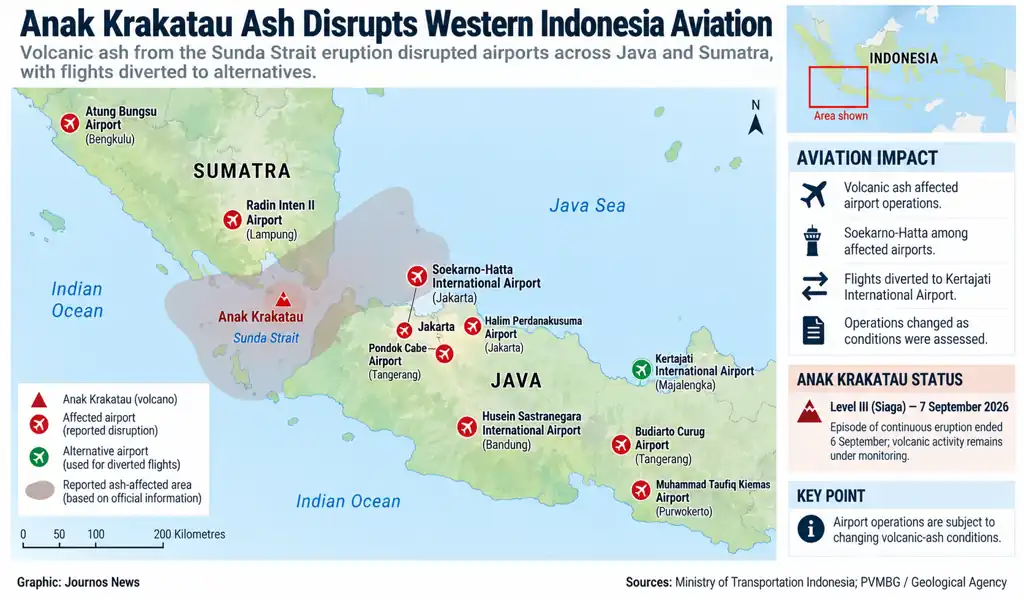
Indonesia’s Ministry of Transportation temporarily closed eight airports as authorities monitored volcanic ash concentrations and assessed the potential risks to aviation.

The closures were repeatedly extended as officials evaluated conditions. The ministry said decisions on reopening would depend on confirmed aviation-safety conditions rather than a predetermined schedule.
Among the affected airports was Soekarno-Hatta International Airport, Indonesia’s main international gateway serving Jakarta. Other airports in Java and Sumatra also experienced disruptions as ash moved through the region.
Airlines Divert and Adjust Flights
The airport restrictions affected domestic and international services, forcing airlines to modify schedules and passenger arrangements.
Authorities prepared alternative airports where possible, with some flights diverted to facilities including Kertajati International Airport in West Java. The scale of the disruption changed as individual airports were assessed and restrictions were extended or lifted.
By September 7, authorities were still reporting operational effects from the volcanic ash.
■ Related News




Operations Resume as Ash Risk Eases
Indonesia’s Ministry of Transportation said on September 8 that restrictions affecting Soekarno-Hatta and other airports had ended, allowing normal operations to resume from 12:01 a.m. local time.
The reopening marked a significant easing of the immediate aviation disruption, but authorities continued monitoring Anak Krakatau and the distribution of volcanic material.
The episode demonstrates why aviation disruptions can persist after an eruption begins to weaken. Airports and aviation authorities must determine that volcanic ash is no longer posing an unacceptable risk to aircraft operations before services can safely resume.
Volcanic Ash Creates Aviation Hazards
Volcanic ash is a significant aviation hazard because it can damage or disrupt jet engines and other aircraft systems. Ash can also reduce visibility and contaminate airport runways.
Aviation restrictions therefore can depend not only on ash detected at an airport but also on the expected movement of an ash plume through flight paths.
Indonesia’s Transportation Ministry repeatedly cited aviation safety as the basis for extending the airport closures.
Eruption Has Wider Environmental and Community Effects
Anak Krakatau lies in the Sunda Strait between Java and Sumatra, an area crossed by substantial maritime and aviation traffic.
BNPB reported that the eruption remained ongoing and that volcanic ash was affecting residents in several areas. The agency said the eruption had consequences beyond aviation, including effects on health and daily activities.
The incident highlights how volcanic activity can affect communities and infrastructure far beyond the immediate area surrounding an erupting volcano.
Current Eruption Differs From 2018 Disaster
Anak Krakatau is also associated with the December 2018 collapse that generated a tsunami and killed hundreds of people along the Sunda Strait.
The current eruption should not be equated automatically with that event. The disruption described in the current reports is primarily related to volcanic ash and aviation safety.
Any tsunami warning or evacuation order would require separate confirmation from the relevant authorities.
Monitoring Remains Critical
The resumption of airport operations has eased the immediate disruption, but it does not mean Anak Krakatau’s eruptive activity has ended.
BNPB and Indonesia’s geological authorities continue monitoring the volcano and the movement of volcanic material. Further changes in eruptive activity or ash distribution could affect aviation again if conditions deteriorate.
The episode also required coordination among disaster-management, geological and transportation authorities, airports and airlines as officials responded to changing volcanic conditions.
For aviation operators, the central concern is not simply whether Anak Krakatau remains active, but whether volcanic ash enters aircraft routes or airport operating areas.
Reporting Credit: Indonesia’s National Disaster Management Agency (BNPB); Ministry of Energy and Mineral Resources, Geological Agency / Center for Volcanology and Geological Hazard Mitigation (PVMBG); Indonesia’s Ministry of Transportation; Directorate General of Civil Aviation; Soekarno-Hatta International Airport and relevant airport authorities.