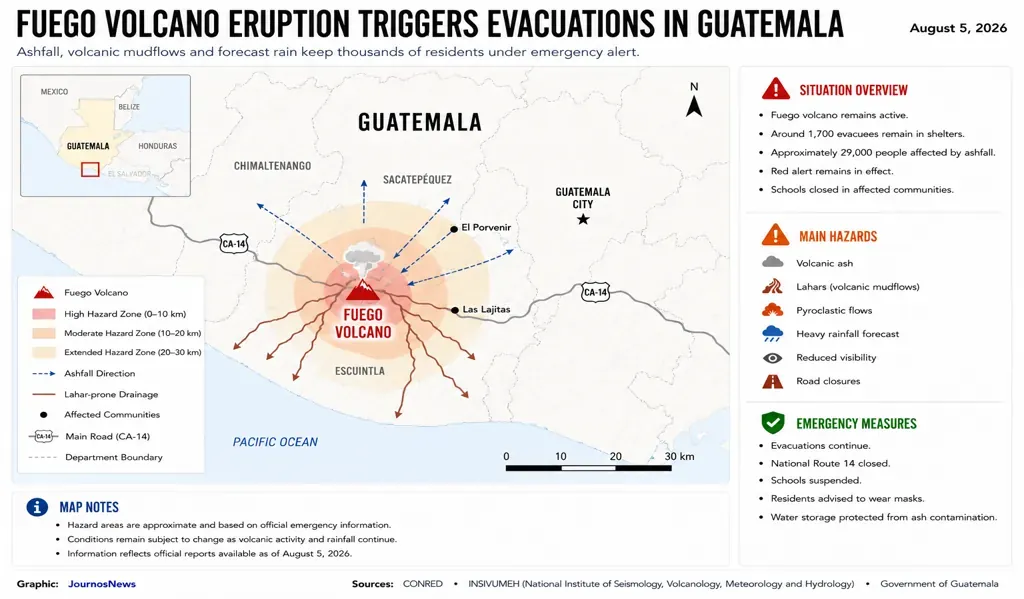
GUATEMALA CITY – Guatemalan authorities kept thousands of residents on high alert Tuesday as Fuego volcano continued erupting, sending fresh ash and volcanic mudflows down its slopes while emergency officials warned that incoming rain could worsen conditions over the coming days.
About 1,700 evacuees remained in temporary shelters after being displaced by the eruption, according to Guatemala’s National Coordinator for Disaster Reduction (CONRED). Officials said residents would not be allowed to return home until volcanic activity subsides and safety assessments are completed.
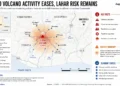
Authorities declared a red alert in the departments of Sacatepéquez, Escuintla and Chimaltenango, where ashfall has affected an estimated 29,000 people. Schools remained closed in impacted communities, and emergency agencies said the next 72 hours will be critical.

Rain Threatens to Intensify Volcanic Hazards
CONRED warned that lahars—fast-moving volcanic mudflows made of ash, rock and water—continue moving down the volcano’s slopes, with some extending up to 7 kilometers (4.3 miles).
Forecasters expect rainfall to increase over the coming days, raising the risk that additional mudflows could develop and threaten nearby communities.
Although the lahars had not reached populated areas by Tuesday, authorities urged residents to remain alert and follow official evacuation instructions if conditions change.
CONRED Executive Secretary Claudinne Ogaldes advised residents to cover water storage containers to prevent ash contamination and wear face masks to reduce exposure to volcanic ash.
Evacuations Continue as Ashfall Spreads
The eruption began Monday morning, producing towering columns of ash and volcanic gas while lava and pyroclastic flows descended the volcano’s slopes.




Volcanic activity continued Tuesday, generating additional ash emissions and mudflows.
Among those evacuated were about 250 residents from the community of El Porvenir and the nearby settlement of Las Lajitas. Officials also warned that changing winds could carry volcanic ash into additional surrounding communities.
As a precaution, authorities closed National Route 14, one of the main highways passing near the volcano, while the Education Ministry suspended classes in affected areas.
Fuego Remains One of Central America’s Most Active Volcanoes
Fuego, also known as the Volcano of Fire, is one of Central America’s most active and dangerous volcanoes, producing frequent eruptions that threaten nearby communities.
Its most devastating recent eruption occurred in June 2018, when fast-moving pyroclastic flows overwhelmed villages on the volcano’s slopes, killing hundreds of people. Another eruption last year also prompted precautionary evacuations.
Emergency officials continue monitoring the volcano around the clock, saying weather conditions and rainfall will play a critical role in determining how the situation develops over the coming days.
This report is based on reporting by The Associated Press.