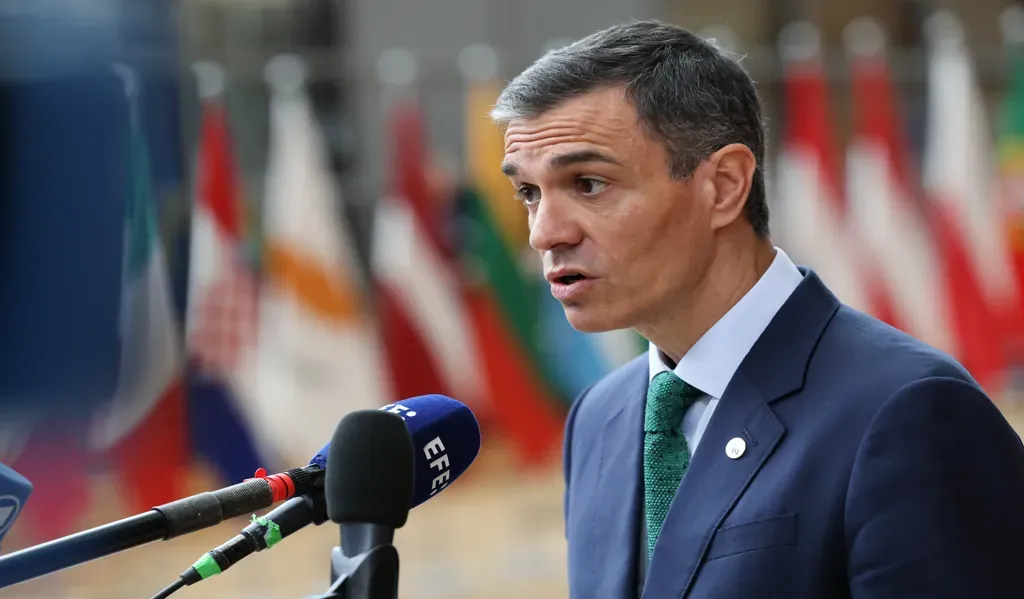
BRUSSELS, Belgium – Spanish Prime Minister Pedro Sánchez faced growing criticism from several European Union leaders on Tuesday as the bloc debated its response to last week’s mass migration crisis in Ceuta, exposing deep divisions over border security, asylum policy and responsibility-sharing across Europe.
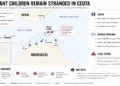
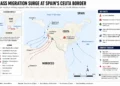
The political dispute follows the arrival of an estimated 72,000 migrants in the Spanish enclave of Ceuta over two days, triggering one of the largest migration emergencies in the territory’s history. Spanish and Moroccan authorities said more than 80 people died during the crossings, while most migrants later returned to Morocco.
The crisis has prompted renewed debate over how the European Union should respond to large-scale migration while balancing border protection with humanitarian obligations.

European Leaders Split on Migration Policy
The issue dominated discussions among EU leaders in Brussels, where several governments questioned Spain’s handling of the crisis.
Although many leaders publicly expressed support for Sánchez after the meetings, analysts said the dispute highlighted broader divisions within the European Union as it simultaneously confronts security concerns involving Russia, economic competition with China and evolving relations with the United States.
Italian Prime Minister Giorgia Meloni called for stronger external border controls and announced plans to reinforce Italy’s air and maritime monitoring involving Spain.
Analysts noted that the political disagreement extends beyond Ceuta itself.
Matteo Villa of the Italian Institute for Political Studies said relatively few migrants arriving in Ceuta ultimately travel to Italy, while Nando Sigona, a professor at the University of Birmingham, said Meloni also opposed Spain’s proposal to potentially legalize hundreds of thousands of undocumented migrants, making the issue politically significant across Europe.
■ Related News

Court Ruling Fuels Political Debate
A recent ruling by Spain’s Supreme Court became a central point of disagreement.
The decision requires legal procedures before migrants arriving by sea can be deported, unlike those who enter Ceuta through its land border or by climbing the border fence.
A joint letter signed by Meloni and 21 other European leaders argued that the ruling encouraged more migrants to attempt the crossing.
Sánchez rejected that criticism, saying Spain’s response complied with European law and humanitarian obligations.
He argued that criminal smuggling networks misrepresented the court’s decision to encourage migrants to travel to Ceuta and noted that Spain had previously supported other EU countries by accepting migrants relocated from Belarus in 2021 and Italy’s island of Lampedusa in 2023.
Spain and Morocco Exchange Accusations
Spain and Morocco also offered differing explanations for the crisis.
A senior Moroccan diplomat said Rabat believed Spain’s court ruling created expectations that migrants arriving by sea would receive greater legal protection.
Spanish officials rejected that claim.
Defense Minister Margarita Robles called on Morocco to investigate how tens of thousands of migrants were able to approach the border within such a short period.
Gil Arias, a former deputy executive director of the European Border and Coast Guard Agency (Frontex), said Moroccan authorities were likely aware of the large-scale movement toward Ceuta.
The Moroccan diplomat dismissed that suggestion, saying Morocco should not be expected to serve as “Europe’s police.”
Migration Debate Extends Across Europe
The Ceuta crisis has renewed wider discussions about the European Union’s migration strategy.
Several member states continue supporting stricter border enforcement under the European Migration and Asylum Pact, which expands powers to detain, process and return migrants to designated safe countries or external return centers.
According to Frontex, irregular border crossings into the European Union fell 37% during the first half of 2026 compared with the previous year.
Frontex Executive Director Hans Leijtens attributed the decline to stronger cooperation with neighboring countries.
Migration advocates, however, argued that the humanitarian challenges exposed by the Ceuta crisis remain unresolved.
Michele LeVoy, director of the Platform for International Cooperation on Undocumented Migrants, said political disagreements continue to overshadow the humanitarian needs of migrants.
Greek Prime Minister Kyriakos Mitsotakis said the events in Ceuta demonstrated the need for stronger European mechanisms to respond when migration is used as a geopolitical tool while preserving coordinated action among EU member states.
This report is based on reporting by The Associated Press.