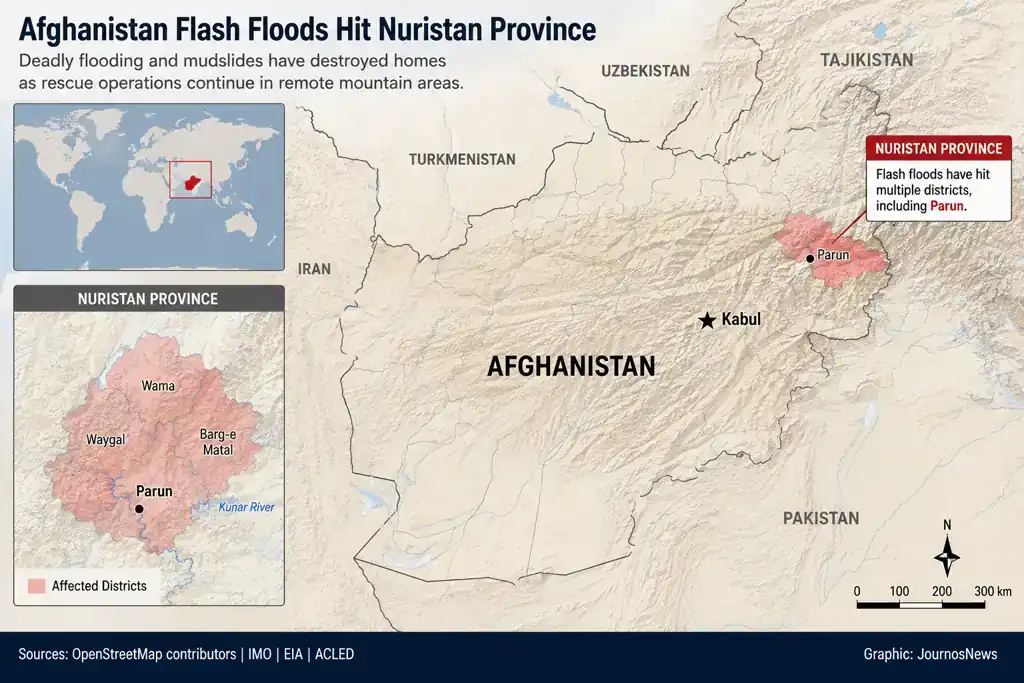
KABUL, Afghanistan – Rescue teams in eastern Afghanistan continued searching Tuesday for survivors and victims after powerful flash floods swept through Nuristan province, killing at least 23 people, injuring dozens and leaving more than 100 others missing, Afghan authorities said.
The Afghanistan National Disaster Management Authority said at least 80 people were injured after flooding struck the mountainous province on Monday, causing an undetermined number of buildings to collapse. The provincial capital, Parun, was among the hardest-hit areas.
Emergency crews searched through flood debris as authorities worked to locate missing residents amid fears the death toll could rise.

Search Operations Continue Amid Widespread Destruction
Footage from Parun showed extensive devastation, with homes reduced to piles of mud, rocks and shattered concrete. Heavy machinery cleared debris while residents joined rescue efforts, using shovels to search collapsed buildings.
Parun resident Zubair Ahmad said he saw floodwaters sweeping away victims as homes and businesses were destroyed.
“The flood came through here. We saw bodies being swept away in the floodwaters with our own eyes,” Ahmad said. “The flooding caused extensive damage and heavy losses for the local people.”
Authorities have not yet determined how many homes and other structures were destroyed.
Authorities Warn of Additional Extreme Weather
The Ministry of Transport and Civil Aviation’s meteorology department warned Monday evening that heavy rain, thunderstorms, strong winds, sandstorms and flash flooding could affect 10 of Afghanistan’s 34 provinces.
Officials urged residents to avoid riverbanks and other flood-prone areas as unstable weather conditions persist.
■ Related News



The warning has heightened concerns that rescue operations could become more difficult if additional flooding strikes communities already affected by the disaster.
Repeated Disasters Expose Afghanistan’s Vulnerability
Afghanistan remains highly vulnerable to extreme weather, with seasonal snowmelt and heavy rainfall frequently triggering deadly flash floods.
In 2024, spring floods killed more than 300 people across the country. Earlier this year, widespread flooding and landslides claimed at least 110 lives in several provinces.
The impact of natural disasters has been compounded by decades of conflict, deteriorating infrastructure, economic hardship, deforestation and the effects of climate change. Many rural communities rely on mud-built homes that offer little protection against sudden floods or severe weather, leaving residents especially vulnerable during extreme rainfall.
As rescue efforts continue in Nuristan, authorities are working to locate those still missing while monitoring forecasts for additional storms that could further complicate recovery operations.
This report is based on reporting by The Associated Press.
Article Topics: Afghanistan | Flash Floods | Nuristan | Natural Disaster | Search and Rescue | Extreme Weather | Climate Risks | Humanitarian Response