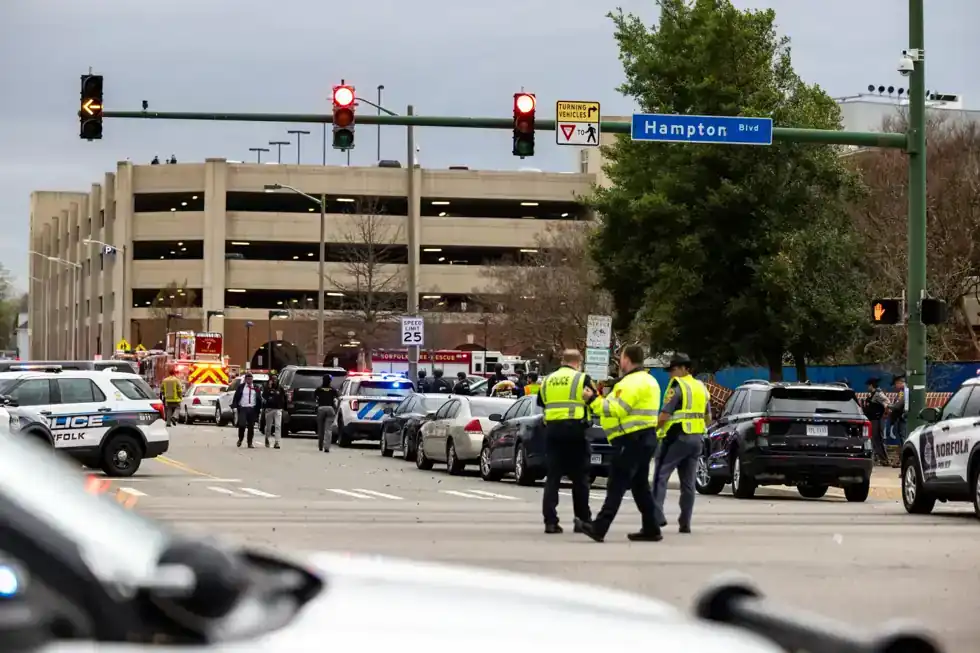
NORFOLK, Virginia (Journos News) – A fatal campus shooting at Old Dominion University has intensified scrutiny over domestic terrorism risk and security oversight after Reserve Officers’ Training Corps cadets intervened to stop a gunman who killed one person and wounded two others inside a classroom building.
Authorities say the attacker — a former member of the Virginia Army National Guard previously convicted of attempting to aid the Islamic State — opened fire Thursday before being subdued and killed by ROTC students on campus.
The incident, now under investigation by the Federal Bureau of Investigation as a possible act of terrorism, underscores concerns about the lingering security risks posed by individuals with past extremist affiliations after their release from prison.

Campus Violence Forces Immediate Security Reckoning
According to authorities, the gunman entered a classroom in the university’s business school building and began shooting, shouting religious slogans during the attack.
Dominique Evans, the special agent in charge of the FBI’s Norfolk field office, said during a news conference that ROTC students acted with what she described as “extreme bravery and courage” to confront the shooter and prevent further casualties.
“The students subdued him and rendered him no longer alive,” Evans said, declining to provide additional details about the circumstances of his death but confirming he was not shot.
University police said the suspect was confirmed dead within 10 minutes of the initial emergency call, highlighting the speed of the confrontation and response.
Security Concerns Grow Over Attacker’s Past
Investigators identified the attacker as Mohamed Bailor Jalloh, a naturalized U.S. citizen originally from Sierra Leone who had previously served in the National Guard before becoming the subject of a federal terrorism case nearly a decade earlier.
■ Related News


Court records show Jalloh pleaded guilty in 2016 to attempting to provide material support to the Islamic State group. Federal authorities said at the time that he had attempted to purchase a rifle and discussed plans to conduct an attack similar to the 2009 shootings at Fort Hood.
During the earlier investigation, prosecutors said Jalloh attempted to donate money to the extremist organization and communicated with individuals he believed to be connected to the group.
He was sentenced to 11 years in federal prison by U.S. District Judge Liam O’Grady and was released from custody in December 2024.
Campus and Military Community Shaken
The person killed in Thursday’s shooting was identified as Lt. Col. Brandon Shah, an ROTC leader who had returned to Old Dominion University in 2022 after serving as an Army helicopter pilot in Iraq, Afghanistan, and Eastern Europe.
Two additional people were injured in the attack, including one ROTC member who was hospitalized in critical condition. Another victim was treated and later released, according to hospital officials.
The university canceled classes and suspended operations on its main campus through Friday as authorities continued investigating the incident.
Old Dominion University President Brian Hemphill said the institution was working closely with law enforcement and expressed condolences to those affected.
Domestic Extremism Monitoring Faces New Scrutiny
The attack is now raising questions about the monitoring of individuals previously convicted of terrorism-related offenses after they complete prison sentences.
According to a 2016 FBI affidavit, Jalloh had expressed admiration for the ideology of radical cleric Anwar al-Awlaki and had discussed plans to target U.S. military personnel.
Authorities say the case illustrates the complexity of managing long-term security risks tied to radicalization and extremist networks.
The Norfolk region, home to the massive Naval Station Norfolk — the world’s largest naval base — also has a significant military-affiliated population, a factor that may intensify federal scrutiny of the incident.
Forward-Looking Security Questions
Federal investigators continue to examine how the attacker obtained his weapon and whether any additional contacts or influences played a role in the incident.
For security officials, the episode highlights the challenge of balancing civil liberties with long-term threat monitoring in cases involving former terrorism suspects.
While ROTC students prevented further casualties through rapid intervention, authorities say the broader investigation will likely focus on the gaps that allowed a previously convicted extremist to carry out a deadly attack on a U.S. university campus.