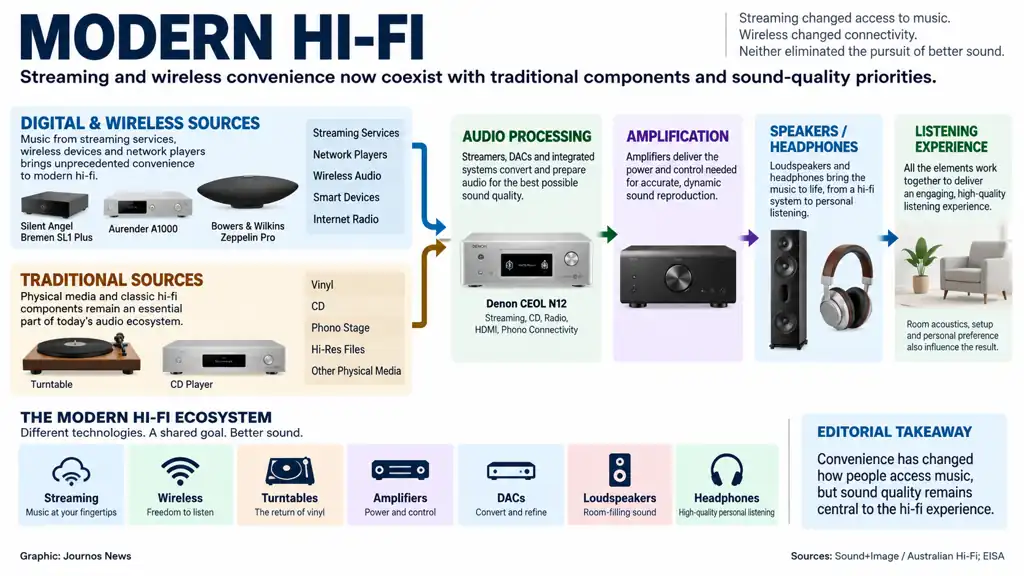
Streaming and wireless audio have transformed how people listen to music, but the latest generation of audio products suggests that convenience has not displaced the industry’s emphasis on sound quality.
The 2026 Sound+Image Awards, announced this year after testing and reviewing a wide range of audio and audiovisual equipment, included dedicated categories for streamers, wireless headphones, true-wireless earbuds and streaming systems alongside traditional turntables, amplifiers and loudspeakers.
That combination reflects a broader shift in consumer audio. Modern systems increasingly remove the need for physical media and complicated connections while continuing to compete on the quality of the sound they produce.

Streaming has become part of hi-fi
The distinction between conventional hi-fi equipment and streaming devices has steadily narrowed.
The 2026 awards recognized the Silent Angel Bremen SL1 Plus as streamer of the year and the Aurender A1000 as streamer/DAC of the year. The Bowers & Wilkins Zeppelin Pro and Denon CEOL N12 were also recognized in streaming-system categories.
These products illustrate how streaming has moved from being an add-on feature to becoming part of the central architecture of home audio.
A modern listener can access music services, personal digital libraries and other sources through a single system without necessarily giving up the components traditionally associated with higher-quality playback.
The result is a different definition of convenience. The goal is no longer simply to make music easier to access; manufacturers increasingly compete on whether that convenience can coexist with satisfying sound.
■ Related News




Wireless does not necessarily mean basic audio
Wireless listening has also expanded beyond inexpensive portable speakers and basic Bluetooth headphones.
The 2026 awards included separate categories for wireless headphones, true-wireless earbuds and other wireless products. Bowers & Wilkins’ Px8 S2, Apple’s AirPods Max 2 and Nothing’s Ear (3) were among the recognized products.
Newer wireless standards are also opening additional possibilities. Sound+Image reported on the use of Auracast in products such as Sennheiser’s RS 275 TV headphones, pointing toward a future in which wireless audio can serve more specialized listening environments as well as casual personal use.
Wireless technology therefore increasingly concerns not only whether audio can be transmitted without a cable, but how reliably and effectively that audio can be delivered to the listener.
Sound quality remains a product differentiator
The continued presence of sound quality as an explicit judging criterion is significant because streaming has made access to music almost effortless.
When millions of recordings can be reached from a phone within seconds, the hardware becomes one of the principal variables that listeners can control.
Speakers, headphones, amplifiers, DACs and streaming components determine how that digital signal is ultimately reproduced.
This is one reason traditional categories have not disappeared. The 2026 awards included turntables, phono stages, amplifiers, DACs and loudspeakers alongside wireless and streaming products.
Rather than replacing older forms of hi-fi, digital convenience has largely expanded the range of ways in which people can build an audio system.
The listening experience matters beyond specifications
Audio quality is also not determined by a single specification.
A streaming service can provide high-quality digital files, but the final listening experience depends on the entire playback chain, including the source, digital processing, amplification, speakers or headphones and the environment in which the system is used.
Room acoustics can significantly influence speaker-based listening, while headphone design, fit and tuning can change how a recording is perceived.
That means better sound is not simply a matter of choosing the highest resolution or the most expensive component.
Good system design can matter as much as individual specifications, particularly for listeners trying to improve an existing setup rather than replace everything.
The market is combining convenience and fidelity
The current direction of the audio market is therefore less about streaming versus hi-fi than it is about bringing the two together.
The 2026 awards included products that combine streaming with traditional inputs and playback formats. The Denon CEOL N12, for example, combines HEOS streaming with a CD player, radio, HDMI and phono connectivity.
That approach recognizes that listeners do not necessarily divide themselves into purely digital or traditional camps.
A household may stream most of its music while still owning records, CDs or other physical media. A listener may use wireless headphones during a commute and a conventional stereo system at home.
Manufacturers are increasingly designing around that reality.
Why quality remains relevant
Streaming has changed the economics and convenience of music consumption, but it has not eliminated the basic purpose of an audio system: reproducing recorded sound in a way that listeners find engaging, accurate or enjoyable.
The current product landscape suggests that consumers do not necessarily view convenience and quality as competing priorities.
Instead, the industry’s challenge is to make high-quality listening easier to achieve.
That is why the modern hi-fi market can contain turntables and network streamers, wired headphones and true-wireless earbuds, conventional amplifiers and integrated streaming systems at the same time.
The technology has changed dramatically. The reason for building a good audio system has not.
Reporting Credit: Sound+Image / Australian Hi-Fi — 2026 audio and audiovisual awards, product testing and category results; EISA — 2026–2027 European audio and audiovisual product awards and participating technology publications.