Journos News - Breaking News, World News, Top Stories, Todays Headlines and Flash Reports
Tuesday, September 1, 2026
  • Login
  • Home
  • World
    • Africa
    • Americas
    • Asia
    • Europe
    • Middle East
    • Oceania
  • Politics
  • Business
  • Technology
  • Health
  • Science
  • Sports
  • Entertainment
  • Culture
No Result
View All Result
  • Home
  • World
    • Africa
    • Americas
    • Asia
    • Europe
    • Middle East
    • Oceania
  • Politics
  • Business
  • Technology
  • Health
  • Science
  • Sports
  • Entertainment
  • Culture
No Result
View All Result
Journos News - Breaking News, World News, Top Stories, Todays Headlines and Flash Reports
No Result
View All Result
Home World News Middle East

Strait of Hormuz at Risk: What an Iranian Blockade Could Mean

Why the Strait of Hormuz Could Be Iran’s Next Move

The Daily Desk by The Daily Desk
June 20, 2026
in Middle East, World News
0
Strait of Hormuz at Risk: What an Iranian Blockade Could Mean

Why the Strait of Hormuz Matters—and Why the U.S. Is Bracing for Iran’s Next Move

After U.S. airstrikes hit three Iranian nuclear facilities over the weekend, fears of Iranian retaliation are rising—and one key area of concern is the narrow stretch of water known as the Strait of Hormuz. It’s more than just a geographic chokepoint—it’s a global lifeline for energy, and any disruption there could ripple across international markets.

U.S. Strikes a Turning Point in Conflict

On Sunday morning local time, the United States launched direct military strikes on Iranian nuclear sites—a move President Trump described as an effort to “neutralize a threat posed by the world’s number one state sponsor of terror.”

While the broader conflict between Israel and Iran has simmered for years through proxy battles and covert actions, these strikes marked the first time U.S. forces intervened openly in the escalating war. And now, all eyes are on how Iran might respond.

The Strait of Hormuz: A Global Energy Lifeline

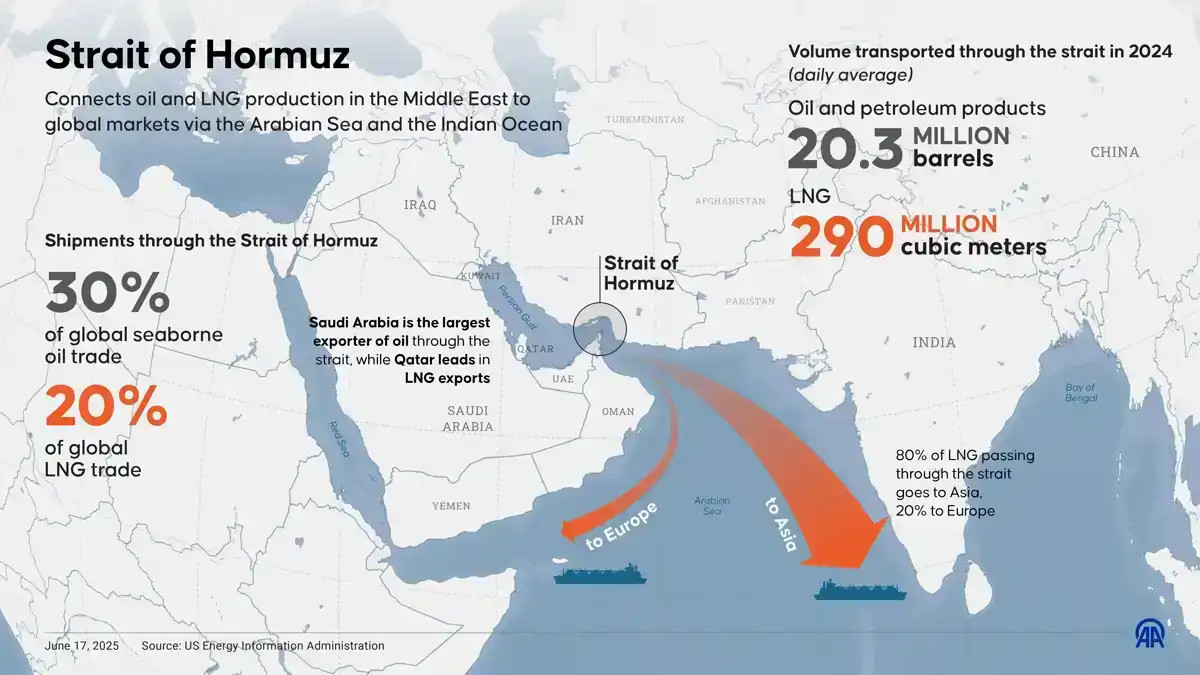
The Strait of Hormuz may only be 21 miles wide at its narrowest point, but its strategic importance is immense. It connects the Persian Gulf to the Gulf of Oman and, ultimately, the Arabian Sea—making it the key artery for oil exports out of the Middle East.

According to the U.S. Energy Information Administration (EIA), more than 20 million barrels of oil per day flow through the strait. That’s roughly one-fifth of all petroleum consumed worldwide and over a quarter of all global maritime oil trade. In 2024 alone, Saudi Arabia accounted for nearly 40% of those exports.

But it’s not just oil—roughly 20% of global liquefied natural gas (LNG) shipments also pass through the strait, most of them from Qatar.

Iran controls the northern side of the waterway, while Oman and the UAE control the southern banks. This gives Tehran a powerful, if controversial, tool: the threat to shut down or obstruct the strait.

What Happens If Iran Tries to Block It?

That possibility is far from hypothetical. Iran has long used the threat of closing the Strait of Hormuz to push back against Western sanctions and pressure. And in the wake of Sunday’s airstrikes, the concern has reemerged with force.
■ Related News

Pacific Islands Forum leaders meet during a regional leaders meeting in 2017.

Great Power Rivalry Threatens to Overshadow Pacific Islands Summit

August 31, 2026
Russian President Vladimir Putin stands with Indian Prime Minister Narendra Modi and Chinese leader Xi Jinping before a BRICS Summit meeting.

China, Russia and India Leaders Gather for SCO Summit as U.S. Influence Faces Challenge

August 31, 2026
U.S. Navy sailor mans a .50-caliber machine gun aboard USS Kitty Hawk while transiting the Strait of Hormuz toward the Arabian Gulf.

U.S. Strikes Iranian Rocket Launchers Near Strait of Hormuz, Breaking Month-Long Lull

August 31, 2026
Iranian leader pictured in an official image associated with a message marking Workers’ Day and Teachers’ Day in May 2026.

Iran’s Leaders Defy the U.S. Six Months Into War, Signaling Little Tolerance for Dissent

August 29, 2026

While Saudi Arabia and the UAE have some overland pipelines to bypass the strait, their capacity is limited. According to the EIA, if oil flow through the strait were cut off, countries like China, India, Japan, and South Korea—which rely heavily on Middle East energy—would be hit hardest.

Even in the U.S., which imports less oil from the region than in the past, prices at the pump could spike due to shaken global markets. In 2024, only 7% of U.S. oil imports came through the strait, but even a minor disruption can send shockwaves through pricing and supply chains.

Rubio: Blocking the Strait Would Be “Suicidal” for Iran

On Sunday, Secretary of State Marco Rubio didn’t mince words when asked about the risk of Iran blocking the waterway.

“If they do that, the first people that should be angry about it are the Chinese government, because a lot of their oil comes through there,” Rubio said on Face the Nation. “It would be a suicidal move… because the world would come against them if they did that.”

He pointed out that mining the strait—placing naval explosives to damage or sink tankers—would not only harm Western countries, but also alienate Iran from the very nations it has tried to align with diplomatically.

The U.S. Navy Is Already in Place

The United States is not leaving anything to chance. Its 5th Fleet, headquartered in Bahrain, has long been tasked with protecting freedom of navigation in the Strait of Hormuz. With tensions escalating, the fleet’s presence may now serve as both a deterrent and a rapid response force should Iran attempt to disrupt shipping lanes.

What Comes Next?

With a ceasefire now reportedly in place between Israel and Iran—brokered with U.S. involvement—there’s hope for de-escalation. But the risk of retaliatory action remains real, and the Strait of Hormuz could be one of the first places it plays out.

A move by Iran to choke off energy flows through the strait would send oil prices soaring, destabilize economies, and possibly drag multiple countries deeper into conflict. For now, the world is holding its breath—and watching that narrow stretch of water.

Source: CBS News – Strait of Hormuz could be vulnerable to Iran retaliation. Here’s what to know about the vital oil trade route.

Tags: #EnergyMarkets#EnergySecurity#Geopolitics#GlobalEnergyCrisis#GlobalOilSupply#GlobalOilTrade#HormuzStrait#InternationalTrade#IranIsraelConflict#IranOilThreat#IranRetaliation#IranTensions#MaritimeSecurity#MiddleEastCrisis#MiddleEastNews#NuclearTensions#OilChokepoint#OilPrices#OilRoute#OilShippingRoutes#OilTransitRoutes#OPECNews#PetroleumTrade#QatarOil#SaudiOilExports#StraitOfHormuz#US5thFleet#USIranConflict#USMilitaryStrikes#WorldNewsUpdate
The Daily Desk

The Daily Desk

The Daily Desk is a contributor at JournosNews.com covering politics, media, governance, and the evolving dynamics of public discourse. Stories published under this byline are produced in accordance with JournosNews' editorial standards, with an emphasis on verified reporting, accuracy, context, and impartiality.

Related Posts

Donald Trump speaks at the Conservative Political Action Conference in Washington, D.C., in 2011 during a political address.

After Six Months of Iran War, U.S. Goals Have Shifted. Strait of Hormuz Is Now a Top Concern

August 27, 2026
Asian stock markets rise as oil prices fall, with market indexes, crude prices, Nvidia shares and key investor risks highlighted. - Journos News, File

Asian Shares Rise as Lower Oil Prices and AI Optimism Support Markets

August 26, 2026
Russian President Vladimir Putin attends a ceremony presenting Hero of Labour medals and state awards in Russia.

Putin Opens Door to State Control of Russian Sites Hit by Ukrainian Drones

August 26, 2026
Iranian fuel tankers arrive in Lebanon as Hezbollah-linked fuel shipments enter the country amid a severe energy crisis.

Iran’s Fuel Lines Grow as U.S. Sanctions Deepen Economic Pressure

August 26, 2026
Journos News explainer graphic showing how tariffs work, who pays them, supply-chain effects, government purposes, quotas and consumer impacts.

What Are Tariffs and How Do They Work?

August 26, 2026
Canada’s innovation minister speaks during a frontier artificial intelligence safety roundtable at Bletchley Park in the United Kingdom.

Canada Escalates Trade Confrontation With U.S. With New Tariffs

August 26, 2026
Strait of Hormuz connecting the Gulf of Oman and Persian Gulf, photographed from the International Space Station.

LIVE: Middle East Conflict — Ongoing Coverage

August 12, 2026
Map showing reported Houthi attack near Bab el-Mandeb and U.S. maritime operations across the Gulf of Oman and Strait of Hormuz

Houthi Attack Kills Six as U.S. Forces Strike Ship Near Iranian Blockade

August 12, 2026
Load More
Next Post
Speaker Challenge: The 25-Song Gauntlet for Your Gear - Headphonesty

Speaker Stress Test: 25 Songs to Push Your System's Limits

The Ultimate Audio Challenge: 15 Movies for Your Sound System - Headphonesty

Movie Sound Secrets: 15 Films That Test Your Audio System

JournosNews logo

Journos News delivers globally neutral, fact-based journalism that meets international media standards — clear, credible, and made for a connected world.

  • Categories
  • World News
  • Politics
  • Business & Markets
  • Technology
  • Health
  • Science
  • Sports
  • Arts & Culture
  • Resources
  • Editorial Standards
  • Submit a Story
  • Advertise with Us
  • Syndication & Partnerships
  • Site Map
  • Press & Media Kit
  • Editorial Team
  • Careers

Join thousands of readers receiving the latest updates, tips, and exclusive insights straight to their inbox. Never miss an important story again.

  • About Us
  • Editorial & Trust Center
  • Contact Us
  • Privacy Policy
  • Terms of Use & Copyright Notice

© JournosNews.com All rights reserved.

Welcome Back!

Login to your account below

Forgotten Password?

Retrieve your password

Please enter your username or email address to reset your password.

Log In
JournosNews

Independent Journalism.
Verified Facts.

You're about to read a professionally edited article from JournosNews.com.

Every article is produced in accordance with our editorial standards, emphasizing factual accuracy, transparent attribution, fairness, editorial independence, and meaningful context.

Editorial Standards
No Result
View All Result
  • Home
  • World
    • Africa
    • Americas
    • Asia
    • Europe
    • Middle East
    • Oceania
  • Politics
  • Business
  • Technology
  • Health
  • Science
  • Sports
  • Entertainment
  • Culture

© JournosNews.com All rights reserved.

This website uses cookies. By continuing to use this website you are giving consent to cookies being used. Visit our Privacy and Cookie Policy.