Sleep changes as people age, but scientists are increasingly finding that those changes may reveal more than how well someone rests at night.
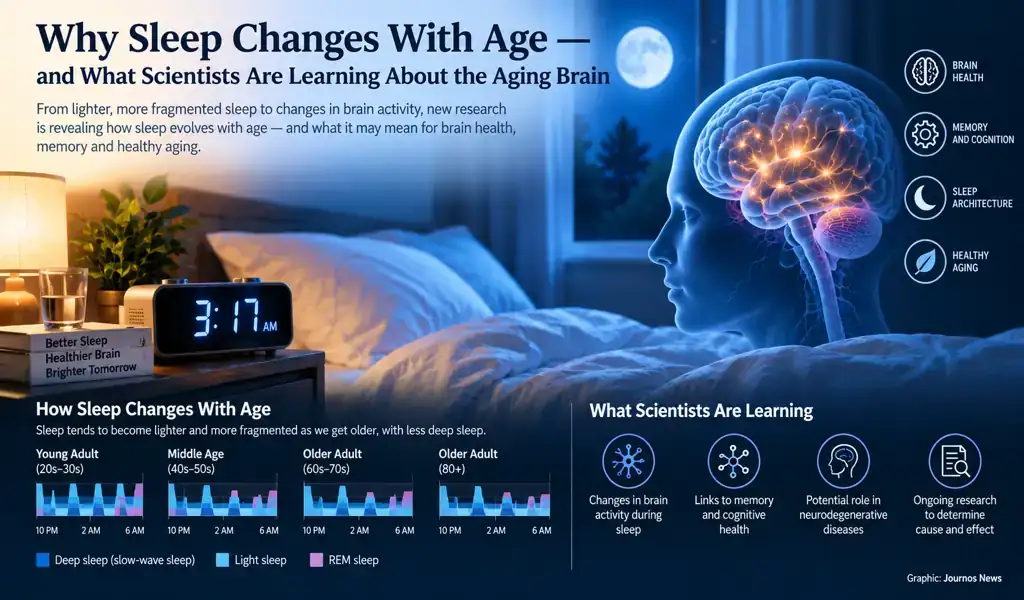
Older adults commonly fall asleep earlier, wake earlier, spend less time in deep sleep and experience more fragmented sleep. The National Institute on Aging says such changes are common with aging, while maintaining adequate, quality sleep remains important for health and cognitive function.
Recent research is expanding the scientific view of sleep beyond the number of hours spent in bed. Studies are examining sleep alongside biological measures of aging and detailed patterns of brain activity, offering new ways to study how the brain and body change over time.

Aging alters the structure of sleep
Sleep consists of several stages, including lighter non-REM sleep, deeper slow-wave sleep and rapid eye movement, or REM, sleep. The balance among these stages changes throughout life.
Older adults generally spend less time in the deepest stages of sleep and experience more interruptions during the night. Circadian rhythms also become less robust, contributing to a tendency to become sleepy earlier in the evening and wake earlier in the morning.
These changes do not necessarily mean that older people require substantially less sleep. Instead, aging can make it more difficult to obtain the same amount of continuous, restorative sleep.
Researchers link sleep with biological aging
A 2026 study published in Nature examined whether sleep duration was associated with biological aging across the body.
Researchers from the MULTI Consortium analyzed data from about half a million UK Biobank participants, examining sleep duration alongside 23 biological aging clocks covering 17 organ systems. The analysis incorporated imaging, protein and metabolic information into measures of biological age.




The researchers reported a broadly U-shaped relationship. Participants who reported sleeping fewer than six hours or more than eight hours tended to have faster biological-aging measures across multiple systems. The lowest biological-age measures generally occurred among people reporting about 6.4 to 7.8 hours of sleep.
The finding extends sleep research beyond the aging brain to biological measures across multiple organ systems.
But the study does not show that sleeping within that range will cause someone to age more slowly.
Association does not establish causation
The Nature research identified associations between reported sleep duration and biological-aging measures. It did not establish that changing an individual’s sleep duration would slow, reverse or prevent biological aging.
That distinction is particularly important for longer sleep. Extended sleep may reflect underlying health conditions or other factors rather than directly contributing to biological aging.
Short sleep can also have multiple causes, including medical, psychological and social factors that may themselves be related to health.
The findings therefore do not provide a prescription to increase or restrict sleep to reach a particular number. Instead, they support examining sleep duration as one component of a broader network of biological and health factors.
Brain activity may provide another measure of aging
A separate 2026 study led by researchers at the University of California, San Francisco examined whether sleep-related brain activity could provide information about brain aging.
The researchers used machine learning to analyze fine-scale patterns in sleep electroencephalography, or EEG, recordings. Rather than relying only on conventional measures such as sleep duration or sleep efficiency, the researchers generated an estimate of “brain age” from patterns in sleep-related brain activity.
The study included approximately 7,000 participants aged 40 to 94 who did not have dementia when the research began.
During follow-up, roughly 1,000 participants developed dementia. The researchers reported that for every 10-year increase in estimated brain age relative to chronological age, dementia risk increased by nearly 40%.
The finding does not mean that a sleep recording can diagnose dementia. Instead, it indicates that sleep EEG may contain measurable information about the condition of the aging brain that conventional measures of sleep may not capture.
Sleep EEG captures more than sleep duration
The significance of the UCSF-led research lies partly in the detail contained within sleep-related brain activity.
Electrical activity in the brain changes across sleep stages, and researchers have examined specific patterns in connection with processes such as memory and communication between brain regions.
The machine-learning model in the study incorporated 13 microstructural features of sleep EEG activity, including signals associated with deep sleep and memory consolidation.
The researchers proposed that these measurements could eventually offer a relatively accessible way to identify differences between chronological age and apparent brain aging.
That remains a research direction rather than an established clinical test.
Why sleep becomes more fragmented
Changes in sleep with age are not limited to brain activity.
Circadian rhythms become less robust, while hormonal changes, medications, chronic medical conditions, pain and changes in physical activity can also affect the ability to fall asleep or remain asleep.
The National Institute on Aging notes that older adults can experience sleep difficulties because of health conditions, medicines and other changes associated with aging.
As a result, sleep duration alone may provide an incomplete picture. Two people can spend a similar amount of time in bed while experiencing different levels of sleep continuity and different patterns of brain activity.
Deep sleep remains a major research focus
Scientists have paid particular attention to deep, slow-wave sleep because it is associated with processes important to brain function, including memory.
Slow-wave activity changes substantially with age, and researchers have also examined whether disrupted sleep may be related to biological processes associated with neurodegenerative disease.
The National Institute on Aging has reported research linking declining sleep in middle age with later accumulation of beta-amyloid and tau, proteins associated with Alzheimer’s disease. Those findings do not establish that poor sleep directly causes Alzheimer’s disease, but they have contributed to scientific interest in the relationship between sleep and brain pathology.
The newer studies extend that research by applying more detailed biological and computational measurements to sleep.
More sleep is not necessarily better
The U-shaped relationship identified in the Nature study also complicates the assumption that more sleep is always protective.
Both shorter and longer reported sleep durations were associated with higher biological-aging measures in the study. But the findings should not be interpreted as evidence that people should deliberately reduce their sleep.
The researchers did not establish causation, and longer sleep may partly reflect underlying illness or other factors. Likewise, short sleep can result from numerous circumstances that may also affect health.
The evidence therefore points toward a more cautious interpretation: sleep duration is an important measurement, but it should not be treated as an isolated indicator of how quickly someone is aging.
Sleep could become a window into brain aging
The UCSF research raises a broader possibility for future studies: sleep could provide a relatively unobtrusive source of information about changes in the aging brain.
The study’s findings suggest that patterns recorded during sleep contain information associated with subsequent dementia risk. If such signals can be better understood and validated, they could help researchers investigate changes that occur before obvious cognitive symptoms.
For now, however, the findings concern associations and risk estimation. They do not provide certainty about whether an individual will develop dementia.
Normal aging is not the same as a sleep disorder
Some changes in sleep architecture are expected with age, but not every sleep problem should automatically be attributed to getting older.
Persistent insomnia, loud snoring, breathing interruptions, excessive daytime sleepiness or major changes in sleep can have multiple causes. The National Institute on Aging notes that sleep difficulties in older adults may arise from health conditions, medicines and other factors.
That distinction is important because normal changes in sleep do not explain every significant disruption.
Scientists are looking beyond the clock
The emerging research is changing how scientists measure the relationship between sleep and aging.
Instead of asking only how long someone sleeps, researchers can examine sleep timing, continuity, brain-wave patterns and biological indicators across the body.
The 2026 studies illustrate two parts of that shift. The Nature study examined reported sleep duration alongside biological-aging measures across multiple organ systems, while the UCSF-led research used detailed sleep EEG patterns to estimate brain age.
Neither study provides a single formula for maintaining brain health through sleep. Both instead point to sleep as a complex biological signal that may contain information about how the brain and body change with age.
The central scientific question is consequently becoming broader. Sleep is not simply a period of recovery measured by hours on a clock; it is also a measurable biological process that may help researchers understand aging itself.
Reporting Credit: Columbia University Irving Medical Center; UCSF; Nature; National Institute on Aging, National Institutes of Health.