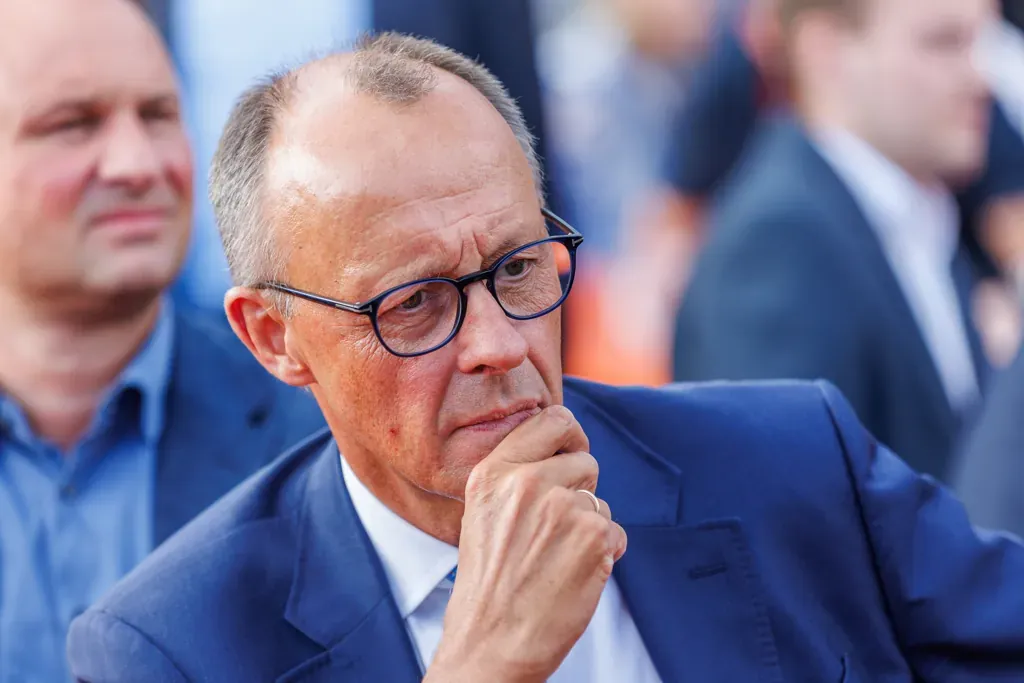
BERLIN, Germany – German Chancellor Friedrich Merz has vowed to continue his government’s reform program after his Christian Democratic Union suffered a historic defeat in Mecklenburg-Western Pomerania and lost substantial ground in Berlin’s state election.
The CDU received just 4.9% of the vote in Mecklenburg-Western Pomerania, according to the preliminary result reported by the state’s election authorities, falling below the 5% threshold for representation in the state parliament. It was the first time the CDU failed to enter a German state legislature since the Federal Republic was founded.
The Alternative for Germany, or AfD, finished first in the northeastern state with 38.2%, ahead of the Social Democrats at 35.5%. The Left Party received 6.5% and the Greens 5.7%.

Merz described the CDU’s result as a “disaster” but said the outcome would not cause him to abandon his reform agenda or leave the chancellorship.
“What needs to be done now requires backbone, steadfastness, and patience,” Merz said after the elections. He said he would demonstrate those qualities as CDU chairman and as chancellor.
CDU suffers historic setback
The result in Mecklenburg-Western Pomerania represents a major reversal for the CDU in a state where it had won 13.3% in the 2021 election.
The party’s failure to cross the 5% threshold means it will not hold seats in the new state parliament through its party-list vote. The preliminary result also left the FDP and Sahra Wagenknecht Alliance below the threshold.
The AfD’s 38.2% made it the largest party in the state, while the governing SPD received 35.5%.
■ Related News

The result does not automatically determine who will form the next state government. Coalition negotiations will be required, and Germany’s established parties have generally maintained a policy of not forming governing coalitions with the AfD.
The election followed an earlier AfD victory in Saxony-Anhalt on September 6, adding to pressure on Merz and the CDU.
Berlin delivers another setback
The CDU also lost ground in Berlin.
The preliminary results put the Left Party first with 25.7%, followed by the CDU at 18.8%. The AfD received 16.2%, the Greens 14.3% and the SPD 12.1%.
The result ended the CDU’s position as the leading party in Berlin’s governing coalition and leaves the formation of a new state government subject to negotiations among the parties.
The Berlin result was particularly significant because the capital had been governed by a CDU-SPD coalition.
The CDU’s national result in the two states therefore reflected two different electoral setbacks: exclusion from the Mecklenburg-Western Pomerania parliament and a sharp loss of position in Berlin.
Merz says reforms will continue
Merz argued that the election results did not change the underlying economic problems his government was trying to address.
The federal government’s reform program includes measures covering taxation, pensions and health care, economic competitiveness, labor-market policy and reducing bureaucracy.
The government says its reforms are intended to improve economic growth, safeguard jobs and strengthen Germany’s long-term competitiveness.
Some measures have already been adopted.
The government says it approved an income-tax reform in September designed to provide relief for low- and middle-income earners. It has also advanced pension measures, including the “Frühstart-Rente” initiative, while pursuing changes intended to reduce administrative burdens and accelerate government processes.
Merz has argued that Germany’s economic difficulties make structural reform more urgent rather than less necessary.
His government took office in 2025 after Germany’s federal election, with a program centered on economic renewal, investment, infrastructure and state modernization.
Election pressure grows around the government
The state-election results add another political test for Merz’s governing coalition in Berlin.
The CDU-led federal government depends on cooperation with the Social Democrats on its legislative agenda. State elections do not directly change the composition of the Bundestag, but poor results can affect the political environment in which the federal coalition operates.
The CDU’s result in Mecklenburg-Western Pomerania is particularly notable because the party did not merely lose votes; it fell below the threshold required for parliamentary representation.
The AfD’s performance also changes the political landscape in the eastern state. With 38.2%, it became the largest party but still faces the question of whether other parties will cooperate with it to form a government.
Merz has meanwhile rejected speculation that he should leave office.
His position is that the federal government should continue working on the reforms it has already begun.
Economic reform remains the government’s central argument
The federal government has presented its economic program as a response to weak growth, high structural costs and declining competitiveness.
Its reform timetable includes measures involving energy costs, infrastructure, taxation, employment, pensions and the reduction of bureaucracy.
In a September 9 address to the Bundestag, Merz said further reforms were needed to strengthen economic growth and provide greater prospects for younger Germans.
The latest state-election results have not changed that stated objective.
They have, however, increased the political pressure under which the government must pursue it.
For Merz, the immediate challenge is to demonstrate that his government can continue passing reforms while responding to declining support for the CDU in several states.
The September 20 elections do not determine the future of the federal government. But they provide a clear measure of the political environment Merz now faces: his party suffered its worst state-level result in postwar history in Mecklenburg-Western Pomerania, while the CDU also lost its leading position in Berlin.
Merz’s response has been to stay the course.
Whether that strategy can translate into stronger economic performance and political support will depend on the implementation of the reforms still ahead.
Reporting Credit: Mecklenburg-Western Pomerania State Returning Officer — preliminary state-election results; Berlin State Election Authority — preliminary Abgeordnetenhaus election results; German Federal Government — official reform program and implementation timetable; German Chancellor Friedrich Merz/Federal Government — statements on the reform agenda and response to the election results.