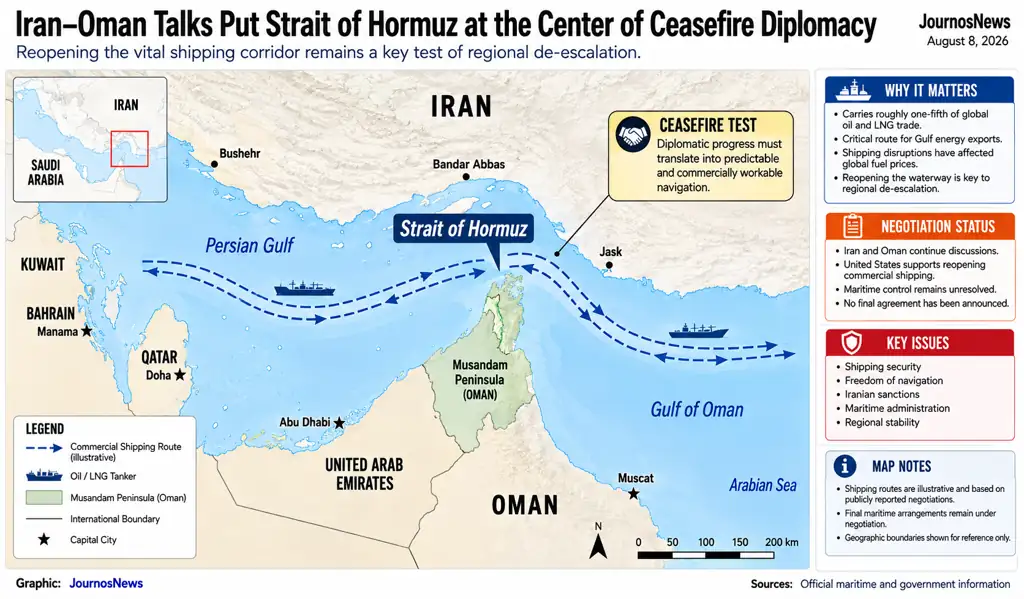
Iran and Oman are moving closer to an arrangement intended to restore commercial shipping through the Strait of Hormuz, while the United States says progress is being made toward a deal. But the waterway remains far from normal, with shipping traffic falling, disputes over control and fees unresolved, and sanctions and insurance rules creating obstacles for commercial operators.
The latest diplomatic movement around the Strait of Hormuz offers one of the clearest indications yet that the conflict involving Iran and the United States could be entering a new phase. But it also exposes how difficult it may be to turn a political understanding into a functioning ceasefire and a reliable commercial corridor.
A U.S. official told Reuters on August 7 that progress was being made between Iran and Oman and that Washington expected a deal soon. The official said the United States would lift its blockade of Iranian ports once an agreement was announced to restore commercial shipping through the strait without impediments, while stressing that U.S. actions would remain conditional on Iran implementing its commitments.

That condition is important. The central question is no longer simply whether diplomats can agree to stop fighting. It is whether they can establish practical rules that allow merchant ships to move through one of the world’s most strategically important waterways without creating new legal, financial or security risks.
For now, the answer remains unclear.
The latest diplomatic opening
The emerging arrangement is being negotiated primarily between Iran and Oman, which share territorial waters in the Strait of Hormuz. Oman has played a central diplomatic role in efforts to reduce regional tensions and establish a framework for maritime navigation.
Oman’s Foreign Ministry said in June that the two countries were committed to safe passage through the strait while also emphasizing their sovereignty and sovereign rights over their respective territorial waters. The two governments agreed to continue discussions through a joint working group concerning the future administration of navigation, services provided to shipping and associated costs. They also said other regional states and relevant parties should be involved in discussions.
That earlier understanding provides important context for the negotiations now approaching a possible agreement.
■ Related News



Oman has consistently presented the issue as one requiring both maritime security and diplomacy. In July, the Omani Foreign Ministry said it was cooperating with all parties to restore freedom of navigation in accordance with international law and reaffirmed its commitment to the United Nations Convention on the Law of the Sea.
The latest talks therefore build on a process that has been developing for months rather than appearing suddenly.
But the proposed arrangements have become more contentious as negotiators try to determine who controls traffic, what routes vessels will use and whether ships would be required to pay charges.
Why the Strait of Hormuz is the immediate test
The significance of the negotiations can be seen in the behavior of shipping companies.
Rather than returning to normal while diplomats negotiate, commercial traffic through the strait has declined.
Reuters reported that only 33 vessels passed through Hormuz from Monday through Thursday this week, compared with 50 during the same period the previous week. Just four vessels transited on Thursday. Six crude oil tankers exited the strait during the week while 21 entered, with many of those movements taking place through Iranian waters.
That is a crucial measure of the gap between diplomatic progress and operational reality.
A government can announce that a waterway is open. A shipping company must still decide whether its vessel can safely enter it, whether the voyage will be insured, whether payments associated with the transit are lawful and whether the vessel will be treated consistently by military and maritime authorities.
Those decisions determine whether the waterway is genuinely functioning.
Before the conflict, Hormuz was a heavily used international maritime route carrying oil and other essential commodities. Reuters reported that roughly 130 to 140 vessels a week had transited the waterway before the conflict disrupted traffic.
The current figures therefore indicate that even a diplomatic breakthrough would begin from a severely disrupted baseline.
The dispute over control
At the center of the negotiations is a difficult question: who ultimately controls the movement of ships through the strait?
Reuters reported that a proposed arrangement would give Iran the ability to intervene when necessary with inbound traffic, while outbound vessels would use a route between Iranian and Omani waters and obtain exit clearance through Oman after notifying Iran.
That proposal has major implications for commercial shipping.
The issue is not simply geographic. It concerns predictability.
For international shipping companies, a workable maritime corridor requires rules that can be understood in advance. Operators need to know which authority controls a particular route, what documentation is required, whether a vessel can be delayed or refused passage and what legal protections apply when a ship complies with established procedures.
Any arrangement that creates uncertainty over those questions could leave companies reluctant to use the route even if governments describe it as open.
The United States has also made clear that it does not view an Iranian-controlled system as an acceptable endpoint. U.S. officials have said the objective is commercial shipping through Hormuz without impediments, while Washington has linked its own actions to Iran’s implementation of commitments under any agreement.
That leaves negotiators trying to reconcile competing priorities: Iran’s demand for recognition of its authority and interests in waters under its sovereignty, Oman’s role as another coastal state, Washington’s insistence on unrestricted commercial access, and the shipping industry’s need for predictable rules.
The unresolved question of transit fees
Money has become another major obstacle.
Reuters reported that Iran is seeking fees equivalent to between 5% and 7% of cargo value from ships using the strait, while Oman has been discussing a figure of around 3%. The United States, by contrast, wants no such fees.
The dispute is significant because the proposed charges would introduce a new financial consideration into commercial voyages through a waterway that had previously operated without comparable compulsory transit fees.
International shipping associations have warned that compulsory charges could undermine the legal and commercial principles governing navigation through international straits. Reuters reported that industry groups described the ability of merchant ships to navigate safely, predictably and without unnecessary impediment as fundamental to resilient supply chains, economic stability and energy security.
For shipping companies, the problem becomes even more complicated when sanctions and insurance are considered.
Reuters reported that U.S. sanctions against an Iranian-established maritime authority could create legal exposure for companies making payments connected to the proposed system. The Lloyd’s Market Association has also introduced insurance clauses affecting vessels that make certain payments.
This creates a practical contradiction.
A government could establish a payment requirement as part of a maritime agreement, but a shipping company could then face sanctions or insurance consequences for complying with it.
Until that problem is resolved, an announced agreement could remain difficult to implement.
Why a ceasefire is not the same as a reopened waterway
The situation illustrates an important distinction in the broader ceasefire process.
A ceasefire can reduce military activity without immediately restoring normal economic activity.
The Strait of Hormuz requires something more complicated: a functioning security arrangement, clear navigation procedures, agreement between coastal states, acceptance by external military powers and rules that commercial operators can legally and financially follow.
The history of the negotiations already demonstrates this distinction.
In June, Oman and Iran publicly reaffirmed their commitment to safe passage and agreed to continue discussions over navigation administration and related services. In July, Omani and Iranian officials continued technical and political discussions over maritime navigation.
Those discussions have now moved toward a possible operational arrangement.
Yet the latest shipping data show that the maritime environment remains unsettled. Traffic has declined even as diplomatic expectations have increased.
That disconnect is one of the clearest reasons not to treat an expected agreement as equivalent to a completed reopening.
The shipping industry’s problem is different from the diplomats’ problem
Governments negotiate political arrangements. Shipowners manage operational risk.
That distinction matters.
A government may calculate that an agreement reduces the probability of a major confrontation. A shipping company has to calculate whether a particular vessel, crew and cargo can safely complete a particular voyage.
The decision can depend on war-risk insurance, sanctions exposure, crew safety, routing instructions, port availability, cargo contracts and the possibility of military incidents.
Reuters reported that some shipping industry sources consider the proposed Hormuz arrangement difficult to implement because of these legal and financial complications.
That helps explain why shipping traffic has not immediately recovered in response to diplomatic developments.
The market is waiting for operational certainty.
Oil prices have also reflected that uncertainty. Reuters reported that Brent crude rose more than $1 on August 7, settling at $83.55 a barrel, while West Texas Intermediate rose 89 cents to $78.18. The movement reflected uncertainty surrounding the negotiations and questions over which vessels would ultimately be allowed to transit.
The market response is therefore another indicator of unresolved risk rather than a definitive judgment about the success or failure of diplomacy.
What a genuine reopening would look like
The most useful way to assess the next stage of the crisis may be to look beyond diplomatic statements and watch what happens to the ships.
A genuine reopening would likely become visible through sustained changes in commercial behavior.
Vessel traffic would need to increase consistently rather than through isolated transits. Tankers would need to resume normal scheduling. Shipowners and charterers would need sufficient confidence to book voyages through the strait. Insurance arrangements would need to support those voyages. Sanctions-related questions would need clear answers.
The route would also need rules that are sufficiently predictable for commercial operators to incorporate them into ordinary voyage planning.
In other words, reopening Hormuz is not a single event.
It is a process.
The first stage is political agreement. The second is operational implementation. The third is commercial confidence. Only after all three occur could traffic begin approaching a more normal pattern.
That distinction is particularly important because the latest traffic figures remain far below the levels reported before the conflict.
The broader economic consequences
The Strait of Hormuz is important because disruptions there do not remain confined to the Gulf.
The waterway connects the Persian Gulf with the Gulf of Oman and the wider Indian Ocean shipping system. Its disruption affects the movement of energy and other commodities, while uncertainty can raise shipping and insurance costs even for cargoes that eventually reach their destinations.
Reuters reported that Iraq’s state oil marketer SOMO has been offering discounts of as much as $30 a barrel on some August Basrah crude cargoes as it seeks buyers amid the disruption. Chinese and Indian refiners have shown interest, but shipping companies have remained cautious about committing vessels because of security concerns.
That illustrates how a maritime security crisis can affect the price received by producers as well as the cost paid by consumers.
The longer the disruption continues, the greater the pressure on inventories, alternative transportation routes and energy markets.
But a diplomatic agreement could reverse some of that pressure if commercial operators become confident that the route is genuinely secure and legally workable.
The speed of any recovery, however, is likely to depend on the details of the final arrangement rather than simply the announcement itself.
Oman is central to the next phase
Oman’s role is particularly important because it is both a neighboring state and one of the two coastal countries whose territorial waters include parts of the Strait of Hormuz.
Muscat has repeatedly emphasized that its approach is based on diplomacy, international law and maritime safety.
In June, Oman and Iran said they would work through a joint mechanism to address the future administration of navigation and associated services. In July, Oman reiterated its commitment to restoring freedom of navigation while maintaining its obligations under international maritime law.
That gives Oman a potentially difficult balancing role.
It must work with Iran while also addressing the interests of other Gulf states, international shipping companies and external powers whose naval forces operate in the region.
An arrangement that satisfies one party but creates unacceptable uncertainty for others may not be durable.
Oman’s diplomatic position therefore points toward the central challenge ahead: creating a maritime framework that is not simply acceptable politically, but workable internationally.
What remains unresolved
Despite the recent progress, several major questions remain unanswered.
First, there is no final publicly established framework that demonstrates the waterway has returned to unrestricted commercial navigation.
Second, the precise division of authority between Iran and Oman remains a central issue.
Third, the proposed fee structure remains disputed.
Fourth, sanctions and insurance restrictions could prevent commercial operators from implementing parts of an agreement even if governments approve them.
Fifth, the United States has tied its own measures to Iran’s implementation of commitments, meaning that the process remains conditional rather than automatic.
And finally, the security environment itself remains uncertain.
An agreement governing navigation cannot by itself guarantee that every vessel will consider the waterway safe. Commercial operators will ultimately make their own risk assessments based on military activity, insurance coverage and the behavior of the parties.
The next measure of the ceasefire will be commercial traffic
The diplomatic developments around Iran and Oman offer a potential path away from the most disruptive phase of the conflict. But the Strait of Hormuz shows why the path from ceasefire to stability is rarely straightforward.
The negotiations are attempting to solve several problems at once: military de-escalation, maritime security, sovereignty, navigation rights, sanctions, insurance and the economic interests of the shipping industry.
A political agreement could address some of those issues.
It will not automatically resolve all of them.
The most important evidence in the coming days will therefore be practical. If ships begin moving through Hormuz in larger and more consistent numbers, if insurance and sanctions concerns ease, and if the parties maintain predictable rules for commercial navigation, that would provide stronger evidence that diplomacy is translating into a functioning ceasefire environment.
Until then, the Strait remains a measure of how much of the conflict has actually ended.
The latest talks may be bringing the parties closer to an agreement. But for the global shipping industry, the decisive question is simpler: can a merchant vessel enter the Strait of Hormuz, transit it safely and predictably, and leave without facing a new set of political, legal or financial obstacles?