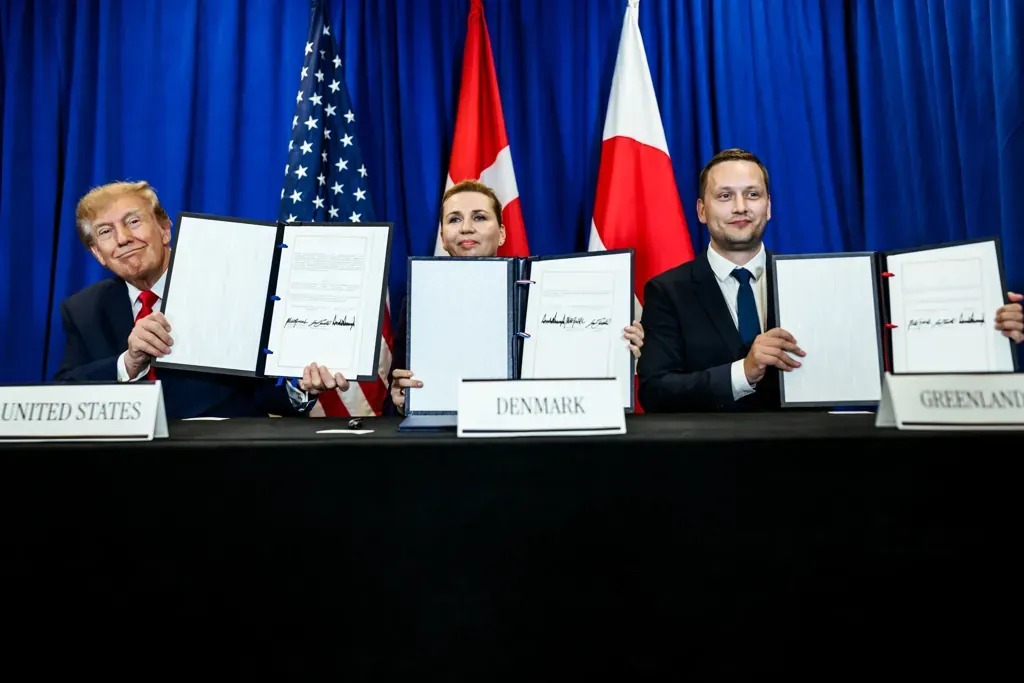
UNITED NATIONS, United States – President Donald Trump, Danish Prime Minister Mette Frederiksen and Greenlandic Prime Minister Jens-Frederik Nielsen signed a trilateral security agreement Tuesday to expand U.S. military access and infrastructure in Greenland while keeping the Arctic territory within the Kingdom of Denmark.
The agreement was signed at the United Nations in New York on the sidelines of the General Assembly. It builds on a 1951 U.S.-Danish defense agreement governing the American military presence in Greenland. The new accord still requires parliamentary procedures in Denmark and Greenland before it enters into force.
The deal follows months of tension after Trump repeatedly called for the United States to acquire Greenland, citing national-security concerns and the strategic importance of the Arctic.

The signed agreement instead establishes a framework for a larger U.S. security presence without transferring Greenland’s sovereignty to the United States.
New U.S. defense sites planned
Under the agreement, the United States can establish two additional defense areas in Greenland, at Narsarsuaq in the south and Mestersvig on the east coast.
Washington can also expand the existing Pituffik Space Base in northwest Greenland, which is currently the only active U.S. military base on the island.
The agreement gives U.S. aircraft rights to fly over and land throughout Greenland and provides U.S. public vessels with specified access to Greenland’s territorial waters.
The document does not set troop numbers or a timetable for the construction of the new facilities.
■ Related News




Trump said before the signing that the agreement would give the United States permanent control over security and other security-related needs in Greenland.
The White House describes the pact as providing lasting U.S. security interests in Greenland, permanent basing rights and restrictions on rival states establishing military or sensitive economic positions on the island. Those descriptions reflect the administration’s interpretation of the agreement.
Denmark and Greenland retain sovereignty
The agreement explicitly addresses the status of Greenland.
The Danish government said the accord recognizes and respects the sovereignty and territorial integrity of the Kingdom of Denmark as well as Greenlanders’ right to self-determination. Greenland’s prime minister likewise said the agreement recognizes Greenland as a people with a right to self-determination.
Greenland remains a self-governing territory within the Kingdom of Denmark.
The agreement does not transfer the island to the United States.
Instead, it establishes expanded U.S. defense rights within the existing political framework governing Greenland.
The agreement also states that if Greenland becomes independent, the arrangements would continue under conditions requiring the future state to remain within NATO.
Non-NATO military presence restricted
A major security provision concerns countries outside the NATO alliance.
The agreement bars non-NATO states from establishing military installations or maintaining a persistent military presence in Greenland unless the parties agree otherwise.
The provision is significant because the Arctic has become an increasingly important area of competition involving Russia, China and NATO countries.
The White House specifically presents the agreement as preventing U.S. adversaries from establishing military or sensitive investment positions in Greenland.
The Danish government has framed the agreement within NATO’s collective security structure rather than as a transfer of Greenland’s defense responsibility to Washington alone. Frederiksen said the deal strengthens common security and is deeply rooted in NATO cooperation.
Investment restrictions extend beyond military facilities
The agreement also contains economic-security provisions.
Investors from outside NATO member states, NATO partners or the European Union cannot obtain control or major influence over specified sensitive sectors in Greenland.
Greenland will be responsible for screening investments under those provisions. The agreement does not itself establish new U.S. rights over Greenland’s mining or natural-resource sector.
That distinction is important because Greenland possesses significant mineral and other natural-resource potential, but the security agreement does not amount to an American takeover of those resources.
Agreement follows months of diplomatic tension
The signing marks a shift from the earlier dispute over whether the United States could acquire Greenland.
Trump had repeatedly argued that Greenland’s location made it important to U.S. national security. His administration’s position generated opposition from Danish and Greenlandic officials, who rejected the idea of transferring the territory to American control.
The agreement provides an alternative framework: greater U.S. military access and infrastructure while Denmark and Greenland retain sovereignty.
Trump did not provide a new public commitment Tuesday that the United States had abandoned every possibility of acquiring Greenland, although the signed agreement itself does not transfer ownership or sovereignty.
The Danish and Greenlandic governments have emphasized the sovereignty provisions while welcoming the new security arrangements.
NATO becomes central to the new framework
The agreement places the expanded U.S. presence within the broader NATO security architecture.
Frederiksen said the agreement strengthens the alliance’s role in the Arctic and North Atlantic. Nielsen also emphasized Greenland’s place within NATO and described the United States as a longstanding ally.
NATO Secretary-General Mark Rutte welcomed the signing, saying greater security in the Arctic and North Atlantic was important for Europe and North America. European officials also welcomed the agreement as a framework for closer transatlantic cooperation.
The agreement has no stated end date and can be amended only by mutual consent, according to the published text.
Parliamentary approval remains
The signing does not immediately put all of the agreement’s provisions into effect.
Denmark and Greenland must complete their respective parliamentary procedures before the agreement enters into force. The Danish government said the parties will each retain a signed copy in English, Danish and Greenlandic.
That leaves implementation as the next stage.
The agreement establishes the framework for additional U.S. defense infrastructure, access rights and restrictions on outside military and economic activity, but the timing and practical scale of the new installations remain to be determined.
For Greenland, Denmark and the United States, the agreement creates a new security arrangement in one of the world’s most strategically contested regions.
It does so without changing Greenland’s status as part of the Kingdom of Denmark.
Reporting Credit: White House — signed agreement and U.S. administration description of security provisions; Danish Prime Minister’s Office — Danish government statement on sovereignty, self-determination and parliamentary procedures; Government of Greenland — position on self-determination and Greenland’s role in Arctic security; published trilateral agreement — military access, defense areas, NATO and investment provisions.