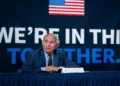
Washington – More than 1,000 pages of journal entries written by Dr. Anthony Fauci have been released ahead of a Senate hearing examining the origins of the COVID-19 pandemic, shedding new light on his evolving views about the virus, his interactions with the Trump White House, and long-running disputes with congressional investigators.
Sen. Rand Paul, the Kentucky Republican who chairs the Senate Homeland Security Committee, released the journals after subpoenaing Fauci to testify before the committee’s hearing on Wednesday as part of its investigation into the origins of COVID-19.
The journals span from December 2019, shortly before the United States declared a public health emergency, through December 2022, when Fauci retired after nearly four decades as director of the National Institute of Allergy and Infectious Diseases.

Journal Entries Document Early Uncertainty Over COVID-19 Origins
Several journal entries describe the uncertainty that surrounded the origins of the coronavirus during the earliest months of the pandemic.
In January 2020, Fauci wrote that the seafood market in Wuhan appeared to have amplified transmission rather than serving as the virus’s original source, while suggesting the virus likely crossed from animals to humans elsewhere.
About a week later, Fauci recorded that several infectious disease experts participating in a conference call believed the virus might not have emerged through natural transmission.
As public debate intensified, Fauci revisited the issue in a May 26, 2021, journal entry. He wrote that he continued to believe natural animal-to-human transmission remained the most likely explanation but acknowledged that certainty was impossible and supported a comprehensive investigation into the virus’s origins.
Paul argued that the journal entries differed from Fauci’s public statements during the pandemic, contending they reflected greater private uncertainty than his public messaging suggested.
■ Related News



The origins of COVID-19 remain disputed.
Many scientists continue to conclude that available evidence is consistent with the virus emerging naturally before spreading to humans through an intermediate animal host associated with a market in Wuhan, China.
At the same time, the FBI has assessed that a laboratory-related incident in Wuhan is the most likely explanation. In January 2025, the CIA released a separate assessment favoring the laboratory-leak hypothesis while stating that its conclusion was made with low confidence.
Fauci Describes Changing Relationship With Trump
Much of the journal chronicles Fauci’s interactions with President Donald Trump, senior White House officials and the media during the pandemic.
Early entries describe generally cooperative exchanges despite public perceptions that the two men were increasingly at odds.
Writing in May 2020, Fauci said he believed Trump remained supportive of him even as Fauci became one of the nation’s most visible public health officials. He also noted that a widely circulated photograph interpreted as showing him reacting negatively during a White House briefing did not reflect what he intended.
Other entries describe disagreements over public messaging and pandemic policy.
According to Fauci’s journals, Trump privately expressed concern that pandemic restrictions were inflicting trillions of dollars in economic losses before announcing Operation Warp Speed. Fauci also wrote that he opposed Trump’s suggestion that officials avoid wearing masks during the event.
As the pandemic continued, Fauci described growing frustration with some White House briefings and criticized several public statements made by Trump regarding COVID-19 data.
Senate Disputes With Rand Paul Continued Throughout the Pandemic
The journals also document Fauci’s repeated confrontations with Paul during congressional hearings.
In April 2021, Fauci wrote that Paul was among those attempting to connect him to research conducted at the Wuhan Institute of Virology. He also recorded concerns raised by adviser David Morens that efforts were underway to damage his reputation.
Morens has since been indicted on federal charges alleging he conspired to conceal communications related to pandemic research grants.
After Fauci’s emails became public in 2021, he wrote that the correspondence demonstrated he had remained respectful toward Trump throughout the public health emergency despite continuing political criticism.
The journals also recount Fauci’s Senate testimony in July 2021, when he and Paul sharply disagreed over whether National Institutes of Health-funded research related to the Wuhan laboratory constituted gain-of-function research.
Paul accused Fauci of providing false testimony to Congress. Fauci maintained that the research cited by the senator did not meet the accepted definition of gain-of-function research.
In an October 2021 journal entry, Fauci wrote that Paul “continues his assault on me,” reflecting the prolonged political and scientific disagreements that became a defining feature of congressional oversight during the pandemic.
CBS News reported that it contacted both Fauci and the White House for comment. Paul’s office did not respond to questions regarding how the senator obtained the journals.
This report is based on reporting by CBS News.