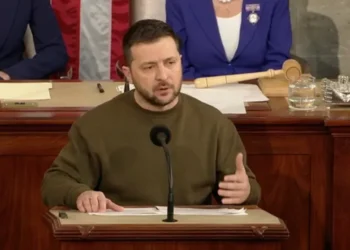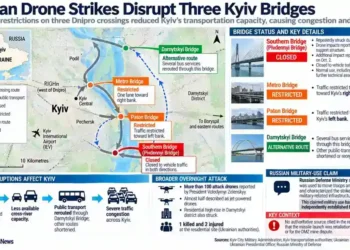

KYIV, Ukraine – Russia launched a large missile and drone assault on Ukraine overnight into October 19, damaging more than 10 energy facilities and disrupting essential services for more than half a million people, Ukrainian President Volodymyr Zelenskyy said. He also said Ukraine received no advance warning from its partners before the initial ballistic-missile strike, although the Ukrainian Air Force reported receiving information before a later attack.
The strikes reached Kyiv and the surrounding region, as well as cities and regions across the country. Reuters reported that Russia fired 16 ballistic missiles at the capital region and more than 200 drones in attacks extending from Kharkiv and Dnipro in the east to Odesa in the south and Volyn and Rivne in the west.
The attack caused civilian casualties and damaged residential, commercial and transport infrastructure. Ukrainian officials reported three deaths: a woman in Kyiv and two people in the industrial city of Kryvyi Rih. The Associated Press identified the woman killed in Kyiv as 21 years old. <Cite refs={[“turn903984view0″,”turn903984view1”]}/>

Energy infrastructure damaged as outages spread
Zelenskyy said more than 10 energy facilities had been damaged, leaving people without electricity, heating and running water. Ukraine’s energy ministry introduced rolling power cuts for households and businesses while crews worked to restore supplies, Reuters reported.
The damage extended beyond energy infrastructure. Prime Minister Yulia Svyrydenko’s government reported damage to railway stations, pharmaceutical warehouses, commercial properties and residential buildings. Kyiv Mayor Vitali Klitschko said a subway station on the capital’s left bank and a 25-storey residential building had been hit.
The latest figures describe the immediate impact reported on October 19. Authorities had not provided a verified nationwide timetable for restoring all affected services in the materials reviewed for this article.
Ukrainian officials distinguish between two missile attacks
Zelenskyy said Ukraine had again received no early warning from its partners before the first ballistic-missile attack. The complaint came amid wider concerns in Kyiv about the reliability of intelligence and military support from the United States and other allies.
Ukrainian Air Force spokesperson Yurii Ihnat made an important distinction between the attack waves. He said no warning information was received before the first ballistic-missile strike, but information arrived ahead of a second attack. Ihnat said Ukrainian specialists were investigating the failure with partners and that it was not the first time such a situation had occurred.




His account indicates that Ukraine did receive information before the subsequent attack. It does not establish why the initial warning was absent or whether the gap resulted from a technical problem, an intelligence-sharing decision or another cause.
Ukraine has relied on information from the United States to help detect Russian ballistic-missile launches, which can leave limited time to respond. Early warnings can help authorities activate air-defence measures and alert civilians, but the public information available after the October 19 attack did not establish why the initial warning failed to arrive.
Rubio denies that Washington suspended intelligence sharing
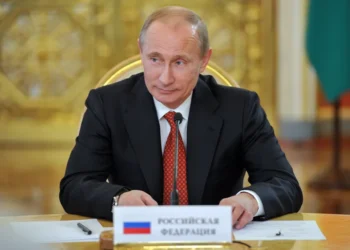
U.S. Secretary of State Marco Rubio denied on October 19 that Washington had paused intelligence sharing with Ukraine. Speaking to reporters during a visit to Uzbekistan, Rubio said, “There’s been no pause,” directly contradicting Zelenskyy’s account that intelligence cooperation had been interrupted and later restored.
In an interview with NBC’s Meet the Press on October 18, Zelenskyy said intelligence sharing had been blocked for a period and subsequently “deblocked” by the American side. He said the United States had unique intelligence that helped Ukraine anticipate Russian ballistic-missile attacks.
The two accounts leave an unresolved question about the scope of the disagreement. Zelenskyy described an interruption in intelligence sharing, while Rubio denied that a pause occurred. Separately, Ihnat’s account concerns the absence of warning information before one particular attack wave. The missing warning alone does not establish that Washington deliberately withheld information or that all intelligence cooperation had been suspended.
No technical explanation for the initial warning gap was confirmed in the official statements and reporting reviewed for this draft.
Russia says it targeted defence-related facilities
Russia’s Defence Ministry said its forces had carried out a “massive strike” using precision weapons and attack drones against Ukrainian defence-industry facilities, storage sites for drones and cruise missiles, and a data centre. The Associated Press also reported Russian claims that targets included a logistics hub, an industrial facility producing drone components and a locomotive depot.
Those statements represent Russia’s account of the operation. Ukrainian officials, meanwhile, reported extensive damage to energy infrastructure as well as residential, commercial and transport sites. The materials reviewed for this article do not independently establish the function of every location struck or verify the Russian ministry’s description of all targets.
The distinction matters because a stated military objective does not by itself establish that every damaged facility was a military target. Equally, reports of damage to civilian infrastructure do not independently determine the intended target of every weapon used.
Restoration work continues as warning questions remain
Ukrainian energy authorities introduced rolling outages while repair crews worked to restore electricity. The number of people affected and the pace of restoration remained subject to further official updates. The reports reviewed did not establish a single nationwide timetable for restoring electricity, heating and water to all affected areas.
The immediate priority for affected communities is the restoration of essential services and repairs to damaged infrastructure. For Ukraine’s government and its partners, the attack also raises questions about how warning information is generated, shared and delivered before incoming ballistic missiles arrive.
The available evidence establishes that Ukrainian officials reported no warning before the first ballistic-missile strike and that the Air Force said information was received before a later attack. It also establishes that Rubio denied a broader pause in U.S. intelligence sharing. The reason for the missing initial warning remains unconfirmed, and the competing accounts have not been reconciled in the public information reviewed.
Missile Warning Coordination is a suitable internal-link marker for a related Journos News article, if one exists.
Reporting Credit: Reuters and The Associated Press for reporting on the October 19 attacks, Ukrainian officials’ statements and the U.S. response; the Ukrainian President’s Office for contextual statements on attacks against energy infrastructure; and Reuters’ report of Marco Rubio’s denial of an intelligence-sharing pause.