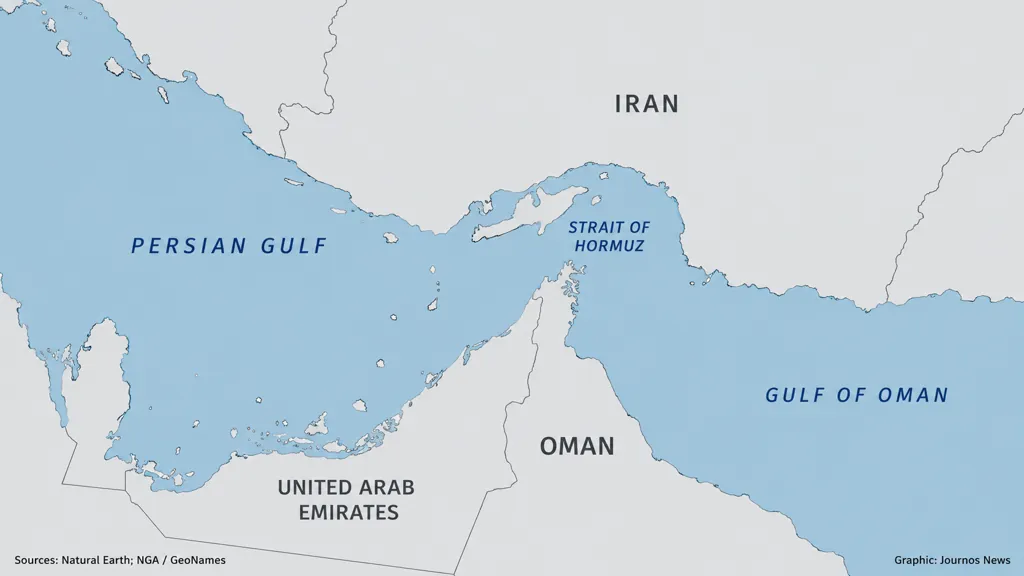
Singapore – Iran’s Islamic Revolutionary Guard Corps Navy said on October 14 that a cargo ship sank after striking a naval mine in the Strait of Hormuz, but the available evidence does not establish whether the vessel was the Singapore-registered container ship GFS Pride, which maritime authorities separately confirmed had sunk.
The distinction is important because Singapore’s Maritime and Port Authority said GFS Pride was struck by an unknown projectile before catching fire and sinking. The authority did not identify a naval mine as the cause.
The Iranian announcement, carried by the Iranian news agency Tasnim, described a container ship carrying more than 2,500 containers that sank in the southern waters of the strait. The IRGC Navy said the vessel had attempted to use what it characterized as an unauthorized and dangerous route.

Neither the published Iranian account nor the Singaporean authority’s statement establishes that the two descriptions refer to the same ship. The cause of the reported sinking in Iran’s announcement therefore remains independently unverified.
What maritime authorities have confirmed
Singapore’s Maritime and Port Authority reported on October 14 that two Singapore-registered container ships had been struck by unknown projectiles while transiting the Strait of Hormuz.
The authority said GFS Pride was struck on October 13, Singapore time. The vessel sustained damage and caught fire before sinking. All 21 crew members were safely evacuated, and no injuries were reported.
The second vessel, GFS Giselle, was reportedly struck on October 14. It sustained hull damage but reached a safe anchorage under its own power. All 22 crew members were safe, with no injuries reported.
The authority did not identify the weapons or projectiles involved in either incident. Its statement also did not attribute the attacks to a specific party.
■ Related News




These findings establish the loss of GFS Pride and damage to GFS Giselle. They do not independently substantiate the IRGC Navy’s claim that a naval mine caused a cargo ship to sink.
The unresolved question of vessel identity
The United Kingdom Maritime Trade Operations centre reported an incident involving a container ship struck by an unknown projectile in the Strait of Hormuz on October 13. The public notice did not identify the vessel by name or establish the precise cause of the damage.
The timing is relevant to the sinking of GFS Pride, but a matching vessel identity cannot be established from the publicly available notice alone.
The Iranian account was published on October 14 and described a ship sinking on Wednesday morning. Differences in reporting times and local time zones may complicate comparisons, but they are not sufficient to establish that the accounts concern the same incident.
A reliable identification would require additional evidence, such as a named vessel in the original Iranian statement, matching incident coordinates, confirmation from the ship’s operator or a direct statement from the relevant maritime authority.
Until such evidence is available, identifying GFS Pride as the vessel described by Iran would go beyond what the available records establish.
Iran’s account and the disputed route
According to Tasnim’s account of the IRGC Navy announcement, the vessel struck a naval mine, exploded and caught fire before sinking. Iranian authorities also warned local vessels and fishermen to exercise caution because containers could be floating in the area.
The published account did not provide the ship’s name, flag, operator, crew details or precise incident coordinates. It also did not provide independently verifiable evidence establishing that a mine caused the sinking.
Iran’s characterization of the vessel’s route as unauthorized is an official assertion. The available material does not establish which specific navigational rule or restriction the ship allegedly violated, nor does it independently establish the legal status of its route.
The distinction between an official claim and a verified finding is particularly important in a conflict in which commercial shipping has faced repeated attacks. Establishing the cause of an incident requires evidence beyond the fact that a military authority has attributed it to a particular weapon.
Risks to commercial shipping
The Strait of Hormuz is a strategic passage connecting the Persian Gulf with the Gulf of Oman and the wider Indian Ocean. Disruptions to commercial traffic through the waterway can affect energy shipments, freight costs and the safety of civilian crews.
The latest incidents highlight the risks facing merchant vessels, even when their crews escape without injury. A ship sinking can also create navigational hazards from floating cargo and debris, while the extent of any environmental damage depends on the vessel’s contents and the circumstances of the loss.
Singapore’s maritime authority condemned the attacks on commercial shipping and said vessels must be protected in accordance with international law, including the United Nations Convention on the Law of the Sea.
For now, the confirmed sinking of GFS Pride remains distinct from Iran’s account of a mine-struck cargo ship. Establishing whether the reports describe the same vessel, and determining what caused the sinking, will require further direct evidence from the relevant maritime authorities, vessel operators or the original issuing authority.
Reporting Credit: Maritime and Port Authority of Singapore; United Kingdom Maritime Trade Operations; Published account of the IRGC Navy statement.