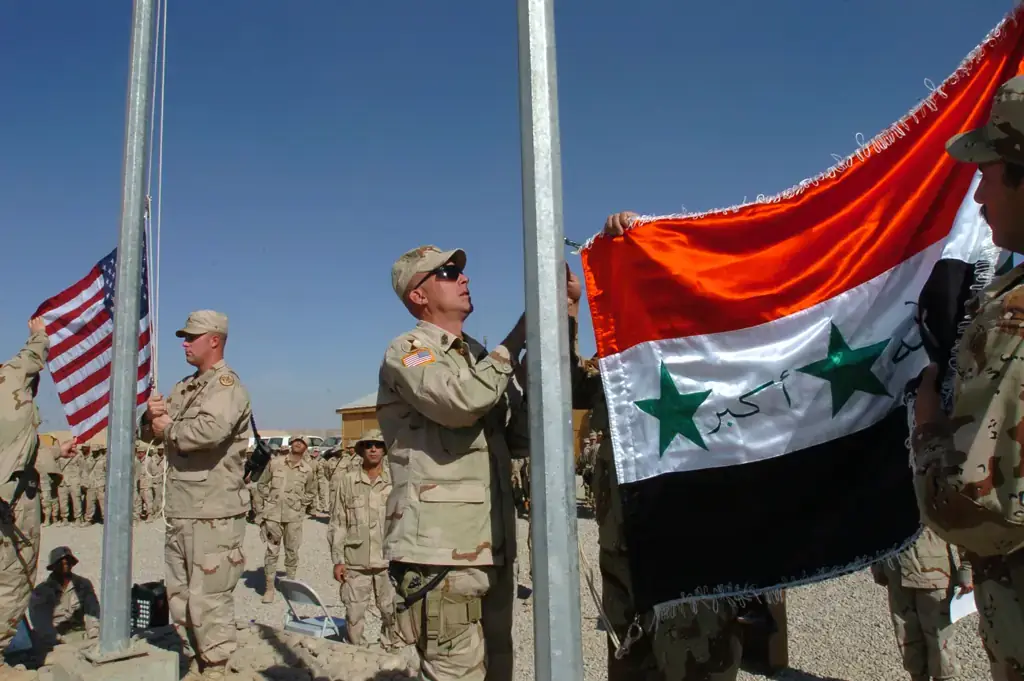
BAGHDAD, Iraq – The United States is completing the withdrawal of its remaining troops from Iraq as some of the country’s most powerful Iran-aligned armed groups reject government demands to surrender their weapons, creating a difficult security transition for Baghdad.
The U.S.-led coalition’s military mission in Iraq is scheduled to end on Sept. 30, 2026, under an agreement reached between Washington and Baghdad. Most coalition forces have already departed, with the remaining U.S. presence concentrated largely in Iraq’s Kurdistan region.
At the same time, the Iraqi government has been pressing armed factions to bring their weapons under state authority. Several of the most powerful groups have rejected the demand or attached conditions to any disarmament process.

U.S. withdrawal nears completion
The American withdrawal marks the end of the current U.S.-led coalition mission against Islamic State in Iraq.
The coalition’s combat role formally ended in 2021, but U.S. troops remained to support Iraqi security forces, provide intelligence and conduct counterterrorism operations. The current withdrawal agreement provides for the end of the coalition’s military mission while allowing broader security cooperation between Washington and Baghdad to continue.
The remaining American forces are expected to leave Iraq by the Sept. 30 deadline or move to other U.S. positions in the region.
The departure will leave Iraqi forces with greater responsibility for countering remaining Islamic State activity and protecting the country’s territory.
Baghdad pushes for militia disarmament
Iraq’s government has also been pursuing a separate effort to place all weapons under state control.



Prime Minister Ali al-Zaidi’s government has called on armed factions to surrender weapons or integrate their military capabilities into recognized state security structures. Officials have argued that the departure of foreign forces removes a principal justification used by militias for maintaining independent armed capabilities.
The issue is complicated by the structure of Iraq’s Popular Mobilization Forces, a state-funded security organization formed during the campaign against Islamic State.
Several powerful factions operate within or alongside that broader structure while maintaining distinct political and military identities.
Powerful factions reject the deadline
Some armed groups have indicated greater willingness to discuss integration with state institutions. The most powerful Iran-aligned factions have been less willing to accept outright disarmament.
Groups including Kataib Hezbollah and Harakat al-Nujaba have demanded conditions before giving up their weapons. Some have called for guarantees that U.S. forces will not return and for an end to American influence in Iraq.
That resistance means Baghdad’s Sept. 30 deadline does not automatically translate into the removal of the factions’ independent military capabilities.
The dispute also illustrates the difficulty of enforcing a state monopoly on weapons when some of the organizations involved possess substantial political influence and formal connections to Iraq’s security institutions.
A changing security environment
The U.S. departure comes as Iraq seeks to strengthen its own defense capabilities.
Baghdad has been working to improve air defenses and other military capabilities as the coalition presence winds down. The government has also sought to maintain security cooperation with international partners after the end of the coalition’s military mission.
The transition could leave Iraq with greater responsibility for responding to threats without the same level of direct U.S. military support.
At the same time, the presence of heavily armed factions creates a separate challenge for the Iraqi government: maintaining state authority while avoiding an internal confrontation with organizations that have political and military power.
Two deadlines converge
The U.S. military withdrawal and Iraq’s militia-disarmament effort are separate processes, but their deadlines now converge on Sept. 30.
For Washington, the date represents the planned conclusion of the coalition’s military mission in Iraq. For Baghdad, it is also the point by which the government wants weapons outside formal state control brought under its authority.
Whether those objectives can be achieved simultaneously remains unresolved.
The American withdrawal can proceed even if the militia issue remains unsettled. But Baghdad’s ability to enforce its disarmament policy after foreign forces depart will be an important test of the government’s authority over Iraq’s armed groups.
Reporting Credit: Iraqi government and Prime Minister’s Office — withdrawal timetable and militia policy; Iraqi security authorities — security arrangements and armed-group integration; U.S. Department of Defense — U.S. force withdrawal and coalition mission transition.