SAN FRANCISCO, United States – Siri’s original creators believe the technology is finally moving closer to the purpose they imagined nearly two decades ago, even as Apple’s latest version of the assistant remains only part of a much larger shift toward AI systems that can act on behalf of users.
Dag Kittlaus and Adam Cheyer, who founded Siri with Tom Gruber in 2007, originally envisioned something more capable than a voice-controlled search tool. They described Siri as a “do engine” — an assistant designed not merely to answer questions but to carry out tasks for people.
Apple acquired Siri in 2010 and introduced it as a major feature of the iPhone 4S in 2011. The company has now rebuilt the assistant around Apple Intelligence, giving it access to personal context, information displayed on a user’s screen, web-based answers and actions across applications.

For Kittlaus and Cheyer, those capabilities are closer to what they had in mind when Siri was still an independent startup.
From voice commands to an AI agent
The original Siri was designed around the idea that computers should help users accomplish things rather than simply retrieve information.
Cheyer explained that distinction as the difference between a search engine and a “do engine.” Instead of sending users to a website to find information, the assistant would ideally understand an intention and complete the task itself.
That idea has become more significant as generative AI has developed.
Modern systems such as ChatGPT and Gemini are considerably better at understanding and generating information than the early generation of voice assistants. But actually completing tasks across applications remains a separate technical and commercial challenge.




That is where the Siri creators see an opportunity.
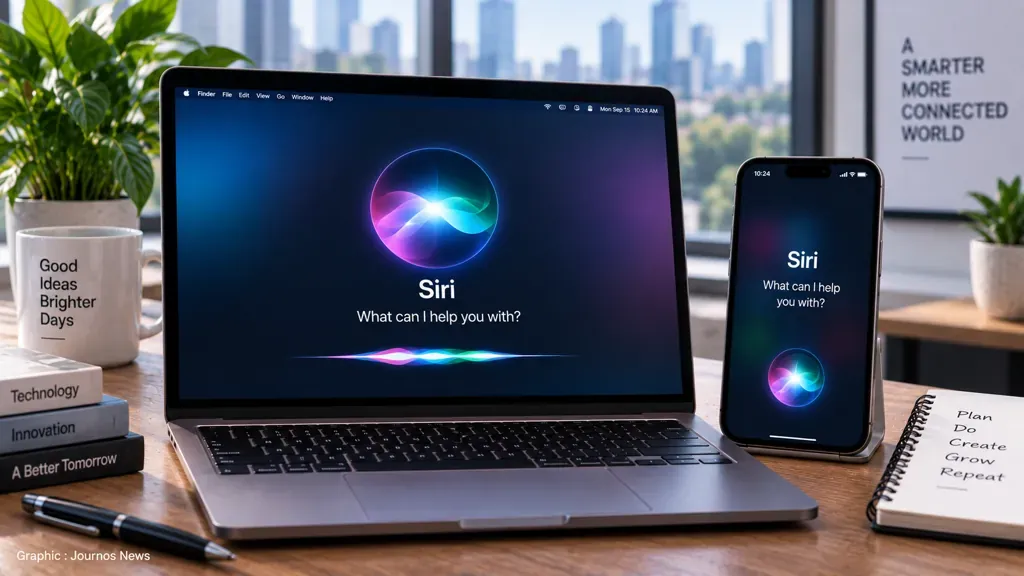
Apple’s new Siri AI can search information stored across a user’s messages, emails and photos, understand what is displayed on the screen and perform actions across supported applications. Apple says the system has been rebuilt around a new Apple Intelligence architecture, including on-device models and Private Cloud Compute.
The company is positioning the new assistant as something considerably more capable than the Siri that users have known for years.
Apple is closer to the original idea
Kittlaus and Cheyer have not dismissed Apple’s progress.
Both told CNN that Apple is well positioned to bring Siri closer to the original “do engine” concept, particularly because the company controls the operating system, hardware and large amounts of personal information stored on its devices.
The ability to connect an assistant with information already on a user’s device could make it substantially more useful than a system that only answers general questions.
Apple demonstrated that direction with its new Siri AI. The assistant can, for example, locate information in personal messages or emails and use context from what is displayed on the screen.
The shift also reflects how much the technology has changed since Siri’s original launch.
The early assistant depended on a network of services and predefined integrations. Today’s AI systems can interpret much more complicated requests, allowing the assistant to become a layer between the user and the applications underneath.
The difficult part may no longer be technology
The remaining challenge is not simply whether AI can understand a request.
It is whether companies will allow an AI assistant to become the primary way customers interact with their services.
Kittlaus has warned that companies such as Uber, Amazon and other major digital services could have reasons to resist an assistant that handles transactions without sending users directly through their own applications or websites.
That creates a business problem alongside the technical one.
If an AI assistant can book a restaurant, arrange transportation, purchase a product or manage a reservation, the user may no longer need to open the individual application. The assistant could become the main interface while the underlying services become increasingly invisible.
Apple’s new Siri already supports interactions with more than 300,000 applications, according to the company, although that represents only a portion of the much larger App Store ecosystem.
The transition therefore depends partly on whether developers see AI assistants as another distribution channel or as a threat to their direct relationship with users.
A vision that has outlasted its first product
Kittlaus and Cheyer left Apple after the acquisition and later worked on Viv Labs, another attempt to develop a more capable digital assistant. Viv was acquired by Samsung in 2016 and contributed to the development of its Bixby assistant.
Their original concept has nevertheless remained unfinished.
The Computer History Museum’s account of Siri’s development describes the early system as an action-oriented interface designed to connect users with online services. It notes that Apple built only part of the broader “do engine” vision.
Generative AI has now solved some of the problems that once limited such a system, particularly the ability to understand natural language and handle broad questions.
But Kittlaus says the central vision itself has not changed.
Fifteen years after Siri arrived on the iPhone, he told CNN that the vision “hasn’t changed one iota” but that nobody has fully achieved it yet.
Apple’s rebuilt Siri may represent the most significant attempt yet to close that gap. Whether it becomes the general-purpose “do engine” its creators originally imagined will depend not only on Apple’s technology, but also on how far users and developers are willing to let AI assistants replace the traditional app-based internet.
Reporting Credit: Apple — official information on Siri AI, Apple Intelligence architecture and system capabilities; Computer History Museum — historical documentation of Siri’s development and original vision; Dag Kittlaus and Adam Cheyer — current views on Siri’s original “do engine” concept and Apple’s AI direction.