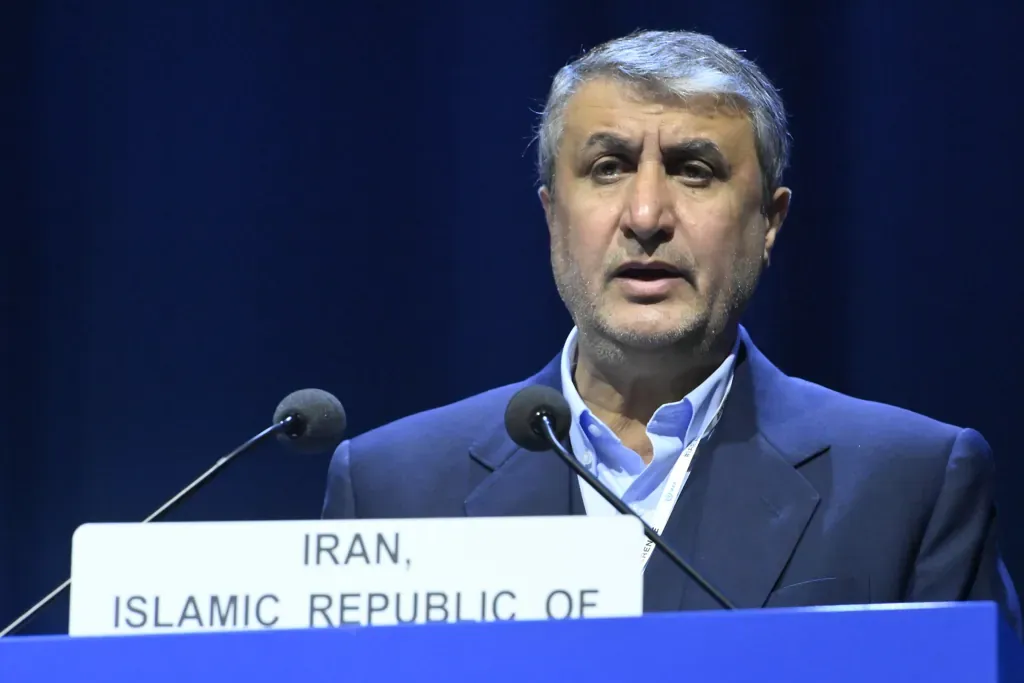
VIENNA, Austria – Iran’s nuclear chief Mohammad Eslami faces possible exclusion from this week’s International Atomic Energy Agency General Conference after an Austrian request for a travel-ban exemption was reportedly rejected, adding another point of tension between Tehran and the U.N. nuclear watchdog.
An official briefed on the matter said Eslami was not expected to attend the conference because he is subject to an international travel ban. Austria had sought an exemption through the U.N. sanctions committee, but the request was not granted, according to the official, who spoke anonymously because the matter was sensitive.
The account is disputed by Iranian state media. Iran’s state news agency IRNA reported that Eslami had left Tehran for Vienna and was expected to participate in the conference and hold meetings with foreign officials. Other reports citing Iranian state media also said he was traveling to the Austrian capital for the gathering.

That leaves Eslami’s actual participation unresolved as the conference begins.
A sensitive meeting for Iran and the IAEA
The IAEA General Conference is scheduled to bring representatives of the agency’s member states together in Vienna from Sept. 14 to 18. The annual meeting addresses the agency’s budget, nuclear cooperation and policy issues, including safeguards in the Middle East.
Eslami has regularly attended the conference since becoming head of Iran’s Atomic Energy Organization in 2021. His potential absence would therefore be notable, particularly as relations between Iran and the IAEA have deteriorated.
The agency says it has been unable to carry out full verification of Iran’s nuclear activities at sites affected by military strikes. Iran has restricted access to those facilities, while Tehran maintains that its nuclear program is peaceful.
The IAEA has also said it cannot currently verify the status of Iran’s stockpile of uranium enriched to 60% purity. The agency previously reported that Iran had accumulated about 440.9 kilograms of such material before access to the affected facilities was disrupted.
■ Related News
Travel restrictions add to the dispute
The reported travel restriction follows the restoration of U.N. sanctions on Iran that include measures affecting designated individuals and entities.
The U.N. Security Council maintains a consolidated sanctions list covering individuals and entities subject to Security Council measures, including travel restrictions where applicable.
The Austrian government, as host of the United Nations presence in Vienna, can request exemptions from certain travel restrictions to allow sanctioned officials to attend U.N.-related meetings. According to the official cited in current reporting, that effort did not result in a waiver for Eslami.
Iran’s reported decision to send Eslami nevertheless suggests Tehran does not accept the restriction as preventing his participation, although it remains unclear whether he will ultimately be permitted to enter the conference venue or address the gathering.
Nuclear dispute has escalated
The uncertainty over Eslami’s attendance comes at a particularly difficult moment for the Iranian nuclear file.
On Sept. 9, the IAEA Board of Governors voted to refer Iran to the U.N. Security Council over what the board described as Iran’s failure to comply with its nuclear safeguards obligations. It was the first such referral in 20 years.
Iran rejected the decision and described the IAEA’s actions as politically motivated. Iranian officials have also warned that continued pressure could have consequences for the future of the country’s participation in the global nuclear nonproliferation system.
The dispute has become more difficult to resolve because the IAEA cannot establish the current status of parts of Iran’s nuclear material and facilities while inspectors remain unable to access sites damaged during previous military strikes.
Iran says the restrictions are linked to security conditions and the attacks on its nuclear facilities. The IAEA, meanwhile, continues to seek the access and information it says are necessary to fulfill its verification mandate.
For the conference now underway in Vienna, the immediate question is whether Eslami will be able to participate as Iran says he intends to.
Until that is established, the conflicting accounts over his travel leave his attendance at the IAEA’s annual meeting uncertain.
Reporting Credit: International Atomic Energy Agency — nuclear safeguards, Iran monitoring and General Conference information; United Nations Security Council — sanctions and travel-restriction framework; Austrian authorities — reported effort to obtain a travel-ban exemption for Eslami; Iran’s Atomic Energy Organization and state media — Eslami’s reported travel and intended participation.