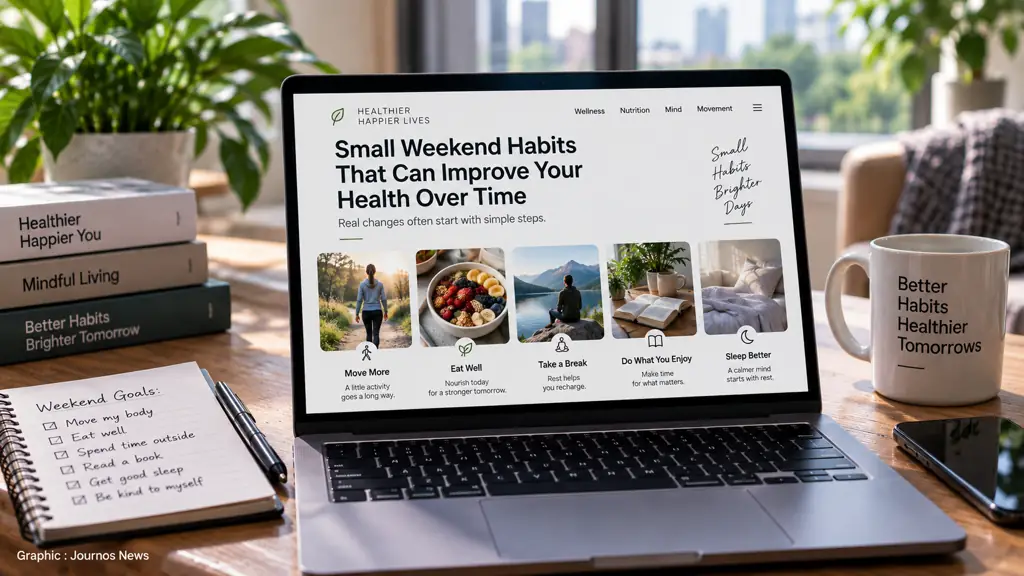
Small changes made during the weekend can help people build healthier routines that continue into the working week, according to public-health guidance on physical activity, diet and well-being.
The weekend often provides more flexibility for activities that are difficult to fit into a busy weekday schedule. That can make it an opportunity to establish habits rather than simply recover from the previous week.
The World Health Organization says regular physical activity, healthy eating, adequate sleep, avoiding tobacco and limiting alcohol are among the behaviors that support health and well-being.

The practical value of these habits comes less from doing something extraordinary for two days than from repeating manageable behaviors over time.
Make movement part of the weekend
Walking is one of the simplest ways to add physical activity without requiring specialized equipment.
WHO recommends that adults aged 18 to 64 get at least 150 minutes of moderate-intensity aerobic activity each week, or 75 minutes of vigorous activity, with additional benefits associated with higher levels of activity. Muscle-strengthening activities are also recommended on at least two days each week.
A weekend walk, cycling trip, household activity or exercise session can therefore contribute to a person’s weekly total.
The important point is that physical activity does not have to take place in a gym. WHO counts activity undertaken through transportation, leisure, household tasks and other daily activities.




For someone who has been inactive, starting with smaller amounts and gradually increasing activity can be more realistic than attempting an intensive workout immediately.
Use the weekend to improve food choices
Weekends can also provide an opportunity to prepare meals and make healthier choices easier during the following week.
WHO’s current healthy-diet guidance emphasizes adequacy, balance, moderation and diversity. It recommends diets built around a variety of foods, including vegetables, fruit, legumes, whole grains and other nutrient-rich foods.
For people older than 10, WHO recommends at least 400 grams of fruit and vegetables each day. It also recommends limiting free sugars, saturated fats and sodium while favoring a diverse diet based largely on minimally processed foods.
A simple weekend habit could therefore be preparing vegetables, fruit, whole grains or legumes in advance rather than relying entirely on convenience foods during busy weekdays.
The objective is not to make every meal perfect. A healthier pattern is built through repeated choices.
Protect time for sleep and recovery
Weekends can also disrupt sleep routines when people stay up substantially later or try to compensate for insufficient sleep during the working week.
Maintaining a reasonably consistent sleep schedule can make it easier to preserve a regular daily rhythm.
Recovery also involves more than sleep. WHO’s guidance on self-care includes healthy eating, physical activity, adequate sleep and connecting with other people among behaviors that can support health and well-being.
A weekend can therefore include periods without work, unnecessary notifications or other demands that make genuine recovery more difficult.
Spend some time away from sedentary routines
A weekend can unintentionally become highly sedentary, particularly when large portions of the day are spent watching television, browsing on a phone or sitting at a computer.
Breaking up long periods of sitting with movement can add activity without requiring a formal exercise session.
Walking while running errands, taking stairs, doing household work or going outside for a short period can all increase movement during the day.
WHO emphasizes that some physical activity is better than none, making small additions relevant even for people who are not ready to follow a structured exercise program.
Make healthy choices easier for Monday
One of the most useful weekend habits may be preparing for the week ahead.
Planning several meals, purchasing nutritious ingredients, preparing exercise clothes or scheduling time for physical activity can reduce the number of decisions required during busy weekdays.
The strategy works because the goal is not to depend entirely on motivation.
A routine that has already been prepared is generally easier to follow than one that requires a new decision every day.
The same principle can apply to other behaviors, such as setting boundaries around work communication or creating a regular bedtime.
Small habits add up
There is no single weekend routine that guarantees better health.
Age, existing health conditions, physical ability, work schedules, diet, culture and access to healthy food and safe spaces for exercise all influence what is practical for an individual. WHO also notes that healthy diets vary according to individual circumstances and cultural and local conditions.
The broader public-health message is therefore about consistency rather than perfection.
A longer walk, a meal built around vegetables and whole grains, a more regular sleep schedule or time spent with other people may seem modest when considered individually.
Repeated over weeks, months and years, however, those behaviors can become part of a person’s normal routine.
The weekend does not need to become a two-day health program. It can simply provide a practical opportunity to establish small habits that make healthier choices easier to maintain throughout the week.
Reporting Credit: World Health Organization — physical-activity recommendations, healthy-diet guidance and 2026 self-care and well-being guidance.