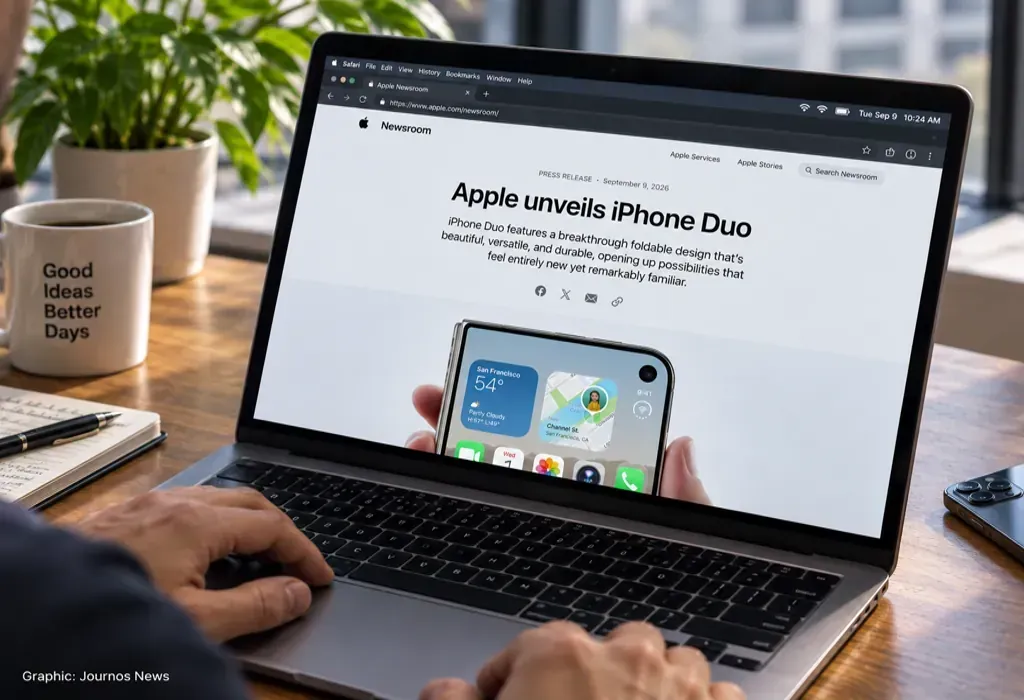
CUPERTINO, United States — Apple has entered the foldable smartphone market with the iPhone Duo, its first iPhone with a folding display, opening a new chapter in competition with Samsung and Chinese smartphone makers that have already spent years developing the category.
Apple unveiled the device on Sept. 9 alongside its iPhone 18 Pro lineup, making the foldable model the centerpiece of the company’s latest product cycle. The launch also marked new Chief Executive John Ternus’ first major iPhone event after succeeding Tim Cook.
The iPhone Duo starts at $1,999 in the United States, making it Apple’s most expensive iPhone. Preorders begin Oct. 16, with sales scheduled to start Oct. 23.

Apple enters a market shaped by rivals
The Duo arrives more than seven years after Samsung introduced its first Galaxy Fold, while Chinese manufacturers including Huawei have expanded the range of foldable devices available to consumers.
Apple is betting that its combination of hardware, software and services can make foldables attractive to a much broader audience. Analysts cited by Reuters expect the company’s entry to significantly increase the size of the market and potentially give Apple a large share of foldable-phone revenue.
Apple has emphasized that the Duo is designed not simply as a smaller tablet but as an iPhone that can change how users interact with applications.
When closed, the device has a 5.4-inch outer display. Opening it reveals a 7.6-inch inner display, Apple’s largest iPhone screen to date. The two displays use the same aspect ratio, allowing content to transition between them while supporting multitasking and different viewing positions.
Hardware is built around the foldable design
The Duo uses Apple’s A20 Pro chip and a custom vapor-chamber thermal system designed to sustain performance during gaming, multitasking and on-device artificial-intelligence workloads.



Apple says the chip uses a 2-nanometer manufacturing process and provides faster CPU and GPU performance than the previous generation, while its neural-engine improvements are intended to support more demanding AI processing directly on the phone.
The phone also uses a dual-battery architecture, with batteries positioned on either side of the folding device. Apple says the Duo can provide up to 24 hours of usage when both displays are used equally and can charge to 50% in about 20 minutes.
The device has a titanium frame and hinge cover and supports storage capacities ranging from 256GB to 2TB. It is also eSIM-only worldwide, according to Apple.
Apple emphasizes productivity and AI
The larger internal screen allows users to run applications side by side and use the device in orientations that are not available on conventional iPhones.
Apple demonstrated the Duo with productivity applications, video calls and multitasking features. The company is also integrating its latest AI capabilities into the device, including an updated Siri and Apple Intelligence functions designed to perform as much processing as possible on the phone itself.
Apple says tasks requiring additional computing power can use its Private Cloud Compute system, which it presents as a way to extend AI capabilities while maintaining privacy protections.
The Duo also introduces foldable-specific camera features. Its 48-megapixel dual-camera system can use the outer display as a preview screen for photographs, while the device’s folding form allows users to position the phone for hands-free photography and video calls.
Price could limit the market
The biggest obstacle may be cost.
At $1,999, the Duo is positioned well above Apple’s mainstream iPhone models and roughly at the premium end of the foldable market. Reuters reported that the starting price is about $100 higher than comparable Samsung and Google foldable models.
That price places Apple in a market that remains relatively small compared with conventional smartphones. Foldables account for less than 5% of global smartphone sales, according to figures cited by the Associated Press.
Apple therefore needs to persuade existing iPhone users that the additional cost provides enough practical value to justify moving to a fundamentally different form factor.
The company is also entering the market after competitors have already gained experience with hinge durability, display technology, multitasking software and consumer expectations around foldable phones.
Apple raises the stakes for smartphone makers
The launch nevertheless changes the competitive landscape.
Samsung has spent years building its Galaxy Z Fold and Z Flip lines, while Chinese companies have pushed foldable hardware toward thinner designs and increasingly sophisticated displays. Apple’s arrival gives the category access to one of the world’s largest smartphone ecosystems and could pressure competitors to accelerate their own hardware and software development.
The broader iPhone launch also reflects Apple’s attempt to increase the value of its premium devices as smartphone growth matures.
The company raised the starting prices of the iPhone 18 Pro and Pro Max by $100, to $1,199 and $1,299 respectively, while adding upgraded cameras and the A20 Pro chip.
The strategy places Apple’s latest products at progressively higher price points while emphasizing AI, performance and new device formats as reasons for customers to upgrade.
The iPhone Duo’s success will ultimately depend on whether consumers see the foldable design as more than a novelty. If Apple can turn the form factor into a mainstream iPhone experience, its entry could accelerate adoption across the smartphone industry. If demand remains concentrated among premium buyers, foldables may continue to occupy a specialized segment despite Apple’s arrival.
Reporting Credit: Apple — product specifications, pricing, availability and technology features; — market context and competitive landscape; — foldable smartphone market context.