Journos News - Breaking News, World News, Top Stories, Todays Headlines and Flash Reports
Thursday, September 10, 2026
  • Login
  • Home
  • World
    • Africa
    • Americas
    • Asia
    • Europe
    • Middle East
    • Oceania
  • Politics
  • Business
  • Technology
  • Health
  • Science
  • Sports
  • Entertainment
  • Culture
No Result
View All Result
  • Home
  • World
    • Africa
    • Americas
    • Asia
    • Europe
    • Middle East
    • Oceania
  • Politics
  • Business
  • Technology
  • Health
  • Science
  • Sports
  • Entertainment
  • Culture
No Result
View All Result
Journos News - Breaking News, World News, Top Stories, Todays Headlines and Flash Reports
No Result
View All Result
Home Science

Interstellar Comet 3I/ATLAS Shows Unexpectedly High Methanol Levels, Scientists Find

ALMA observations reveal a methanol-rich chemistry unlike most known comets, offering clues to the object’s formation beyond our Solar System.

The Daily Desk by The Daily Desk
September 10, 2026
in Science, Space & Astronomy
0
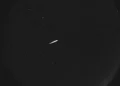
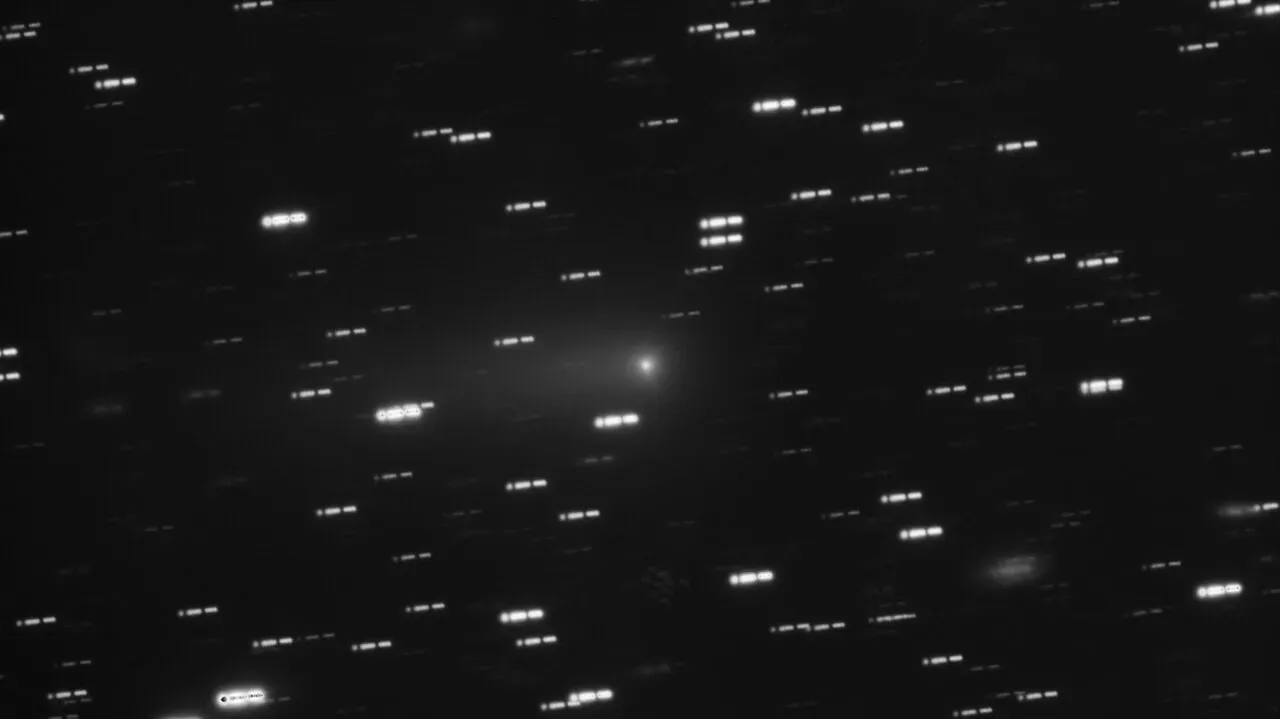
Interstellar comet 3I/ATLAS photographed by ESO’s Very Large Telescope, with stars appearing as trails in the background.

ESO image of interstellar comet 3I/ATLAS captured with the FORS2 instrument on the Very Large Telescope on February 18, 2026.

SANTIAGO, Chile — Astronomers studying the interstellar comet 3I/ATLAS have found unusually high levels of methanol in its surrounding gas, adding to evidence that the object formed under chemical conditions unlike those that produced most comets in our Solar System.

Observations made with the Atacama Large Millimeter/submillimeter Array (ALMA) detected strong methanol signatures in the comet’s coma and found an exceptionally high ratio of methanol to hydrogen cyanide. The measured ratios of about 124 and 79 on two observation dates rank among the highest recorded for comets observed at radio wavelengths.

The finding provides another chemical clue from an object that originated outside the Solar System. Because 3I/ATLAS formed around another star before entering interstellar space, its composition offers astronomers a rare opportunity to compare planetary-building material from another system with the comets found around the Sun.

Methanol stands out in the comet’s chemistry

The researchers detected methanol, or CH₃OH, together with hydrogen cyanide, or HCN, as 3I/ATLAS approached the Sun in 2025.

When sunlight warms a comet, frozen material sublimates and produces a cloud of gas and dust around the nucleus. Spectroscopic observations of that coma allow astronomers to identify individual molecules and estimate how they are being released.

In 3I/ATLAS, methanol was particularly prominent relative to HCN. The researchers found CH₃OH/HCN production-rate ratios of 124⁺³⁰₋₃₄ and 79⁺¹¹₋₁₄, depending on the observation date. Only the unusual Solar System comet C/2016 R2 (PanSTARRS) has shown a higher enrichment in comparable radio observations.

The result does not mean methanol is unique to 3I/ATLAS. Methanol is commonly detected in comets and can form on icy dust grains in interstellar environments. What makes 3I/ATLAS unusual is the relative abundance revealed by its molecular fingerprint.

Icy grains may be releasing additional methanol

The ALMA observations also provided information about where the molecules appear to originate.
■ Related News

NASA rocket moved back to launch pad for Artemis II mission - AP Photo/Terry Renna

NASA resumes Artemis II preparations after repairs on Space Launch System rocket

June 23, 2026
Red lunar eclipse visible across Asia and Americas sky - Petros Giannakouris/AP

Total Lunar Eclipse Colors the Moon Reddish-Orange Across Multiple Continents

June 23, 2026
Gemini South telescope captures glowing Butterfly Nebula image - NSF NOIRLab via AP

Chile Telescope Discovery Reveals Striking New Image of Cosmic ‘Butterfly’

June 24, 2026
Orionid Meteor Shower Peaks This Week for Stargazers - Jet Propulsion Laboratory/NASA via AP, File

How to Watch the Orionid Meteor Shower This Week

June 24, 2026

The distribution of methanol suggested that at least some of its production may occur away from the nucleus, within the comet’s coma. Statistical analysis indicated production from coma sources more than about 258 kilometers from the nucleus at 99% confidence, although the researchers could not completely rule out direct production from the nucleus because of limitations in the observations.

The researchers suggest that icy grains surrounding the nucleus may act as miniature cometary sources, releasing methanol as they are warmed by sunlight.

Hydrogen cyanide behaved differently. Its distribution was consistent with direct sublimation from the nucleus, providing a contrast with the more extended methanol production.

The distinction gives astronomers a more detailed picture of how different molecules are stored and released as an interstellar comet approaches the Sun.

The chemistry points to a different birthplace

The unusually high methanol-to-HCN ratio suggests that the ices incorporated into 3I/ATLAS formed under conditions different from those experienced by most known Solar System comets.

Those conditions could reflect differences in temperature, chemistry or the availability of molecular ingredients in the planetary system where 3I/ATLAS originated. The observations cannot identify its parent star or reconstruct its entire formation history, but they provide measurable evidence that its chemical environment differed from the Solar System’s.

Earlier observations have already shown other unusual characteristics. The James Webb Space Telescope found a coma strongly dominated by carbon dioxide when 3I/ATLAS was still far from the Sun. Later observations also revealed unusual gas-outflow behavior.

Separate observations with the IRAM 30-meter telescope detected methanol, carbon monoxide, formaldehyde, methyl cyanide and other molecules, while finding that several molecular abundances were at the upper end of ranges measured in Solar System comets.

A rare chemical sample from another planetary system

3I/ATLAS is only the third confirmed interstellar object observed passing through the Solar System. It was discovered in July 2025 by the ATLAS survey in Chile.

Unlike spacecraft missions that return samples from bodies within our planetary system, observations of 3I/ATLAS allow astronomers to study material that formed around another star without physically traveling to another planetary system.

Its chemical composition therefore serves as a kind of remote sample of planetary formation elsewhere in the galaxy.

The latest measurements do not establish exactly where 3I/ATLAS originated or what type of planetary system produced it. They instead add methanol enrichment to a growing list of characteristics that distinguish the interstellar comet from many of its Solar System counterparts.

As astronomers continue analyzing observations from different instruments, the unusual chemistry of 3I/ATLAS could help refine models of how icy bodies form and evolve around other stars.

Reporting Credit: National Radio Astronomy Observatory and ALMA — methanol and hydrogen-cyanide observations; NASA Technical Reports Server — accepted research manuscript and observational results; IRAM — independent molecular observations and compositional analysis.

Tags: #3IATLAS#ALMA#Astronomy#Comets#InterstellarComet#Methanol#PlanetaryScience#SpaceResearch
The Daily Desk

The Daily Desk

The Daily Desk is the editorial byline of Journos News, representing reporting produced by the newsroom across world news, politics, business, technology, disasters, and other areas of public interest. Stories published under this byline are independently researched, verified, and edited in accordance with Journos News’ editorial standards, with an emphasis on accuracy, transparent sourcing, attribution, context, and editorial independence.

Related Posts

October 2025 Supermoon to Shine Brighter and Larger Across the Globe - AP PHoto/Ariel Schalit

October’s First Supermoon of 2025 to Illuminate Skies Worldwide

June 24, 2026
NASA announces historic new astronaut class, selecting 10 from over 8,000 applicants for Moon and Mars exploration missions. - NASA via AP

NASA Welcomes New Astronaut Class for Moon and Mars Missions

June 23, 2026
NASA Spots Hidden Mineral Ridges That Could Rewrite Mars’ History - NASA/JPL-CALTECH/MSSS/HANDOUT/Anadolu Agency/Getty Images

NASA’s Curiosity Rover Discovers Strange ‘Boxwork’ Patterns on Mars

June 24, 2026
Countdown Begins for Japanese Lunar Lander's June Touchdown - ispace via AP, File

Japan’s Resilience Lunar Lander Enters Orbit Ahead of June Landing

June 24, 2026
The Mystery of Dark Energy: Could It Be Changing? - KPNO/NOIRLab/NSF/AURA/B. Tafresh via CNN

Is Dark Energy Evolving? New Findings Could Rewrite Cosmic Theory

June 24, 2026
Partial Solar Eclipse Visible Across Europe, North America, and Africa - Frank Gunn/The Canadian Press via AP, File

Partial Solar Eclipse to Illuminate Skies Across Europe, North America, and Africa

June 24, 2026
SpaceX’s Latest Mission Brings New Crew to ISS, Prepares for Astronaut Swap - Gregg Newton/AFP/Getty Images

SpaceX Crew-10 Arrives at ISS, Paving the Way for NASA Astronauts’ Return

June 24, 2026
Red Moon Alert! Everything You Need to Know About the March Eclipse - Ringo H.W. Chiu/AP Photo

March’s Blood Moon: Watch the Lunar Eclipse Turn the Sky Red

June 23, 2026
Load More
JournosNews logo

Journos News delivers globally neutral, fact-based journalism that meets international media standards — clear, credible, and made for a connected world.

  • Categories
  • World News
  • Politics
  • Business & Markets
  • Technology
  • Health
  • Science
  • Sports
  • Arts & Culture
  • Resources
  • Editorial Standards
  • Submit a Story
  • Advertise with Us
  • Syndication & Partnerships
  • Site Map
  • Press & Media Kit
  • Editorial Team
  • Careers

Join thousands of readers receiving the latest updates, tips, and exclusive insights straight to their inbox. Never miss an important story again.

  • About Us
  • Editorial & Trust Center
  • Contact Us
  • Privacy Policy
  • Terms of Use & Copyright Notice

© JournosNews.com All rights reserved.

Welcome Back!

Login to your account below

Forgotten Password?

Retrieve your password

Please enter your username or email address to reset your password.

Log In
JournosNews

Independent Journalism.
Verified Facts.

You're about to read a professionally edited article from JournosNews.com.

Every article is produced in accordance with our editorial standards, emphasizing factual accuracy, transparent attribution, fairness, editorial independence, and meaningful context.

Editorial Standards
No Result
View All Result
  • Home
  • World
    • Africa
    • Americas
    • Asia
    • Europe
    • Middle East
    • Oceania
  • Politics
  • Business
  • Technology
  • Health
  • Science
  • Sports
  • Entertainment
  • Culture

© JournosNews.com All rights reserved.

This website uses cookies. By continuing to use this website you are giving consent to cookies being used. Visit our Privacy and Cookie Policy.