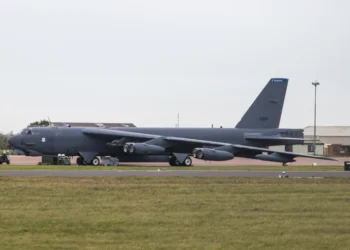
The U.S. military said it completed a new wave of strikes against Islamic Revolutionary Guard Corps (IRGC) targets in Iran on Tuesday. The operation followed Iranian attacks involving commercial shipping and U.S. forces in and around the Strait of Hormuz.
Iran responded with missile and drone attacks against U.S. military positions in the region, including targets in Jordan and Bahrain, according to reports. The renewed exchanges have raised concerns that the conflict could move into another sustained phase of direct U.S.-Iran fighting.
Strait of Hormuz becomes central to the conflict
The latest escalation is closely tied to control and security of the Strait of Hormuz.

Before the current conflict, roughly 20% of global oil consumption passed through the waterway, making any prolonged disruption a major risk for energy markets and the global economy.
Iran’s Islamic Revolutionary Guard Corps has warned that traffic through the strait could face further restrictions following the latest U.S. attacks.
Commercial shipping has already fallen sharply.
Preliminary Kpler data showed only four commodity vessels transited the Strait of Hormuz on Tuesday, compared with about 13 on average over the previous 10 days.
Oil prices rise
Energy markets immediately responded to the renewed military confrontation.
■ Related News


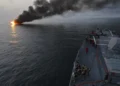
Brent crude rose to about $95.40 a barrel on Wednesday, while U.S. West Texas Intermediate crude reached about $90.66. Both benchmarks had already gained more than $4 a barrel during Tuesday’s trading session.
The market is increasingly pricing in the possibility that disruptions around Hormuz could last longer than previously expected.
Two tankers in the strait were also attacked earlier in the week, adding to concerns among shipping companies and energy traders.
U.S. military action expands
The latest American operation represents a significant escalation after roughly a month of reduced direct U.S.-Iran military activity.
CENTCOM’s public releases show that the United States has continued conducting operations against Iranian military capabilities during the conflict, including air-defense systems, coastal surveillance assets, missile and drone facilities and naval capabilities.
The Pentagon’s latest operation was presented as a response to Iranian threats against U.S. forces and commercial vessels.
The United States has also maintained a naval blockade against Iranian ports and has previously intercepted or redirected commercial vessels suspected of violating the restrictions.
Iran threatens retaliation
Iran has vowed to respond to the latest U.S. attacks.
Iranian forces launched missiles and drones toward American military positions, while Iranian officials warned that the conflict would continue if Washington maintains its military pressure.
The exchanges have also increased risks for U.S. forces stationed across the Middle East, particularly in countries hosting American military installations.
Jordan said its forces intercepted incoming missiles during the latest Iranian attack.
Shipping companies face growing uncertainty
The immediate economic concern is whether commercial vessels can continue operating safely through Hormuz.
Shipping companies are already reducing traffic through the waterway, while some vessels are delaying voyages or changing routes.
A sustained reduction in traffic could affect deliveries of crude oil, refined petroleum products and liquefied natural gas to international markets.
The consequences would extend beyond the Middle East because higher energy costs can feed into transportation, manufacturing, electricity and consumer prices worldwide.
Diplomatic space narrows
The renewed attacks also threaten diplomatic efforts to restore the ceasefire arrangement that had temporarily reduced direct fighting.
Iranian President Masoud Pezeshkian has said Tehran would return to its previous ceasefire commitments if Washington does the same, but the latest military exchanges demonstrate how difficult it will be to restore that framework.
The United States, meanwhile, continues to emphasize military pressure and protection of commercial shipping.
With both sides again exchanging direct attacks, the immediate priority for regional governments is preventing the confrontation from spreading further.
Global markets watch Hormuz
Financial markets are closely monitoring the situation because a prolonged closure or severe restriction of the strait could produce a much larger energy shock.
Higher oil prices would increase inflationary pressure at a time when investors are already concerned about interest rates and economic growth.
For governments in Europe and Asia, the security of energy supplies is becoming an increasingly urgent concern.
What Happens Next
The key question is whether the latest U.S.-Iran exchanges remain limited or develop into another sustained military campaign.
The Strait of Hormuz will remain the most important immediate flashpoint. Any further attacks on commercial vessels, additional mining activity or restrictions on shipping could push oil prices higher and deepen the economic consequences.
For now, military escalation and maritime disruption are moving together, increasing the stakes for both Washington and Tehran.
Key Facts
- Main parties: United States and Iran
- Latest U.S. action: Strikes against IRGC targets in Iran
- Iranian response: Missile and drone attacks against U.S. positions
- Key flashpoint: Strait of Hormuz
- Brent crude: About $95.40 per barrel
- WTI crude: About $90.66 per barrel
- Hormuz oil significance: About 20% of global oil consumption before the conflict
- Recent shipping traffic: Four commodity vessels crossed Tuesday
- Main risk: Prolonged energy and shipping disruption
- Status: DEVELOPING — U.S.-IRAN CONFLICT
Reporting Credit: U.S. Central Command — military operations and strikes; U.S. Department of Defense — regional security and military policy; Iranian government and Islamic Revolutionary Guard Corps — Iranian military response; maritime authorities — Strait of Hormuz shipping incidents; U.S. Energy Information Administration — global oil-flow data.