Journos News - Breaking News, World News, Top Stories, Todays Headlines and Flash Reports
Monday, August 10, 2026
  • Login
  • Home
  • World
    • Africa
    • Americas
    • Asia
    • Europe
    • Middle East
    • Oceania
  • Politics
  • Business
  • Technology
  • Health
  • Science
  • Sports
  • Entertainment
  • Culture
No Result
View All Result
  • Home
  • World
    • Africa
    • Americas
    • Asia
    • Europe
    • Middle East
    • Oceania
  • Politics
  • Business
  • Technology
  • Health
  • Science
  • Sports
  • Entertainment
  • Culture
No Result
View All Result
Journos News - Breaking News, World News, Top Stories, Todays Headlines and Flash Reports
No Result
View All Result
Home World News Asia

Nagasaki Anniversary Highlights Japan’s Nuclear Policy Dilemma

Japan renews its call for nuclear disarmament as its expanding defense posture tests its reliance on U.S. deterrence.

The Daily Desk by The Daily Desk
August 10, 2026
in Asia, World News
0
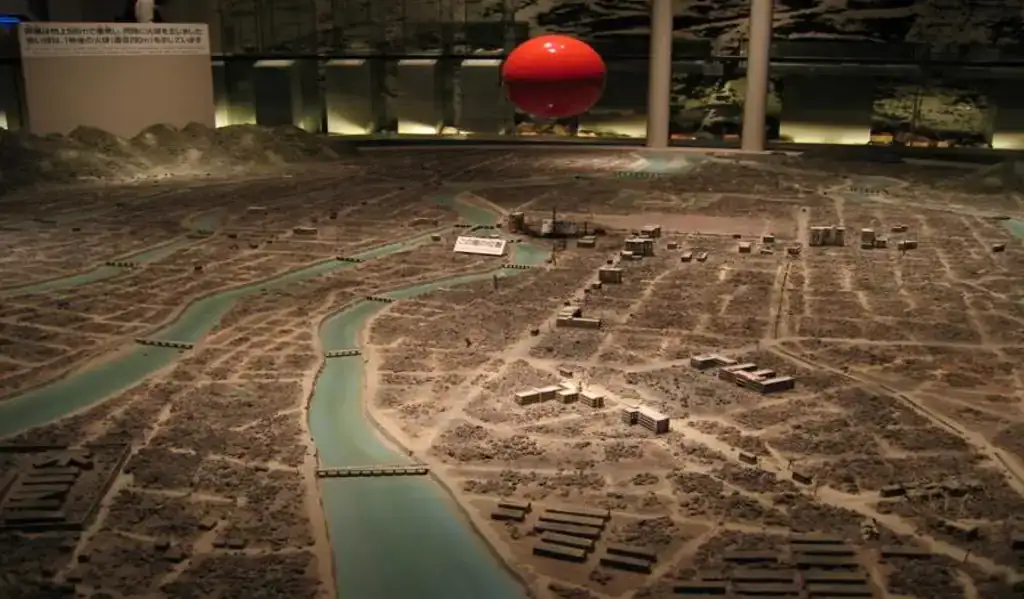
Diorama at Hiroshima Peace Memorial Museum showing the city after the atomic bomb blast, with a red marker indicating the blast location.

Diorama of Hiroshima following the atomic bomb blast, displayed at the Hiroshima Peace Memorial Museum. The red marker indicates the location and approximate size of the blast shortly after the explosion. — Photo: Michael Reeve.

TOKYO, Japan – Japan marked the 81st anniversary of the atomic bombing of Nagasaki on Sunday, renewing calls for nuclear disarmament as the government strengthens the country’s defense capabilities and maintains reliance on the U.S. nuclear umbrella.

More than 90 countries were represented at a ceremony in Nagasaki’s Peace Park, where participants observed a moment of silence at 11:02 a.m., the time the United States dropped the plutonium bomb known as “Fat Man” on Aug. 9, 1945.

The anniversary comes as Prime Minister Sanae Takaichi’s government moves to expand Japan’s military capabilities, intensifying debate over how the country can pursue nuclear disarmament while relying on U.S. extended nuclear deterrence for its security.

Nagasaki mayor challenges nuclear deterrence

Nagasaki Mayor Shiro Suzuki used the anniversary ceremony to challenge the idea that nuclear weapons provide dependable security through deterrence.

Suzuki described nuclear weapons as “absolute evil” and argued that the atomic bombings of Hiroshima and Nagasaki demonstrated the risks of relying on a strategy in which nuclear weapons are intended to prevent conflict.

He called on leaders of nuclear-armed states and countries that depend on nuclear deterrence to recognize what he described as the growing risk of nuclear war.

Suzuki also urged the Japanese government to uphold the country’s war-renouncing Constitution, participate in a review conference later this year for the Treaty on the Prohibition of Nuclear Weapons and maintain Japan’s three non-nuclear principles.

The position reflects a longstanding tension in Japan’s security policy: the country is the only nation to have experienced atomic bombings during wartime while also relying on the United States for extended nuclear deterrence.

■ Related News

Former Taiwan President Tsai Ing-wen observes military personnel and equipment during the Han Kuang 32 military exercise in Pingtung County.

Taiwan Military Drills Highlight Closer U.S. Alignment as China Tensions Persist

August 7, 2026
Fresh iceberg lettuce displayed for sale at a grocery store during the CDC investigation into a multistate Cyclospora outbreak linked to recalled lettuce.

CDC Links Multistate Cyclospora Outbreak to Recalled Iceberg Lettuce from Taylor Farms de Mexico

August 6, 2026
DEA wanted poster displaying eight senior CJNG cartel leaders targeted by new U.S. criminal charges and reward offers announced in August 2026.

U.S. Announces New Charges and $100 Million in Rewards Targeting Senior CJNG Cartel Leaders

August 6, 2026
U.S. President Donald Trump chairs a Cabinet meeting with administration officials in the Cabinet Room at the White House on Jan. 29, 2026.

Trump Says Strait of Hormuz Reopening Deal Could Come Within Days as Negotiations Advance

August 5, 2026

Takaichi maintains cautious nuclear position

Takaichi attended the Nagasaki ceremony and said Japan would continue pursuing what she described as a realistic and pragmatic approach toward achieving a world without nuclear weapons.

Her government supports Japan’s principles against possessing and developing nuclear weapons, but she has been less explicit about the third non-nuclear principle, which opposes allowing nuclear weapons to be introduced into Japan.

That position has fueled speculation over whether Japan’s changing defense policy could eventually lead to adjustments in its approach to the principle.

Takaichi did not mention the Treaty on the Prohibition of Nuclear Weapons in her ceremony speech. Japan has not signed the treaty because of its reliance on the U.S. nuclear umbrella.

She later told reporters that Japan would continue working through the Nuclear Nonproliferation Treaty framework and determine its approach to the nuclear weapons ban treaty based on what the government considers most effective for national security and nuclear disarmament.

Atomic bomb survivors warn of fading memories

The debate comes as the number of atomic bomb survivors, known as hibakusha, continues to decline.

The number of survivors has fallen to 91,105, about one-quarter of the original number, while their average age has risen above 86. Survivors have warned that firsthand memories of the atomic bombings could gradually disappear as the generation that experienced them grows smaller.

Some survivors have also criticized Japan’s reliance on nuclear deterrence, arguing that it conflicts with the country’s historical experience of atomic warfare.

Protests have been held in Hiroshima and Nagasaki amid concerns that the government could weaken its longstanding non-nuclear principles.

Japan balances disarmament and national security

The Nagasaki anniversary highlights the challenge facing Japan as it attempts to reconcile its nuclear disarmament identity with a more expansive defense policy and continued reliance on the United States.

The United States dropped an atomic bomb on Hiroshima on Aug. 6, 1945, killing about 140,000 people by the end of that year. Three days later, the United States dropped the atomic bomb on Nagasaki, where about 70,000 people were killed by the end of 1945.

Japan surrendered on Aug. 15, 1945, ending World War II and bringing an end to decades of Japanese military expansion across Asia.

For the government, the central policy challenge is balancing its commitment to nuclear nonproliferation and disarmament with the security requirements it sees as necessary in an increasingly uncertain regional environment.

For Nagasaki’s survivors and nuclear abolition advocates, the anniversary remains a reminder of the human consequences of nuclear warfare. Japan’s evolving defense policy is likely to keep that tension at the center of its security and diplomatic debate.

This report is based on reporting by The Associated Press.

Tags: #Japan#Nagasaki#NationalSecurity#NuclearDeterrence#NuclearDisarmament#NuclearWeapons#UnitedStates#USJapanAlliance
The Daily Desk

The Daily Desk

The Daily Desk is a contributor at JournosNews.com covering politics, media, governance, and the evolving dynamics of public discourse. Stories published under this byline are produced in accordance with JournosNews' editorial standards, with an emphasis on verified reporting, accuracy, context, and impartiality.

Related Posts

Locator map of the Strait of Hormuz showing major international shipping lanes between the Persian Gulf and Gulf of Oman, alongside the locations of Iran, Oman, and neighboring Gulf states.

Iran, Oman Advance Strait of Hormuz Talks as U.S. Backs Diplomatic Progress

August 5, 2026
Japan Maritime Self-Defense Force frigate JS Mogami (FFM-1) moored at Yokosuka Naval Base, viewed from the left rear during a port visit.

Japan Prioritizes Combat Drones and AI as Defense Strategy Evolves Amid Regional Security Challenges

August 4, 2026
Japan's Sanae Takaichi and Italian Prime Minister Giorgia Meloni meet during the Italy–Japan summit in Tokyo on January 16, 2026.

Japan Begins Recovery as Prime Minister Visits Earthquake-Hit Kumamoto

August 4, 2026
A U.S. sailor stands watch on the bridge of the guided-missile destroyer USS John Finn (DDG 113) during Operation Epic Fury in the U.S. 5th Fleet area of responsibility.

Trump Says Iran Talks Resume as Diplomatic Efforts Focus on Reopening Strait of Hormuz

August 4, 2026
Load More
JournosNews logo

Journos News delivers globally neutral, fact-based journalism that meets international media standards — clear, credible, and made for a connected world.

  • Categories
  • World News
  • Politics
  • Business & Markets
  • Technology
  • Health
  • Science
  • Sports
  • Arts & Culture
  • Resources
  • Editorial Standards
  • Submit a Story
  • Advertise with Us
  • Syndication & Partnerships
  • Site Map
  • Press & Media Kit
  • Editorial Team
  • Careers

Join thousands of readers receiving the latest updates, tips, and exclusive insights straight to their inbox. Never miss an important story again.

  • About Us
  • Editorial & Trust Center
  • Contact Us
  • Privacy Policy
  • Terms of Use & Copyright Notice

© JournosNews.com All rights reserved.

Welcome Back!

Login to your account below

Forgotten Password?

Retrieve your password

Please enter your username or email address to reset your password.

Log In
JournosNews

Independent Journalism.
Verified Facts.

You're about to read a professionally edited article from JournosNews.com.

Every article is produced in accordance with our editorial standards, emphasizing factual accuracy, transparent attribution, fairness, editorial independence, and meaningful context.

Editorial Standards
No Result
View All Result
  • Home
  • World
    • Africa
    • Americas
    • Asia
    • Europe
    • Middle East
    • Oceania
  • Politics
  • Business
  • Technology
  • Health
  • Science
  • Sports
  • Entertainment
  • Culture

© JournosNews.com All rights reserved.

This website uses cookies. By continuing to use this website you are giving consent to cookies being used. Visit our Privacy and Cookie Policy.