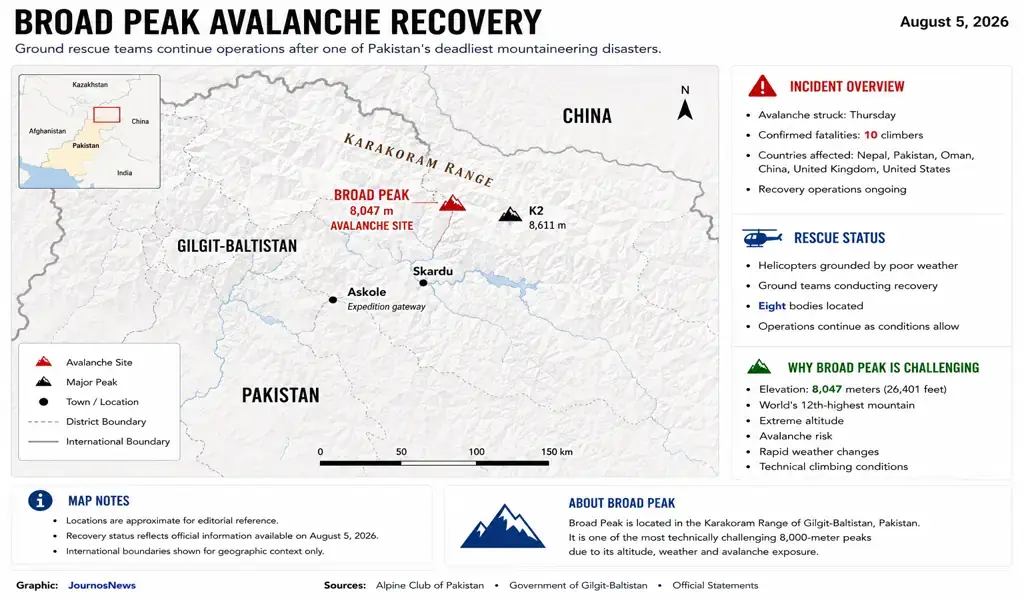
Officials in Gilgit-Baltistan said helicopters remained on standby but could not be deployed because of unfavorable flying conditions. Ground teams continued searching for the remaining victims despite difficult terrain, extreme altitude and unstable weather.
The avalanche struck Thursday on Broad Peak, the world’s 12th-highest mountain, claiming the lives of climbers from Nepal, Pakistan, Oman, China, the United Kingdom and the United States. The Alpine Club of Pakistan described the tragedy as one of the country’s worst mountaineering disasters.
Recovery Efforts Continue in Harsh Conditions
Rescue teams have recovered the remains of eight climbers, with at least three bodies already brought down from the mountain. Authorities said operations remain slow because of steep terrain, avalanche risks and changing weather conditions.

Officials continue working to recover the remaining victims as conditions permit.
Nirmal Purja Among Those Killed
Among the victims was renowned mountaineer Nirmal Purja, widely known as Nims Dai, a Nepal-born former British Army soldier celebrated for climbing the world’s 14 peaks above 8,000 meters in record time.
His expedition company said the global mountaineering community had lost one of its most influential climbers.
Pakistan Expresses Condolences
Pakistan’s Foreign Minister Ishaq Dar extended condolences to the families of those who died and to the governments of China, Nepal, Oman, the United Kingdom and the United States.
In a statement posted on X, Dar also paid tribute to Pakistani climber Sohail Sakhi, describing him as a dedicated mountaineer whose courage and passion would be remembered.
■ Related News




Dar praised rescue personnel for continuing operations under dangerous conditions and said Pakistan remains in close coordination with the embassies of the affected countries throughout the recovery effort.
Northern Pakistan Remains One of the World’s Most Dangerous Climbing Regions
Pakistan’s Karakoram range attracts climbers from around the world, including expeditions attempting Broad Peak and nearby K2.
The region is renowned for its technical difficulty and unpredictable conditions, with avalanches, rockfalls, severe weather and extreme altitude posing constant risks.
Last year, a Chinese climber died after being struck by falling rocks while descending K2, underscoring the dangers faced by mountaineers in northern Pakistan.
Pakistani authorities generally conduct recovery missions for foreign climbers at the request of families and their respective governments. When recovery is not requested or conditions make operations impossible, remains are often left on the mountain.
This report is based on reporting by The Associated Press.