CEUTA, Spain – Hundreds of unaccompanied migrant children remain stranded in Spain’s North African enclave of Ceuta after a mass border crossing that left dozens dead and overwhelmed local reception facilities.
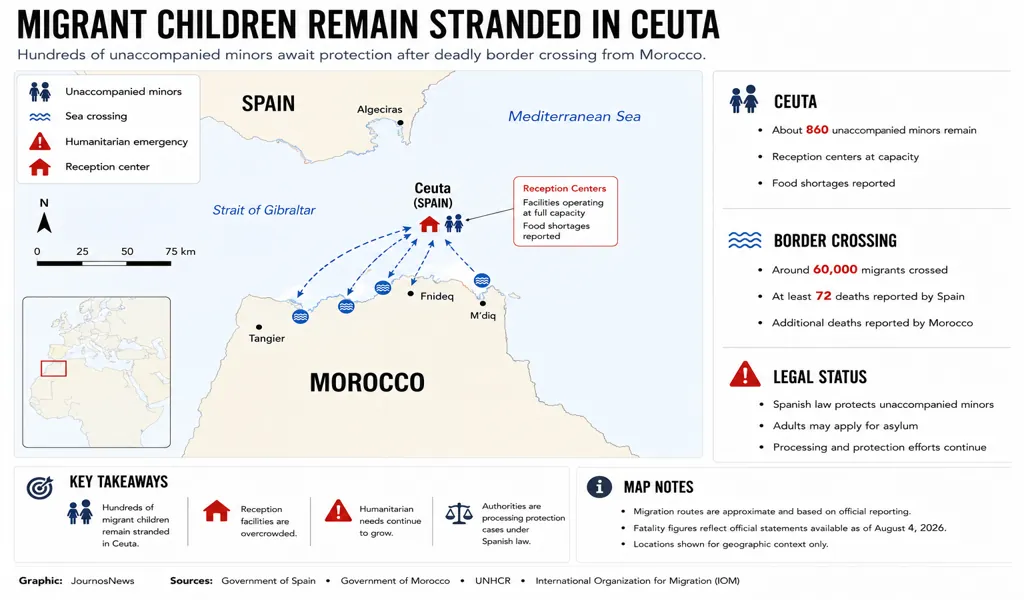
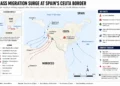
Spanish officials said about 860 children were still in Ceuta on Monday, four days after tens of thousands of migrants crossed into the territory from neighboring Morocco by swimming around border barriers or entering through the sea.
Authorities said 72 people died during the crossing, most of them in the Mediterranean Sea. Morocco separately reported 11 additional deaths that are not included in Spain’s official toll.

Teenager Describes Family Tragedy
Among those waiting for assistance is a 17-year-old girl from Tangier who said she became separated from her mother after witnessing her younger brother drown during the crossing.
The Associated Press is not identifying the teenager because she is a minor in a vulnerable situation.
She said her family joined thousands of others hoping to reach Ceuta in search of better opportunities. During the crossing, she said she saw Spanish police recover the body of her 8-year-old brother from the water.
After reaching the enclave, she survived with food and clothing provided by local residents. One woman allowed her to bathe at her home before she sought help at a government-run youth center, which had already reached capacity.
“I saw people stepping on the dead,” she said through a translator. “Now we are children begging on the street.”
■ Related News


Associated Press journalists also observed other migrant children asking residents for food.
Spanish Law Provides Protection for Minors
The estimated 860 unaccompanied children account for a significant share of the roughly 3,000 to 5,000 migrants who remain in Ceuta after an estimated 60,000 people crossed into the enclave.
Most adult Moroccan migrants have either returned voluntarily or been sent back by Spanish authorities.
Under Spanish law, adults may apply for asylum, although Moroccan nationals are rarely granted humanitarian protection if their applications are denied.
Unaccompanied children, however, are entitled to government protection and care.
An Associated Press journalist witnessed Spanish soldiers escorting a Moroccan boy toward the border despite his repeated pleas not to be returned.
Local residents intervened, telling soldiers the child was a minor. After media arrived at the scene, a Spanish Army lieutenant colonel stopped the repatriation and transferred the boy to the Spanish Civil Guard.
Reception Centers Struggle to Cope
Ceuta’s main migrant reception center, designed to accommodate about 600 people, remains full.
According to Associated Press journalists, food shortages have also been reported, while many migrants continue sleeping on beaches and in the surrounding hills because no shelter space is available.
Those remaining in Ceuta include not only Moroccans but also migrants from Sudan, Gaza, Afghanistan and several African countries.
Ramsés Mohamed Azumik, a migration activist with Asociación Elín, accused authorities of allowing conditions to deteriorate in an effort to encourage migrants to return voluntarily to Morocco.
He said hunger, thirst and exhaustion were placing increasing pressure on people who remain in the enclave.
Spanish authorities continue processing asylum requests and providing protection for unaccompanied children. However, hundreds of young migrants still face an uncertain future as officials work to manage one of the largest migration emergencies in Ceuta’s recent history.
This report is based on reporting by The Associated Press.