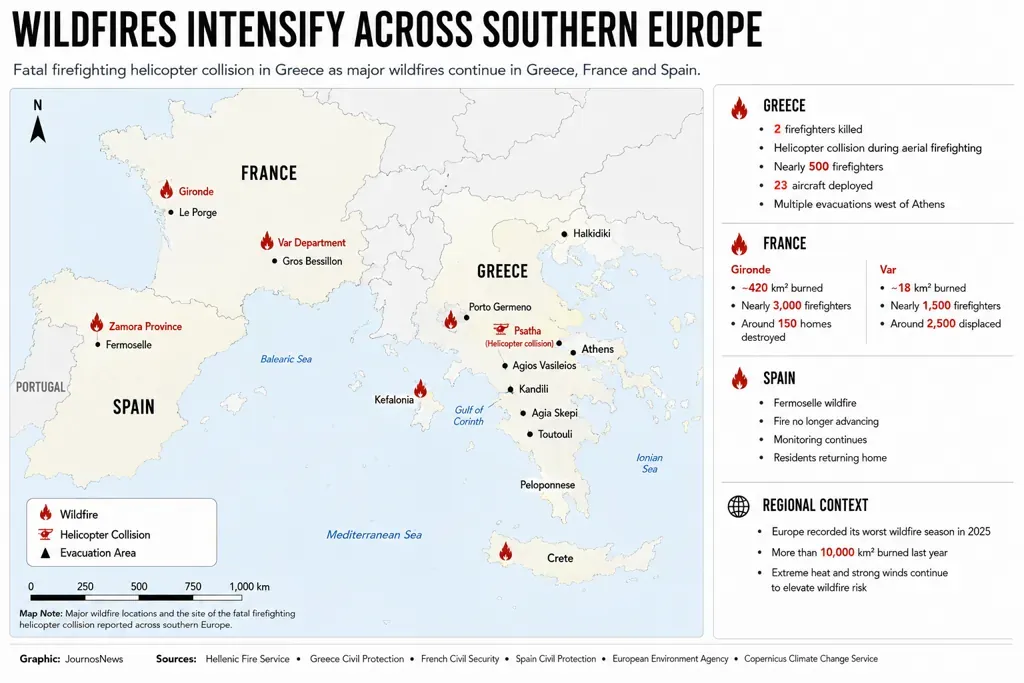
ATHENS, Greece – Two firefighters were killed after two helicopters collided while battling a fast-moving wildfire west of Athens on Sunday, underscoring the growing dangers facing emergency crews as southern Europe confronts another severe wildfire season.
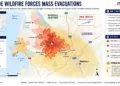
The collision occurred over the Psatha area near Porto Germeno, where powerful winds fueled a wildfire that forced evacuations and complicated aerial firefighting operations.
Greek authorities said one of the helicopters crashed after the collision, killing a Greek firefighting coordinator and a Danish pilot. Two other crew members—a Greek and a British national—survived and were rescued.

Prime Minister Kyriakos Mitsotakis expressed condolences to the victims’ families, describing their deaths as a tragic loss during efforts to contain the wildfire.
Greece Battles Wind-Driven Wildfires
The two Bell helicopters were part of Greece’s aerial firefighting fleet, which includes both domestic and international crews during the summer wildfire season.
Nearly 500 firefighters and 23 aircraft were deployed to battle the blaze. However, gale-force winds repeatedly disrupted operations by preventing some aircraft from collecting seawater for water drops.
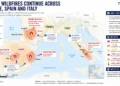
Authorities ordered evacuations in Kandili, Agia Skepi and Toutouli as flames spread through dry forests toward Porto Germeno on the Gulf of Corinth.
The wildfire began Friday near Agios Vasileios before advancing across coastal and mountainous areas west of Athens.
■ Related News

Firefighters evacuated 254 people by sea on Friday and another 12 on Saturday after heavy smoke and advancing flames cut off road access.
Wildfire meteorologist Theodore Giannaros estimated that between 40 and 50 square kilometers (15 to 19 square miles) had burned, although officials have not released a final damage assessment.
Elsewhere in Greece, firefighters also battled wildfires threatening homes on Kefalonia and near Nea Tenedos in Halkidiki. Earlier in the week, three firefighters died while responding to separate fires on Crete and the Peloponnese.
France Continues Large-Scale Firefighting Operations
France continued battling two major wildfires despite making progress in containing its largest blaze.
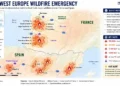
Officials said the Gironde megafire in southwestern France remained within its perimeter after burning about 420 square kilometers (162 square miles) of forest over 10 days.
Nearly 3,000 firefighters remained on the ground extinguishing hotspots while thousands of residents stayed displaced.
Authorities warned that high temperatures and strong afternoon winds could reignite the fire, and the Gironde region remained under France’s highest wildfire alert.
In Le Porge, local officials said about 150 homes had been destroyed. Reinforcements from Ukraine, Lithuania and French Polynesia were expected to join firefighting efforts.
Farther southeast, nearly 1,500 firefighters continued battling the Gros Bessillon wildfire in the Var department after it burned about 18 square kilometers (7 square miles).
Although the fire was no longer advancing, around 2,500 people remained displaced.
Prime Minister Sébastien Lecornu said France’s largest fires were generally under control but warned that conditions remained unstable. He also appointed a national coordinator to oversee reconstruction efforts.
Authorities said more than 1,170 square kilometers (452 square miles) have burned across France this year.
Spain Makes Progress Against Major Fires
Spain reported encouraging progress as its largest wildfires were no longer advancing.
Emergency crews continued monitoring the Fermoselle wildfire in Zamora province near the Portuguese border to prevent flare-ups, while most evacuated residents had returned home.
Prime Minister Pedro Sánchez called for a national agreement to strengthen Spain’s wildfire response, warning that climate change is contributing to increasingly destructive fire seasons.
Europe Faces Growing Wildfire Threat
The fires across southern Europe highlight the increasing scale of the continent’s wildfire challenge.
Europe entered 2026 after experiencing its worst wildfire season on record in 2025, when more than 10,000 square kilometers (3,860 square miles) burned.
According to the European Environment Agency, nearly 800 people have died in wildfires across Europe during the past four decades.
The Copernicus Climate Change Service says Europe has been warming more than twice as fast as the global average since the 1980s.
Scientists from World Weather Attribution also concluded that human-caused climate change made the extreme fire weather behind this year’s French wildfires at least twice as likely.
This report is based on reporting by The Associated Press.