HONG KONG – Oil prices fell Thursday while most Asian stock markets traded lower as investors weighed renewed tensions in the Middle East against growing concerns about technology valuations, particularly among artificial intelligence chipmakers.
The latest military developments added uncertainty to global markets. At the same time, investors continued reassessing whether spending on AI infrastructure can support the sector’s high valuations.
Oil Prices Ease Despite Regional Tensions
Crude prices declined after surging the previous day.

The pullback came even after the United States said it carried out a “heavy wave” of strikes against Iran in response to an attack on a U.S. military base. The renewed fighting increased concerns about global energy supplies, but traders appeared to take profits following Wednesday’s sharp gains.
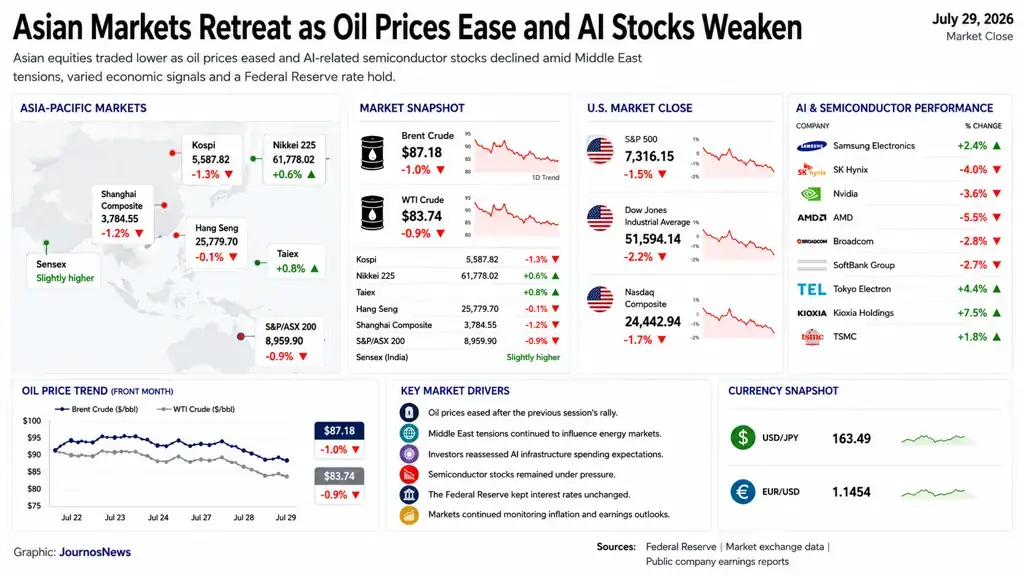
Brent crude, the international benchmark, fell 1% to $87.18 a barrel. U.S. benchmark West Texas Intermediate crude slipped 0.9% to $83.74 a barrel.
Before the conflict began in late February, Brent crude had traded near $72 a barrel.
Investors also continued watching shipping through the Strait of Hormuz, one of the world’s most important oil transit routes. Vessel traffic remained limited following the latest exchange of attacks between Washington and Tehran.
President Donald Trump said the United States would respond “very hard” after Iran targeted a U.S. military base in Jordan.



Asian Markets Deliver Mixed Performance
Most Asian markets finished lower, although losses varied across the region.
South Korea’s Kospi fell 1.3% to 5,587.82. The decline followed a 10.8% drop on Tuesday and another loss of nearly 6% on Wednesday.
Despite the recent sell-off, the benchmark remains about 30% higher for the year. However, it has fallen more than 35% from its record high above 9,000 reached in June.
Japan’s Nikkei 225 outperformed most regional markets, rising 0.6% to 61,778.02.
Taiwan’s Taiex gained 0.8%, supported by strength in Taiwan Semiconductor Manufacturing Co. (TSMC).
Elsewhere, Hong Kong’s Hang Seng Index slipped less than 0.1% to 25,779.70. China’s Shanghai Composite Index fell 1.2% to 3,784.55, while Australia’s S&P/ASX 200 lost 0.9% to 8,959.90. India’s Sensex traded slightly higher.
AI Chip Stocks Face Fresh Pressure
Technology shares remained under pressure as investors questioned whether enthusiasm for AI-related spending has become excessive after months of strong gains.
Samsung Electronics rose 2.4% after reporting record quarterly operating profit that broadly matched analysts’ expectations.
SK Hynix moved in the opposite direction. The memory chipmaker fell 4% after dropping more than 9% a day earlier.
Although SK Hynix reported record quarterly operating profit that increased nearly sixfold, the results missed analysts’ expectations. Investors responded by selling the stock.
Japanese technology shares also delivered mixed results.
SoftBank Group, a major investor in OpenAI, fell 2.7%.
Chip equipment maker Tokyo Electron gained 4.4%, while memory chip producer Kioxia Holdings climbed 7.5%.
TSMC shares advanced 1.8%, helping lift Taiwan’s broader market.
Wall Street Extends Decline
U.S. markets also finished lower on Wednesday as weakness in semiconductor stocks combined with the Federal Reserve’s latest policy decision.
The S&P 500 fell 1.5% to 7,316.15.
The Dow Jones Industrial Average dropped 2.2% to 51,594.14.
The Nasdaq Composite lost 1.7% to 24,442.94.
Among major chipmakers, Nvidia declined 3.6%. Advanced Micro Devices (AMD) lost 5.5%, while Broadcom fell 2.8%.
Investors Await the Fed’s Next Move
The Federal Reserve left interest rates unchanged despite some policymakers supporting additional increases.
Federal Reserve Chair Kevin Warsh said the central bank remains committed to returning inflation to its 2% target while providing limited guidance about future rate decisions.
“Did the Fed take an explicit change in its policy rate today? No, but I think that’s the beginning of the story,” Warsh said after the policy announcement.
Investors are now weighing several risks at once, including inflation, interest-rate expectations, corporate earnings and geopolitical tensions.
Currency Markets
In early Thursday trading, the U.S. dollar rose to 163.49 Japanese yen from 163.41 yen.
The euro slipped to $1.1454 from $1.1467.
This report is based on reporting by The Associated Press.