BANGKOK, Thailand – Asian stock markets mostly advanced Monday as oil prices fell sharply after the United States and Iran refrained from further military action and discussed a possible return to negotiations on an interim ceasefire, easing immediate concerns over disruptions to global energy supplies.
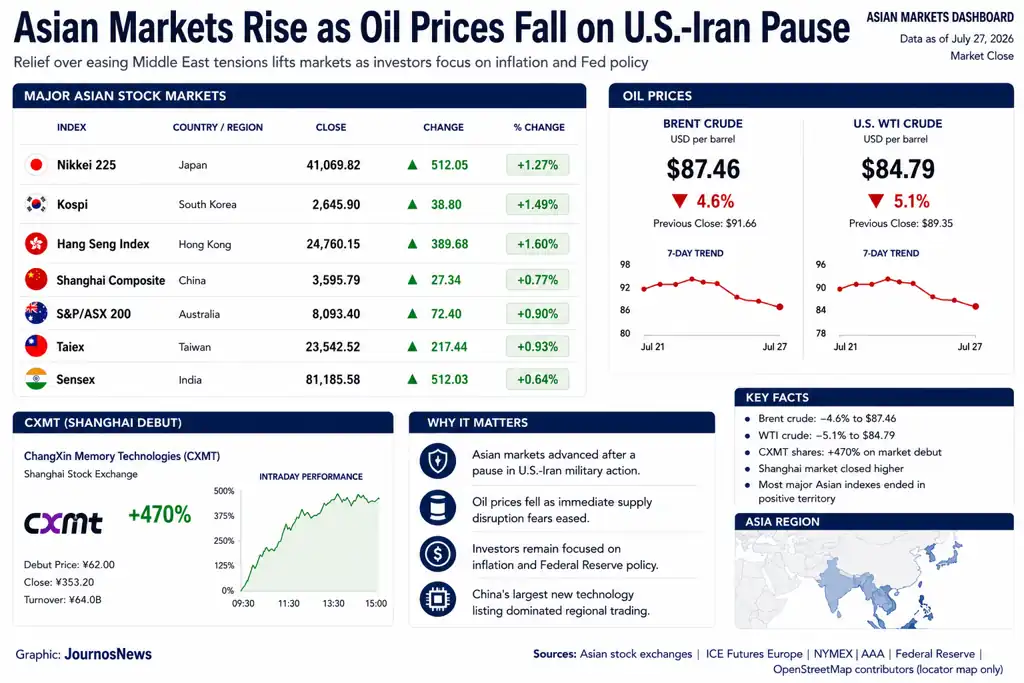
Brent crude, the international oil benchmark, dropped 4.6% to $87.46 per barrel in early trading, while U.S. benchmark crude fell 5.1% to $84.79. The decline followed signs that hostilities between Washington and Tehran had paused after nearly two weeks of escalating conflict linked to attacks on shipping in the Strait of Hormuz.
Chinese Chipmaker Dominates Shanghai Debut
Chinese memory chipmaker CXMT was the standout performer in regional markets, with its shares surging about 470% during their first day of trading on Shanghai’s technology-focused exchange.

The rally lifted the company’s estimated market capitalization to about 3.3 trillion yuan, or nearly $490 billion, making it China’s most valuable publicly listed company.
Regional Markets Post Broad Gains
Lower oil prices helped improve investor sentiment across much of Asia by easing concerns over higher energy costs.
Japan’s Nikkei 225 rose 0.2% to 64,771.02, while South Korea’s Kospi gained 0.3% to 6,708.87.
Hong Kong’s Hang Seng Index climbed 0.8% to 25,164.81, and the Shanghai Composite Index advanced 0.4% to 3,827.96. Australia’s S&P/ASX 200 added 1.3% to 8,883.00.
Elsewhere, Taiwan’s Taiex slipped 0.3%, while India’s Sensex gained 0.7%.
■ Related News



Wall Street Ends Mixed Week
Despite Monday’s gains across much of Asia, Wall Street finished last week with mixed results.
The S&P 500 edged up less than 0.1% to 7,411.98 on Friday but posted its second consecutive weekly decline, its first two-week losing streak since March. The Dow Jones Industrial Average gained 0.5% to 51,947.25, while the Nasdaq Composite fell 0.6% to 24,975.82 as several large technology stocks came under pressure.
Micron Technology dropped 7%, and Broadcom fell 2.7%, weighing on the technology-heavy Nasdaq because of their large market capitalizations.
Inflation and Federal Reserve Outlook Remain in Focus
Investors continue to assess the potential economic impact of higher energy prices and new tariffs announced last week by President Donald Trump’s administration, both of which could add to inflationary pressures.
The Federal Reserve is scheduled to meet this week. According to AP reporting, persistent inflation has reduced expectations for an interest rate cut, while some investors have increasingly considered the possibility of another rate increase if price pressures remain elevated.
Higher fuel costs also continue to affect household budgets. According to AAA, the national average price for a gallon of regular gasoline stood at $4.11, below the highs reached earlier this spring but nearly $1 higher than a year ago.
AI Investment Continues to Face Scrutiny
Corporate earnings season is also keeping investor attention focused on whether heavy spending on artificial intelligence infrastructure can generate returns that justify elevated stock market valuations.
Major technology companies, including Alphabet and Nvidia, have invested billions of dollars to expand AI capacity, while investors increasingly seek evidence that those investments will translate into sustained profit growth.
This report is based on reporting by The Associated Press.