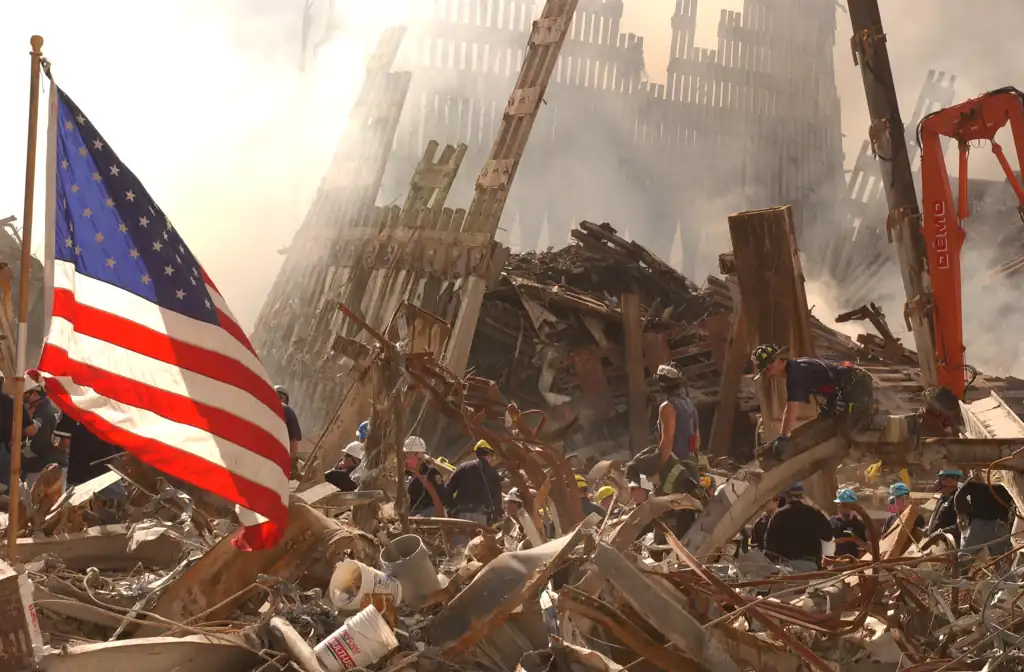
The September 11 attacks transformed how the United States understood national security and helped reshape wars, institutions, immigration, aviation, intelligence and public life. A quarter-century later, their consequences remain visible in American society and in the international system.
September 11, 2001, began as a series of coordinated terrorist attacks and became a dividing line in modern history. Nineteen al-Qaeda hijackers seized four commercial aircraft. Two struck the World Trade Center in New York, one struck the Pentagon, and passengers on the fourth plane fought back before it crashed in Pennsylvania. The attacks killed 2,977 people from 90 nations.
The immediate shock was followed by a transformation that extended far beyond the sites of the attacks. The United States reorganized its national-security institutions, changed aviation security, expanded counterterrorism authorities and went to war in Afghanistan. The broader post-9/11 campaign eventually extended into Iraq and other countries and produced consequences that lasted long after the original attackers were defeated.

The attacks also changed daily life. Airports became security checkpoints of a different kind. Governments gained new surveillance and investigative powers. Immigration and border security became more closely associated with counterterrorism. Muslim Americans and other communities perceived as connected to the Middle East or South Asia experienced new suspicion and discrimination.
Twenty-five years later, the central question is no longer simply what happened on September 11. It is how much of the political, institutional and social world that followed can still be traced to that morning.
The World Before September 11
The attacks did not emerge from an entirely new threat.
The 9/11 Commission’s investigation traced the development of al-Qaeda and its campaign against the United States through the 1990s, including earlier attacks and warnings received by U.S. agencies. Its report examined the evolution of al-Qaeda, the organization’s presence in Afghanistan and the failure of different parts of the U.S. government to combine information effectively enough to prevent the September 11 operation.
The commission’s account is important because it changed the understanding of 9/11 from a single catastrophic surprise into a case study in institutional failure.



Before the attacks, terrorism was primarily treated through a combination of law enforcement, intelligence and limited military responses. The institutions responsible for these areas often operated within separate structures and authorities.
The commission later concluded that the United States had not adequately adapted to the changing nature of the terrorist threat. Its recommendations therefore went beyond preventing another aviation hijacking. They called for greater unity of effort across intelligence, law enforcement, diplomacy, border security, Congress and homeland defense.
The lesson became one of the defining ideas of the post-9/11 era: information was valuable only if the institutions holding it could share and act on it.
September 11 and the Transformation of National Security
The first transformation occurred inside the U.S. government.
The federal response moved quickly from an emergency response to a permanent restructuring of national security. The Homeland Security Act of 2002 created the Department of Homeland Security, consolidating 22 federal departments and agencies into a new Cabinet-level organization.
The change was larger than the creation of another federal department.
Homeland security became a central organizing principle of government. Border controls, emergency preparedness, transportation security, immigration enforcement and protection of critical infrastructure increasingly became connected to the prevention of terrorism.
The 9/11 Commission had specifically called for stronger organization of America’s defenses at home and better coordination across government.
This institutional architecture remains in place 25 years later.
The United States did not simply respond to a single attack. It built a new permanent security system around the possibility of another one.
Airports Became a Visible Symbol of the New Era
Few changes became more familiar to ordinary Americans than aviation security.
The Aviation and Transportation Security Act, enacted in November 2001, established the Transportation Security Administration. Within a year, federal TSA officers were staffing airport security checkpoints, replacing the previous system with a federalized approach.
Over the following decades, aviation security expanded through new screening procedures, technologies and identity-verification systems.
For travelers, the result became routine: identification checks, baggage screening, restrictions on liquids and increasingly sophisticated screening equipment.
These measures are so familiar today that it can be easy to forget how unusual the post-9/11 security environment was when it began.
The broader significance is that 9/11 changed the relationship between citizens and the state in spaces that had previously been treated largely as ordinary transportation environments.
Security became part of everyday travel.
The USA PATRIOT Act and the Expansion of Government Power
Another major transformation occurred in law.
Congress passed the USA PATRIOT Act on October 25, 2001, and President George W. Bush signed it into law on October 26. The legislation expanded investigative and law-enforcement authorities in response to the terrorist threat.
The law reflected the extraordinary political environment immediately after the attacks.
The central argument was that government agencies needed stronger tools to detect terrorist networks, disrupt planned attacks and investigate people suspected of supporting terrorism.
But the expansion of government power also produced a lasting debate over civil liberties.
The question was not simply whether authorities should have more tools. It was where the limits should be placed and how those powers should be supervised.
That debate became one of the defining political consequences of 9/11.
The tension between security and individual rights did not disappear when the immediate danger receded. Instead, it became a continuing feature of American political life.
International institutions subsequently confronted the same problem. The United Nations human-rights system has emphasized that states have a duty to protect people from terrorism while ensuring that counterterrorism measures comply with international human-rights obligations.
Afghanistan: The First War of the Post-9/11 Era
The military response began in Afghanistan.
The United States identified al-Qaeda and its leadership as the central threat behind the attacks and moved against the organization and the Taliban government that had provided it a base.
Congress authorized the use of military force against those responsible for the attacks and those who harbored them on September 18, 2001.
The campaign rapidly removed the Taliban government from power, but the conflict did not end.
What began as a response to the September 11 attacks developed into a two-decade military, political and reconstruction effort.
The United States and its allies spent years attempting to build Afghan security institutions and a functioning state while fighting an insurgency.
The eventual outcome exposed the difficulty of converting military victory over an extremist organization into a durable political settlement.
In 2020, the United States and the Taliban signed the Doha Agreement. The process ultimately led to the withdrawal of U.S. and allied forces in August 2021. The Taliban returned to power, and the U.S. military mission ended on August 31, 2021.
The end of the war created one of the most consequential reassessments of the post-9/11 era.
A military campaign that began in response to an attack on the United States had lasted nearly two decades.
Iraq and the Expansion of the War on Terror
The aftermath of 9/11 also changed U.S. policy toward Iraq, although the Iraq invasion represented a distinct decision from the initial military response to the September 11 attacks.
The 9/11 Commission’s report treats Iraq separately, with a dedicated section examining the Bush administration’s planning for war and the question of Iraq.
The United States invaded Iraq in 2003 after the Bush administration argued that Saddam Hussein’s government posed a serious security threat.
The war dramatically expanded the geographic and political consequences of the post-9/11 era.
It also became one of the most consequential foreign-policy controversies in modern American history.
The Iraq conflict contributed to prolonged instability, large-scale displacement and regional political disruption. It also demonstrated how the political momentum generated by 9/11 could produce military decisions extending far beyond the original battlefield in Afghanistan.
The distinction matters historically.
September 11 created the political environment in which a much broader U.S. war strategy emerged, but the military campaigns in Afghanistan and Iraq had different immediate rationales and different histories.
The Human Cost Extended Far Beyond the Original Victims
The most immediate human cost of 9/11 was measured in the lives lost that morning.
But the consequences continued through the wars, the emergency response and the health effects of exposure at Ground Zero.
The National September 11 Memorial & Museum records 2,977 people killed in the attacks, including victims in New York, at the Pentagon and aboard Flight 93.
The World Trade Center disaster also created a long-term public-health crisis.
According to the CDC’s World Trade Center Health Program, more than 96,000 people have been diagnosed with physical or mental health conditions associated with exposure to the dust, smoke, debris and trauma of the attacks. The program now serves more than 125,000 responders and survivors.
The health consequences include respiratory illnesses, cancers and mental-health conditions.
The scale of the problem changed the meaning of the word “victim.”
The people affected by 9/11 were not limited to those who died on September 11. They included firefighters, police officers, medical workers, cleanup workers, residents, office workers, students and others exposed to the disaster and its aftermath.
Congress eventually established the World Trade Center Health Program through the James Zadroga 9/11 Health and Compensation Act of 2010, later extending its authorization through 2090.
The persistence of the program demonstrates that the physical consequences of the attacks have outlasted the political moment in which they occurred.
The Veterans of the Post-9/11 Wars
The wars also created another long-term population of people living with the consequences of the response to 9/11.
Thousands of U.S. service members served in Afghanistan, Iraq and other post-9/11 operations.
The costs continued after combat operations ended.
The Department of Veterans Affairs expanded health-care eligibility and benefits for veterans exposed to burn pits and other toxic hazards through the PACT Act of 2022. The law added numerous presumptive conditions for veterans of the post-9/11 era.
The issue illustrates another important feature of the post-9/11 period: wars can end militarily while their medical and financial consequences continue for decades.
Brown University’s Costs of War Project estimates that the United States had appropriated or become obligated to spend about $8 trillion on post-9/11 wars through fiscal year 2022, including future obligations for veterans.
That figure is an academic estimate rather than a U.S. government accounting figure, and its methodology differs from official budget measures. It nevertheless illustrates the extraordinary long-term financial scale of the post-9/11 military era.
Muslim Americans and the Domestic Social Legacy
The effects of 9/11 were also felt by Americans who had no connection to the attacks.
Muslim Americans experienced a complicated aftermath.
In the immediate period after September 11, many Americans expressed support for Muslim Americans, even as discrimination and suspicion increased. Pew Research Center’s 2026 review of 25 years of survey data found that anti-Muslim hate crimes reported to the FBI rose sharply in 2001, reaching 481 incidents compared with 28 in 2000. The figure subsequently declined but has fluctuated and never returned to the pre-9/11 level in the data presented by Pew.
The social consequences were not limited to hate crimes.
Muslim Americans reported experiences involving suspicion, discrimination and concerns about how Islam and Muslims were portrayed.
The pattern has persisted in different forms.
Pew’s 2026 research found that 59% of Muslim Americans surveyed said there was a lot of discrimination against Muslims, while 59% said news coverage of Islam and Muslims was unfair.
At the same time, the history is not one of uninterrupted hostility.
Pew’s earlier research found substantial expressions of support for Muslim Americans after the attacks, and the 2026 data show continuing political and civic participation by Muslim Americans.
The legacy is therefore more complicated than either a story of permanent backlash or a story of complete social reconciliation.
The Globalization of Counterterrorism
The United States was not the only country transformed by 9/11.
The attacks accelerated international cooperation against terrorist organizations and helped place counterterrorism at the center of international security policy.
Governments expanded intelligence cooperation, financial monitoring, border controls and legal frameworks aimed at disrupting terrorist networks.
International organizations also developed stronger mechanisms for counterterrorism cooperation.
But the global response produced another enduring question: how far governments should go in the name of security.
The Office of the U.N. High Commissioner for Human Rights has repeatedly emphasized that counterterrorism measures must remain consistent with international human-rights obligations.
That debate became especially important as governments confronted detention, surveillance, interrogation, targeted killings and military operations outside traditional battlefields.
The post-9/11 world therefore changed not only the practice of security but also the legal arguments surrounding security.
The Cost of the Post-9/11 Wars
The scale of the wars that followed is difficult to measure through a single number.
Brown University’s Costs of War Project estimates that post-9/11 wars produced at least 4.5 million to 4.7 million direct and indirect deaths across major war zones when indirect deaths are included in its methodology. It also estimates about 38 million people were displaced by the post-9/11 wars in Afghanistan, Pakistan, Iraq, Syria, Libya, Yemen, Somalia and the Philippines.
These are research estimates, not universally accepted official totals.
Their significance lies in showing the magnitude of the conflict environment that developed after 2001.
The wars affected civilians, soldiers, contractors, journalists and humanitarian workers. They altered national budgets, regional politics and migration patterns.
They also changed how the United States approached military intervention.
The post-9/11 era normalized prolonged counterterrorism operations across multiple countries rather than limiting military action to a conventional war between states.
The End of the War Did Not End the Security Framework
When U.S. forces left Afghanistan in 2021, the formal military mission that had begun after 9/11 finally ended.
But the institutions created during the post-9/11 period did not disappear.
The Department of Homeland Security remained a central federal institution. TSA remained responsible for transportation security. Intelligence and law-enforcement agencies continued counterterrorism operations. The legal framework surrounding terrorism, surveillance and national security continued to evolve.
This is one of the most important distinctions between the immediate event and its historical legacy.
A crisis can end without the institutions created in response to it disappearing.
In the United States, many of the changes introduced after September 11 became permanent parts of government.
9/11 and the Meaning of National Security
Before September 11, national security was often associated primarily with military power, nuclear deterrence and traditional state-to-state conflict.
After September 11, the concept became much broader.
A terrorist network without an army could threaten the United States on its own territory.
Commercial aviation became a potential weapon.
Financial systems became part of counterterrorism investigations.
Internet communications became increasingly important to intelligence operations.
Borders became security infrastructure.
Local police departments became part of a national counterterrorism architecture.
Emergency preparedness became a national-security issue.
The result was a broader understanding of security in which domestic institutions and international policy became more closely connected.
That transformation remains visible today.
The 9/11 Commission and the Institutional Lessons
One of the most enduring attempts to understand the attacks came from the National Commission on Terrorist Attacks Upon the United States.
The independent bipartisan commission was created by Congress in late 2002 and issued its final report on July 22, 2004. Its mandate included examining the circumstances surrounding the attacks, preparedness and the immediate response, while recommending measures to prevent future attacks.
Its findings emphasized failures of imagination, policy, capabilities and management.
The commission’s recommendations included greater unity across government, stronger information sharing and a more integrated approach to homeland defense.
The report became more than a historical record.
It became a blueprint for institutional reform.
Two and a half decades after the attacks, that remains one of the clearest examples of how a national tragedy can reshape government architecture.
What Changed — and What Did Not
The most visible changes after 9/11 were institutional.
The United States created a new Cabinet department, federalized airport security, expanded counterterrorism authorities and entered prolonged wars abroad.
But some of the deepest changes were less visible.
The attacks altered the vocabulary of American politics.
Words such as homeland security, terrorist watchlists, airport screening, intelligence sharing, counterterrorism and national-security threat became part of ordinary political discussion.
The attacks also changed the expectations placed on government.
After 9/11, preventing terrorism became not simply one responsibility among many but a central measure of government competence.
At the same time, the debate over how much security is enough never disappeared.
That tension remains unresolved.
Twenty-Five Years Later
Twenty-five years is long enough for an entire generation to have grown up after September 11.
For millions of Americans, the attacks are a lived memory. For younger Americans, they are increasingly a historical event encountered through photographs, recordings, documentaries, school lessons and memorials.
Yet the institutional consequences remain contemporary.
The Department of Homeland Security still exists.
TSA still controls airport security.
The World Trade Center Health Program continues treating people affected by the attacks.
Veterans continue receiving care for conditions associated with post-9/11 service.
The wars have ended in their original forms, but their political and human consequences continue across Afghanistan, Iraq and other regions.
The debate over civil liberties and national security also remains part of American politics.
In that sense, September 11 did not simply change one period of history.
It created a framework through which much of the following quarter-century was understood.
What Remains Unresolved
The central unresolved question is whether the security architecture created after September 11 achieved the balance its architects intended.
The United States became substantially more organized around preventing terrorist attacks. Government agencies were reorganized, aviation security was transformed, intelligence cooperation expanded and new investigative authorities were created.
But those achievements came with costs.
The post-9/11 wars consumed enormous financial resources and produced extensive human consequences. Civil-liberties debates intensified. Muslim and other minority communities experienced discrimination. Veterans and first responders continue to face health consequences.
There is also an unresolved historical question about proportionality.
The attacks killed thousands of people in a single morning. The response ultimately shaped military and political decisions across multiple countries for two decades.
Determining whether the scale of that response was justified is not simply a question of emotion or hindsight. It requires examining what governments knew at different moments, what alternatives were available and how the consequences of each decision developed.
The historical record remains contested in some areas.
What is not contested is the scale of the transformation.
Conclusion
September 11, 2001, was a terrorist attack that killed 2,977 people and devastated New York, the Pentagon and a field in Pennsylvania.
But its historical significance cannot be contained within that morning.
The attacks changed the organization of the U.S. government, the security of airports, the powers of intelligence and law-enforcement agencies, the conduct of American foreign policy and the lives of communities inside the United States.
They began an era of war that lasted far longer than many Americans initially expected. Afghanistan became America’s longest war. Iraq became a separate and deeply consequential military intervention. The combined post-9/11 campaigns generated costs that continue to be measured in money, lives, displacement and veterans’ health.
The attacks also created a lasting tension between security and liberty.
That tension was not resolved by the creation of new institutions or the withdrawal of troops from Afghanistan. It remains part of the democratic debate over how governments should respond to terrorism and how much power they should possess to prevent another attack.
Twenty-five years later, the most important legacy of September 11 may therefore be less about one day than about the decisions that followed it.
The World Trade Center site became a memorial. The victims became names read aloud each year. The responders became patients in a health program that will continue for decades. The wars became part of a generation’s military history. The security institutions created after the attacks became permanent features of government.
The attacks ended on September 11.
Their consequences did not.
Reporting Credit: National Commission on Terrorist Attacks Upon the United States, for the official 9/11 Commission Report and findings on the attacks, preparedness, intelligence and government response; U.S. Government Publishing Office and GovInfo, for the USA PATRIOT Act and official presidential and legislative records; U.S. Department of Homeland Security, for the creation and development of the post-9/11 homeland-security system; Transportation Security Administration, for the transformation of federal aviation security; National Institute of Standards and Technology, for the official World Trade Center building and fire investigation; CDC/NIOSH World Trade Center Health Program, for long-term health effects and treatment of responders and survivors; National September 11 Memorial & Museum, for victim and memorial records; U.S. Department of State, for the Afghanistan withdrawal record; U.S. Department of Veterans Affairs, for post-9/11 veteran toxic-exposure policy; Pew Research Center, for longitudinal research on Muslim Americans and the social legacy of 9/11; Brown University’s Costs of War Project, for independent academic estimates of the financial and human costs of post-9/11 wars.