Journos News - Breaking News, World News, Top Stories, Todays Headlines and Flash Reports
Tuesday, September 1, 2026
  • Login
  • Home
  • World
    • Africa
    • Americas
    • Asia
    • Europe
    • Middle East
    • Oceania
  • Politics
  • Business
  • Technology
  • Health
  • Science
  • Sports
  • Entertainment
  • Culture
No Result
View All Result
  • Home
  • World
    • Africa
    • Americas
    • Asia
    • Europe
    • Middle East
    • Oceania
  • Politics
  • Business
  • Technology
  • Health
  • Science
  • Sports
  • Entertainment
  • Culture
No Result
View All Result
Journos News - Breaking News, World News, Top Stories, Todays Headlines and Flash Reports
No Result
View All Result
Home Business

U.S. Gasoline Tops $4 as Middle East Supply Shock Rekindles Inflation Risks

Rising fuel and diesel costs threaten transport margins, consumer spending, and price stability.

The Daily Desk by The Daily Desk
May 12, 2026
in Business, Industry
0
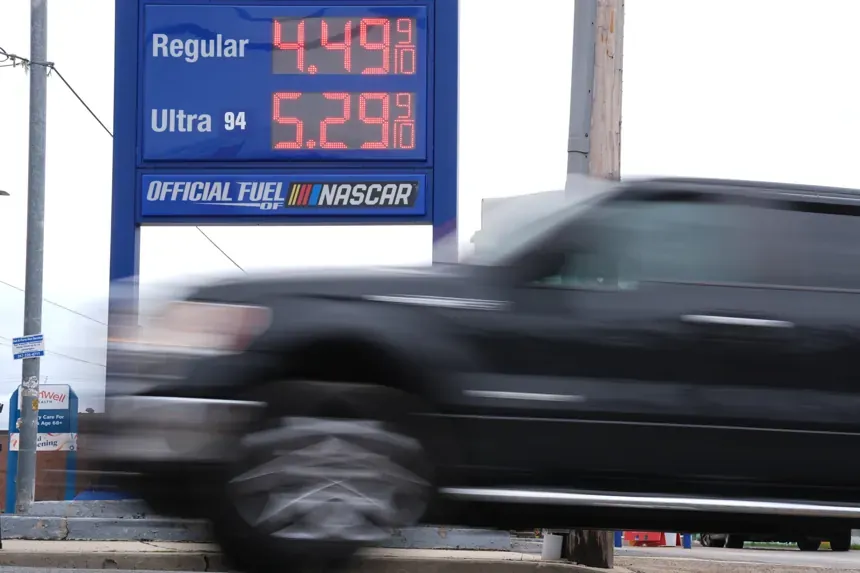
U.S. gas station sign showing prices above four dollars- AP Photo/Matt Rourke

Fuel prices rise nationwide as crude supply disruptions intensify.- AP Photo/Matt Rourke

U.S. gasoline prices climbed above $4 per gallon on Tuesday for the first time since 2022, as the Iran conflict and disruptions around the Strait of Hormuz tightened global crude supplies and pushed transport costs higher. AAA data showed the national average for regular gasoline at $4.02, while diesel rose to roughly $5.45, intensifying concerns about second-round inflation effects across logistics, groceries, and consumer goods. The move matters beyond energy markets because fuel remains a key pass-through cost for freight-heavy sectors and household budgets.

Market and inflation impact

The dominant business angle is the macro and inflationary impact of higher fuel costs. With gasoline now more than $1 per gallon above pre-conflict levels, economists are increasingly focused on how transport-intensive categories such as food distribution, parcel delivery, and utilities may feed into broader consumer price indices over the coming weeks.

Diesel’s sharper rise is especially significant for the corporate sector because it directly affects trucking fleets, warehousing operators, and last-mile delivery networks. Analysts tracking consumer staples note that grocery chains and food distributors typically pass through higher freight expenses faster than other sectors because replenishment cycles are short and inventory turns are frequent.

Supply disruption and energy market mechanics

The current price escalation reflects the closure and disruption of shipping flows through the Strait of Hormuz, a corridor that normally handles around one-fifth of global oil transit. Crude prices have moved above $100 per barrel, increasing feedstock costs for U.S. refiners even though the United States remains a net oil exporter.

A structural refinery mismatch continues to amplify the domestic impact. Much of U.S. production is light, sweet crude, while several coastal refineries are optimized for heavier imported grades, meaning international disruptions still transmit quickly into pump prices and downstream industrial costs. This leaves U.S. fuel markets exposed to geopolitical risk despite high domestic production.

Policy response and strategic reserves

In response, the International Energy Agency said member nations would release 400 million barrels from emergency reserves, an unusually large coordinated intervention aimed at stabilizing benchmark crude and calming wholesale fuel markets. The White House has also temporarily eased certain maritime transport rules and loosened selected sanctions to increase crude availability.

However, the economic relief may not be immediate. Refiners and wholesalers often work through previously purchased crude inventories, delaying any decline in retail gasoline and diesel prices. That lag raises the probability that April inflation data could capture part of the current fuel shock even if oil prices retreat in coming sessions.

Corporate and sector outlook

For businesses, the near-term risk is margin compression rather than outright demand destruction. Retailers, airlines, trucking groups, and e-commerce logistics operators face renewed cost pressure just as many were rebuilding margins after the 2024–2025 inflation cycle. Energy-intensive manufacturers may also face higher input and distribution costs if crude volatility persists.

■ Related News
Asian stock markets rise as oil prices fall, with market indexes, crude prices, Nvidia shares and key investor risks highlighted. - Journos News, File

Asian Shares Rise as Lower Oil Prices and AI Optimism Support Markets

August 26, 2026
Iranian fuel tankers arrive in Lebanon as Hezbollah-linked fuel shipments enter the country amid a severe energy crisis.

Iran’s Fuel Lines Grow as U.S. Sanctions Deepen Economic Pressure

August 26, 2026
Strait of Hormuz connecting the Gulf of Oman and Persian Gulf, photographed from the International Space Station.

LIVE: Middle East Conflict — Ongoing Coverage

August 12, 2026
Map showing reported Houthi attack near Bab el-Mandeb and U.S. maritime operations across the Gulf of Oman and Strait of Hormuz

Houthi Attack Kills Six as U.S. Forces Strike Ship Near Iranian Blockade

August 12, 2026

The broader market implication is that sustained fuel inflation could complicate central bank efforts to anchor inflation expectations, particularly if freight and food categories begin reflecting higher diesel costs. Industry figures suggest the next several weeks will depend heavily on whether shipping activity resumes through the Gulf and whether emergency stockpile releases are sufficient to narrow crude spreads.

Tags: #CrudeOil#DieselCosts#EnergyMarkets#FreightSector#GlobalMarkets#InflationRisk#JournosNews#OilMarkets#RetailMargins#StraitOfHormuz#TradeAndEconomy#USGasPrices
The Daily Desk

The Daily Desk

The Daily Desk is a contributor at JournosNews.com covering politics, media, governance, and the evolving dynamics of public discourse. Stories published under this byline are produced in accordance with JournosNews' editorial standards, with an emphasis on verified reporting, accuracy, context, and impartiality.

Related Posts

USCGC Aquidneck transits the Strait of Hormuz during U.S. naval operations on December 2, 2020.

LIVE: Middle East Conflict — Ongoing Coverage

August 11, 2026
New York Stock Exchange building on Wall Street in Lower Manhattan, New York City.

U.S. Stocks Retreat From Records as 5% Oil Surge Revives Inflation Concerns

August 11, 2026
Houthi supporters protest against Saudi-led coalition airstrikes in Sana’a, Yemen, in September 2015.

Houthi Attacks Raise Risk of Wider Conflict and Red Sea Shipping Disruption

August 9, 2026
Saudi Crown Prince, Turkish President and Pakistani Prime Minister attend the signing of a joint defense agreement in Makkah.

Turkey, Pakistan and Saudi Arabia Sign Mutual Defense Pact as Regional Security Tensions Rise

August 8, 2026
Editorial map showing the Strait of Hormuz, Iran and Oman, with shipping routes and key locations amid Iran-Oman ceasefire diplomacy.

Iran Ceasefire Talks Put the Strait of Hormuz at the Center of a Fragile Middle East De-Escalation

August 8, 2026
U.S. Navy sailors aboard USS William P. Lawrence prepare to provide rescue assistance to a burning vessel while transiting the Strait of Hormuz.

Iran Signals Progress on Strait of Hormuz Agreement as Middle East Tensions Persist

August 7, 2026
A U.S. Navy sailor stands watch aboard a military vessel while transiting the Strait of Hormuz, monitoring nearby maritime traffic.

Iran Nears Strait of Hormuz Agreement as Israel Reports First Troop Deaths Since Lebanon Ceasefire

August 6, 2026
U.S. President Donald Trump chairs a Cabinet meeting with administration officials in the Cabinet Room at the White House on Jan. 29, 2026.

Trump Says Strait of Hormuz Reopening Deal Could Come Within Days as Negotiations Advance

August 5, 2026
Load More
Next Post
Traders watch Wall Street indexes rebound as oil prices ease - AP Photo/Seth Wenig

Wall Street Rebounds as Oil Rally Pauses, Easing Pressure on Inflation Trade

Gulf leaders press US for deeper military action against Iran- AP Photo/Jose Luis Magana

Gulf Pressure Campaign Intensifies as Trump Weighs Deeper War Against Iran

JournosNews logo

Journos News delivers globally neutral, fact-based journalism that meets international media standards — clear, credible, and made for a connected world.

  • Categories
  • World News
  • Politics
  • Business & Markets
  • Technology
  • Health
  • Science
  • Sports
  • Arts & Culture
  • Resources
  • Editorial Standards
  • Submit a Story
  • Advertise with Us
  • Syndication & Partnerships
  • Site Map
  • Press & Media Kit
  • Editorial Team
  • Careers

Join thousands of readers receiving the latest updates, tips, and exclusive insights straight to their inbox. Never miss an important story again.

  • About Us
  • Editorial & Trust Center
  • Contact Us
  • Privacy Policy
  • Terms of Use & Copyright Notice

© JournosNews.com All rights reserved.

Welcome Back!

Login to your account below

Forgotten Password?

Retrieve your password

Please enter your username or email address to reset your password.

Log In
JournosNews

Independent Journalism.
Verified Facts.

You're about to read a professionally edited article from JournosNews.com.

Every article is produced in accordance with our editorial standards, emphasizing factual accuracy, transparent attribution, fairness, editorial independence, and meaningful context.

Editorial Standards
No Result
View All Result
  • Home
  • World
    • Africa
    • Americas
    • Asia
    • Europe
    • Middle East
    • Oceania
  • Politics
  • Business
  • Technology
  • Health
  • Science
  • Sports
  • Entertainment
  • Culture

© JournosNews.com All rights reserved.

This website uses cookies. By continuing to use this website you are giving consent to cookies being used. Visit our Privacy and Cookie Policy.