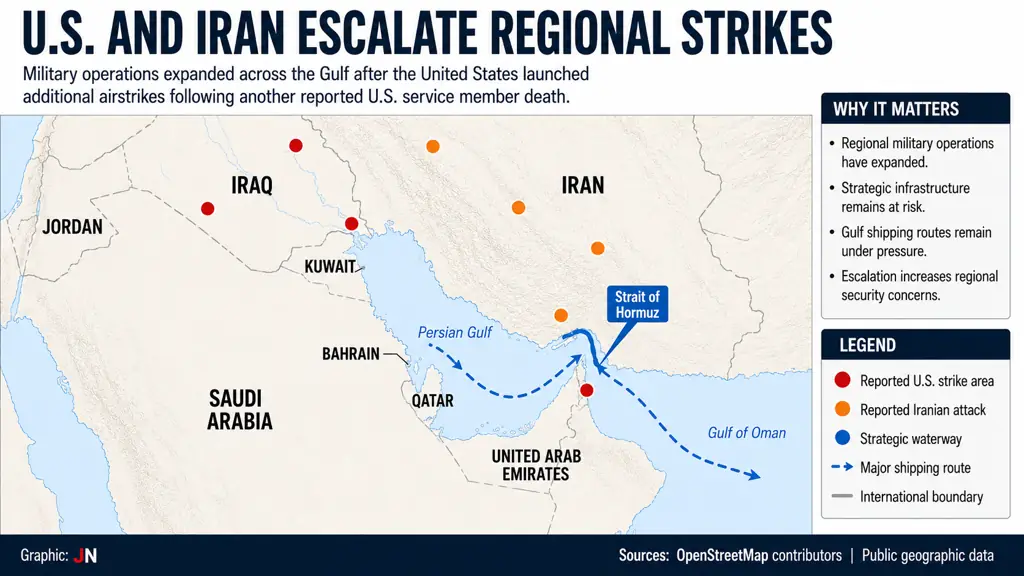
DUBAI, United Arab Emirates — The United States launched another wave of airstrikes against Iran early Monday, while Iran fired missiles toward Jordan, marking another sharp escalation in a conflict that is increasingly drawing neighboring countries into the fighting.
The latest exchange followed the U.S. announcement that another American service member had died in Iraq during the controlled detonation of a downed Iranian drone, bringing U.S. military fatalities higher as hostilities entered a second week.
Renewed fighting has further disrupted shipping through the Strait of Hormuz, fueled concerns of a broader regional war and pushed global oil prices above $90 a barrel.

US launches ninth consecutive night of strikes
The U.S. military said the latest operation targeted facilities belonging to Iran’s paramilitary Revolutionary Guard, including sites it says support attacks on commercial shipping and civilian vessels operating in the Strait of Hormuz.
U.S. Central Command described the mission as its ninth consecutive night of strikes against Iranian targets.
“The strikes will continue degrading Iranian military capabilities used to attack commercial vessels and civilian mariners transiting the Strait of Hormuz,” the command said.
Officials said the campaign also responds to recent attacks that have killed American personnel in the region.
Earlier Monday, the Pentagon confirmed another U.S. service member died in Iraq while helping dispose of a downed Iranian drone. One service member remains missing, while forensic specialists continue examining unidentified human remains recovered Sunday.
According to the military, 17 American service members have been killed since the conflict began.
■ Related News
Iran expands missile attacks
Iran responded by launching missiles toward Jordan, prompting Bahrain, Jordan and Kuwait to activate air-defense systems against incoming drones and missiles.
Jordan’s military said it intercepted several missiles before they reached populated areas and reported no casualties or damage. The government later summoned Iran’s chargé d’affaires to protest the launches.
Israeli officials also warned that missiles aimed toward Jordan’s port city of Aqaba risked crossing into Israeli airspace.
Authorities in the southern Israeli city of Eilat said interceptor missiles were launched to prevent falling debris from reaching residential neighborhoods.
Meanwhile, the U.S. Embassy in Bahrain issued a security alert warning that Iran could target unspecified locations in central Manama, although officials provided no further details.
Military strikes hit strategic sites
Video released by the U.S. military appeared to show fighter aircraft and Tomahawk cruise missiles striking multiple targets across Iran.
One attack appeared to hit a mountainous area believed to contain Revolutionary Guard missile facilities.
Iran’s Atomic Energy Organization also said U.S. forces struck the construction site of the planned Darkhovin nuclear power plant in southwestern Iran.
Satellite imagery reviewed by Planet Labs showed only limited construction activity at the site as of July 9.
The International Atomic Energy Agency said Darkhovin remained in the early stages of development and contained no nuclear material during its most recent inspection.
Critical infrastructure comes under pressure
Kuwait said one of its power generation and water desalination plants came under attack for the second consecutive day, causing fires that emergency crews later extinguished.
Officials said electricity supplies remained stable despite the damage.
Because desalination provides about 90% of Kuwait’s drinking water, any prolonged disruption could quickly affect essential services.
Gulf Cooperation Council Secretary-General Jasem Mohamed al-Budaiwi condemned attacks on civilian infrastructure and accused Iran of committing war crimes.
International humanitarian law generally prohibits attacks on civilian infrastructure unless it is being used for military purposes. Even then, military operations must remain proportionate and seek to minimize civilian harm.
Strait of Hormuz remains at center of conflict
Control of the Strait of Hormuz continues to drive the military confrontation.
Before fighting erupted, roughly one-fifth of globally traded oil passed through the narrow waterway.
President Donald Trump has repeatedly threatened to strike Iran’s transportation and energy infrastructure in an effort to weaken Tehran’s influence over the strait. Recent attacks on bridges and power facilities suggest that strategy is expanding.
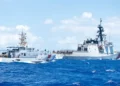
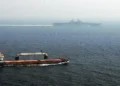
The U.S. military also confirmed that it has restored its naval blockade of Iranian ports, saying six commercial vessels had been redirected and one disabled during the past week.
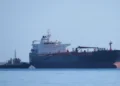
Separately, a ship caught fire Monday in the Strait of Hormuz near Oman’s coastline.
Britain’s maritime security agency said investigators had not yet determined the cause.
Later, Iran’s Revolutionary Guard claimed responsibility for targeting tankers operating in the area.
Humanitarian and economic costs continue to grow
Iranian authorities said the latest U.S. strikes killed at least 50 people and wounded 517 others, although those figures could not be independently verified.
Beyond the battlefield, the conflict continues to ripple through the global economy.
Higher fuel prices and shipping disruptions have increased transportation and supply-chain costs worldwide, placing additional pressure on countries already struggling with inflation and rising food prices.
The 60-day interim agreement designed to create space for negotiations over Iran’s nuclear program has now passed its halfway point.
With military operations intensifying instead of slowing, hopes for a diplomatic breakthrough continue to diminish, leaving one of the world’s most important energy corridors at the center of an increasingly volatile regional conflict.
This report is based on reporting by The Associated Press.
Article Topics: Iran | United States | Middle East Conflict | Airstrikes | Strait of Hormuz | Regional Security | Global Oil Prices