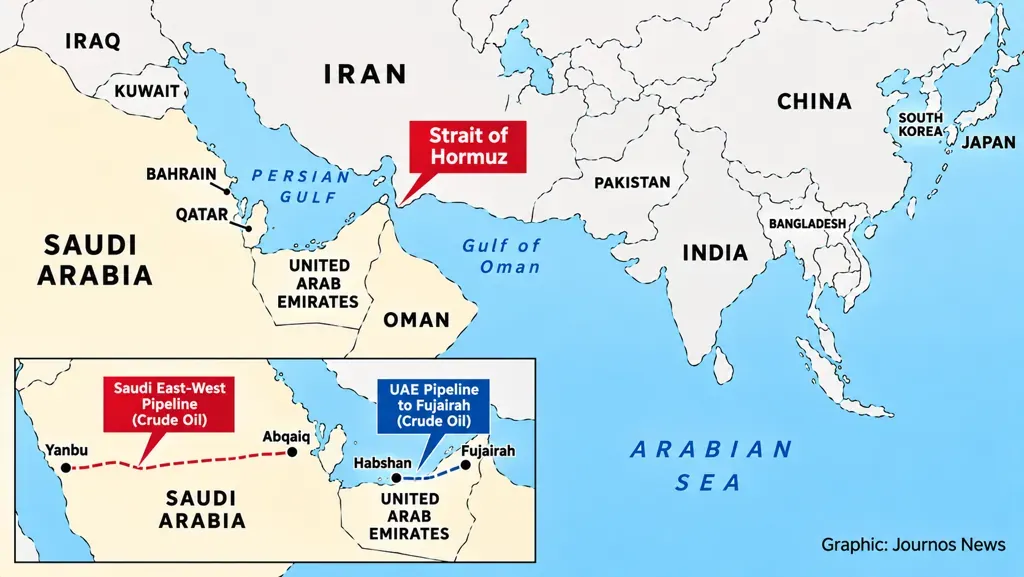
The disruption of shipping through the Strait of Hormuz has developed into a global energy crisis, with consequences extending well beyond crude oil markets. Asia faces particularly significant risks because of its dependence on Gulf energy supplies, exposing households, manufacturers, power systems and governments to a prolonged period of uncertainty.
Introduction
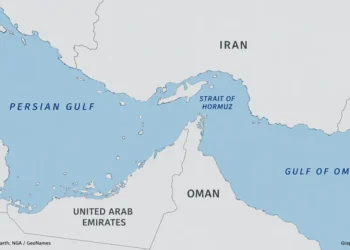
The Strait of Hormuz is a narrow maritime passage between Iran and the Arabian Peninsula, connecting the Persian Gulf with the Gulf of Oman and the wider Indian Ocean. Despite its limited geographical size, it occupies an essential position in the global energy system, serving as the principal export route for oil and liquefied natural gas (LNG) produced across much of the Gulf.

For Asia, the waterway is more than an international shipping route. It is a critical connection between major energy-producing economies in the Middle East and some of the world’s largest industrial and consumer markets. China, India, Japan and South Korea are among the principal destinations for oil transported through the strait, while several South and Southeast Asian countries depend on Gulf LNG to support electricity generation and industrial activity.
The scale of that exposure has become increasingly apparent during the 2026 Middle East conflict. The International Energy Agency (IEA), in its World Energy Outlook 2026, describes the disruption as the largest energy supply shock the world has faced. Its November assessment records cumulative losses of 2.8 billion barrels of oil and 60 billion cubic metres of natural gas from Gulf supplies, with the crisis still unresolved.
The consequences extend beyond the immediate availability of petroleum. Higher fuel costs, restricted supplies of industrial feedstocks, pressure on electricity generation, expensive transportation and disruptions to fertilizer markets are connecting the Gulf crisis to economic conditions across Asia.
The central problem is therefore not simply how much oil can reach Asian refineries. It is how deeply the region’s economic development, industrial production and household energy consumption remain connected to a vulnerable international supply route.
Why the Strait of Hormuz matters to the global economy
The Strait of Hormuz is approximately 39 kilometres wide at its narrowest point. Its navigable shipping channels are considerably narrower, concentrating large volumes of international energy trade within a relatively restricted maritime corridor.
■ Related News


Before the current crisis, approximately 20 million barrels of crude oil and petroleum products passed through the strait each day in 2025. This represented around one-quarter of global seaborne oil trade, according to the IEA’s February 2026 factsheet.
Approximately 80% of those oil shipments were destined for Asian markets. China and India together received 44% of crude oil exports passing through the waterway in 2025. Japan and South Korea were also particularly dependent on these supplies.
The significance of Hormuz extends beyond crude oil.
The waterway also carries substantial volumes of LNG from Qatar and the United Arab Emirates. In 2025, more than 112 billion cubic metres of LNG passed through the strait, representing almost 20% of global LNG trade.
Approximately 90% of these LNG shipments went to Asian destinations. The supplies transported through Hormuz accounted for around 27% of Asia’s total LNG imports, compared with approximately 7% of Europe’s LNG inflows.
These figures reveal two separate vulnerabilities. Asian economies depend on the strait for petroleum used in transportation and industrial production, while several countries also rely on it for natural gas used to generate electricity and operate manufacturing facilities.
When shipping through the passage becomes restricted, the consequences therefore reach multiple parts of the energy system simultaneously.
The disruption also affects the ability of Gulf producers to deliver exports to international markets. Saudi Arabia and the UAE possess pipelines that can redirect some crude oil away from Hormuz, but the available alternative capacity is limited.
The IEA estimates that approximately 3.5 million to 5.5 million barrels per day of crude oil could potentially be redirected through alternative routes. This is substantially below the approximately 20 million barrels of daily oil flows that normally passed through the strait before the crisis.
Furthermore, these alternatives primarily address crude oil transportation. They cannot provide an equivalent replacement route for the LNG exports from Qatar and the UAE that normally pass through Hormuz.
The geographical concentration of these energy exports makes the disruption difficult to overcome through transportation adjustments alone.
Asia’s dependence creates uneven exposure
Asia is particularly vulnerable because of its position as a major energy-importing and manufacturing region. However, the consequences are not distributed equally among countries.
The level of exposure depends on several factors, including the origin of imported fuels, the composition of electricity generation, the availability of domestic energy resources, strategic reserves, alternative suppliers and the financial capacity to absorb higher import costs.
Japan and South Korea face significant exposure through their dependence on imported energy. Both economies have extensive industrial sectors requiring stable supplies of petroleum, natural gas and other energy products.
The Bank for International Settlements’ Annual Economic Report 2026 identifies the disproportionate exposure of Asian economies to the Hormuz disruption. Before the conflict, Japanese refiners sourced approximately 95% of their crude oil from Gulf states, with around 70% shipped through Hormuz. Malaysia, South Korea and Thailand also imported between 60% and 70% of their oil from the Gulf.
These dependencies create risks extending beyond the immediate supply of crude oil. Refineries, chemical manufacturers and other industrial facilities require particular grades of petroleum and specific intermediate products. Replacing one supplier with another may require adjustments to procurement, transportation and refining operations.
Although it is the world’s largest crude oil importer and receives substantial supplies from the Gulf, its accumulated inventories and ability to adjust imports provide additional flexibility. The IEA’s assessment of the crisis identifies China’s substantial pre-existing oil stocks as an important buffer.
This does not eliminate China’s exposure. Its industrial economy remains dependent on reliable supplies of petroleum, natural gas and petrochemical inputs. However, its inventory position and wider supplier network give it options that are not equally available to every importing economy.
South Asia faces particularly serious risks from disruptions to LNG.
Bangladesh, India and Pakistan imported almost two-thirds of their LNG supplies through Hormuz in 2025. The consequences are especially significant for Bangladesh and Pakistan, where natural gas represented approximately 50% and 25% of electricity generation, respectively, in 2024.
A shortage of imported gas can therefore affect more than the energy sector. It can constrain electricity production and place additional pressure on industries that use natural gas as a primary production input, including fertilizer manufacturing.
The exposure of these economies illustrates why the crisis cannot be understood through crude oil prices alone. For some countries, access to LNG is directly connected to the reliability of electricity supply and the operation of essential industries.
Southeast Asia faces a structural energy security problem
Southeast Asia is among the regions where the Hormuz crisis has exposed deeper weaknesses in energy security.
The region’s economic expansion has increased demand for transportation, electricity, industrial production and household energy. However, domestic production has not kept pace with consumption in several countries, increasing dependence on imported fossil fuels.
The IEA’s Southeast Asia Energy Outlook 2026 identifies the scale of this exposure. Before the crisis, approximately 60% of Southeast Asia’s crude oil imports and one-third of its gas imports came from the Middle East.
The report also estimates that around 45% of the region’s oil product supply was connected to Middle Eastern crude when refinery feedstocks and indirect product trade were included.
This last figure is particularly important.
A country does not necessarily need to purchase petroleum directly from a Gulf producer to remain exposed to disruptions originating there. Refineries throughout Asia operate within an interconnected international market. When their traditional sources of crude become unavailable or more expensive, alternative buyers compete for supplies from other producing regions.
Consequently, a disruption in the Gulf can affect the cost and availability of petroleum products even when those products are sourced from outside the Middle East.
Governments across Southeast Asia have introduced emergency measures to reduce consumption and protect households and businesses.
The IEA documented several responses as of May 7, 2026. These included teleworking arrangements, reduced travel, fuel conservation, tax relief, subsidies, price controls and efforts to diversify supply.
The Philippines introduced measures including teleworking, a four-day workweek, restrictions on energy consumption, fuel subsidies and supply diversification. Indonesia promoted public transportation and carpooling while pursuing supply diversification and biofuel measures. Thailand introduced fuel price controls, conservation measures and restrictions affecting fuel exports.
These interventions can help manage immediate pressure, but they do not resolve the structural problem.
Subsidies transfer part of the additional energy cost from consumers to government budgets. Tax reductions can temporarily lower fuel prices but also reduce public revenue. Demand restrictions can conserve available supplies, although they may affect productivity and commercial activity.
The region therefore faces a difficult balance between protecting households from immediate price increases and maintaining the financial resources required for longer-term energy investment.
The crisis reaches beyond oil and electricity
One of the most consequential aspects of the Hormuz disruption is the way it affects industries that are not normally associated with energy security.
Petroleum and natural gas are essential inputs for a broad range of industrial processes. They support the production of plastics, chemicals, synthetic materials, fertilizers and other goods used throughout modern manufacturing.
The Middle East is also an important supplier of liquefied petroleum gas (LPG), which is used for cooking, as well as petrochemical feedstocks required by industrial facilities.
The IEA’s assessment of the 2026 crisis identifies shortages of petrochemical feedstocks and LPG among the most immediate consequences for consumers and industrial markets. The disruption has also affected fertilizer, aluminium, sulphur and helium supplies, demonstrating how the effects extend into sectors that depend on Gulf exports for essential raw materials.
Fertilizer production is particularly important because natural gas is a major feedstock for ammonia manufacturing, an essential component of many nitrogen fertilizers.
When gas supplies become restricted or more expensive, fertilizer producers face higher operating costs. Some facilities may reduce production, while manufacturers dependent on imported products must compete for supplies in a tighter international market.
The Asian Development Bank (ADB) identifies fertilizer prices as an important transmission channel between the Middle East conflict and food security in developing Asia.
South Asian economies are particularly exposed because several depend heavily on fertilizer imports from the Middle East. Higher prices ahead of planting seasons can increase agricultural production costs and discourage fertilizer use, potentially affecting crop yields and food prices.
This creates a longer chain of economic consequences.
An energy disruption can increase fertilizer production costs, which can raise agricultural expenses and eventually place pressure on food affordability. The impact may emerge gradually rather than immediately, making it difficult for governments to assess the full consequences during the early stages of a crisis.
For lower-income households, the combination of higher transportation costs, more expensive electricity and rising food prices can become particularly difficult to manage.
The disruption also affects aviation and maritime transportation.
Higher prices for jet fuel increase airline operating expenses, while more expensive bunker fuel raises the cost of international shipping. These pressures can affect passenger travel, cargo transportation and the movement of goods between Asian markets and their trading partners.
The ADB identifies disruptions to aviation connectivity and higher jet fuel prices as risks to tourism-dependent economies, including the Maldives, Sri Lanka and Thailand.
The wider implication is that the Hormuz crisis is not confined to the energy industry. It can influence the cost of producing, transporting and distributing goods throughout the regional economy.
Why global energy markets cannot easily replace Gulf supplies
The international oil market is interconnected, allowing importing countries to purchase crude from different producing regions when traditional suppliers become unavailable.
However, diversification does not necessarily mean immediate replacement.
The availability of alternative crude oil depends on production capacity, export infrastructure, shipping availability, refinery requirements and competition from other buyers.
The IEA identifies several mechanisms that have helped cushion the 2026 disruption, including emergency stock releases, alternative export routes, increased supplies from outside the Gulf and adjustments by refineries.
In March 2026, IEA member countries agreed to release 400 million barrels from emergency oil reserves, the largest coordinated stock release in the agency’s history.
The measure helped bring additional supplies into the market during the initial stages of the disruption. However, emergency reserves are intended to provide temporary protection against supply emergencies rather than replace normal international production and transportation.
Alternative Gulf export routes have also helped preserve some supplies.
Saudi Arabia can transport crude through its East-West pipeline towards the Red Sea, while the UAE operates a pipeline connecting its onshore oil facilities to Fujairah on the Gulf of Oman.
These routes reduce dependence on Hormuz for some exports, but they cannot accommodate the entire volume of oil normally transported through the waterway.
Natural gas presents an even greater challenge.
Unlike crude oil, which can be transported through several established pipelines and tanker routes, LNG requires specialized liquefaction facilities, storage infrastructure and purpose-built vessels.
The IEA notes that there are no alternative export routes capable of bringing Qatar’s and the UAE’s LNG supplies to international markets outside their existing LNG infrastructure. Other LNG export facilities are also operating close to their production capacity, limiting the ability to replace lost volumes quickly.
This is why competition for available LNG cargoes can intensify during a supply disruption.
Asian importers seeking additional shipments must compete with buyers in Europe and other regions. The result can be higher prices even in countries that do not directly depend on Gulf LNG.
The problem is therefore both physical and financial. A country may be able to secure alternative supplies, but the additional cost can still weaken its economy.
A prolonged disruption to Gulf energy supplies is testing Asia’s fuel security, economic resilience and industrial supply chains.
Energy is a fundamental input into almost every major economic activity.
When oil, gas and transportation costs rise, the effects can spread through manufacturing, agriculture, logistics, construction and consumer markets.
For energy-importing countries, higher international prices also increase the amount of foreign currency required to purchase essential supplies.
This can place pressure on national trade balances and currencies, particularly where governments and businesses already face substantial external financing requirements.
The ADB identifies five major channels through which the Middle East conflict affects Asia and the Pacific: energy, food security, financial conditions, remittances and tourism.
Higher fuel import costs can contribute to inflation and weaken external balances. Investors may become more cautious about economies facing increased import bills, while demand for US dollar-denominated assets can place additional pressure on regional currencies.
At the same time, central banks face difficult decisions. Higher energy costs can push inflation upward even when domestic economic activity is slowing, complicating decisions about interest rates and monetary policy.
Government spending is another important consideration.
Fuel subsidies and electricity support programmes can protect consumers from sudden price increases. However, maintaining these measures over an extended period can create significant fiscal pressure.
The ADB’s September 2026 economic outlook projected growth of 5.0% for developing Asia and the Pacific in 2026, compared with 5.5% in 2025. Its regional inflation forecast stood at 4.2% for 2026.
The bank also cautioned that broad subsidies used to stabilize prices can carry substantial fiscal costs.
These regional figures do not mean every Asian economy is experiencing the same economic damage. The effects depend on national energy structures, financial conditions, government policies and the ability of businesses to absorb additional costs.
Nevertheless, they demonstrate how an energy disruption can become a broader macroeconomic challenge.
The consequences can be especially serious for developing economies with limited fiscal resources and substantial dependence on imported fuel.
The human cost of energy insecurity
The economic consequences of the crisis ultimately reach households.
Fuel prices influence the cost of commuting, public transportation, food distribution and commercial services. Electricity costs affect household budgets and the operating expenses of businesses providing essential goods and services.
For families with limited disposable income, increases in basic expenses can require difficult adjustments to household spending.
The effects can be more pronounced in countries where public transportation is heavily dependent on petroleum or where electricity generation relies substantially on imported fuels.
Cooking fuel is another concern.
LPG remains an important household energy source across many Asian markets. Disruptions to its availability or affordability can place additional pressure on families, particularly those without reliable access to alternative cooking technologies.
Energy insecurity can also affect access to essential services. Hospitals, water utilities, public transportation systems and other critical infrastructure require reliable and affordable energy.
The ADB has consequently expanded its crisis-response financing mechanisms to address energy and food supply shocks, including situations where shortages or rising costs threaten public services without causing direct physical destruction of infrastructure.
The distribution of these effects matters.
Wealthier economies and households generally have more financial capacity to absorb higher costs, secure alternative supplies and maintain consumption. Lower-income economies and families have fewer options.
The crisis therefore exposes not only weaknesses in energy infrastructure but also differences in economic resilience and the ability to protect vulnerable populations.
The long-term challenge: Reducing dependence without compromising growth
The Hormuz crisis has renewed an important question for Asian governments: how can economies that continue to require growing amounts of energy reduce their exposure to international supply disruptions?
There is no single solution. Energy security requires a combination of diversified imports, stronger domestic infrastructure, adequate reserves, more flexible electricity systems and investment in alternative sources of energy.
For countries heavily dependent on imported petroleum, diversification can reduce reliance on individual suppliers and shipping routes. However, diversification must involve more than signing additional supply agreements. Governments also need sufficient storage facilities, refinery flexibility, port infrastructure and access to reliable transportation networks.
For LNG-dependent economies, the challenge is more complicated. Additional suppliers can improve resilience, but LNG infrastructure requires substantial investment, and international production capacity cannot always expand quickly enough to respond to unexpected shortages.
Domestic renewable energy offers another avenue.
Solar and wind power can reduce the amount of imported fossil fuel required for electricity generation. Battery storage, improved transmission networks and regional electricity interconnections can help manage the variability of renewable generation and improve the reliability of power systems.
The IEA’s Southeast Asia Energy Outlook 2026 identifies renewable energy, electrification and energy efficiency as important components of a more resilient regional energy system.
The report also highlights the potential of the ASEAN Power Grid, which aims to strengthen electricity connections between Southeast Asian countries.
Approximately $27 billion in investment is estimated to be required by 2040 to deliver planned cross-border electricity interconnections under the initiative.
Regional cooperation could allow countries to share electricity resources, improve supply flexibility and make better use of renewable energy generated in different parts of Southeast Asia.
However, the transition will require more than infrastructure construction. Governments must establish compatible regulations, financing arrangements, investment incentives and mechanisms for managing cross-border electricity trade.
Nuclear energy is also receiving renewed attention in parts of Southeast Asia as governments consider ways to diversify electricity generation. However, nuclear projects require strong regulatory institutions, substantial financing, skilled workforces and long-term planning.
The wider objective should not be to replace one form of energy dependence with another. It should be to create energy systems capable of maintaining reliable supplies under different geopolitical and economic conditions.
What remains unresolved
The future of Asia’s energy security remains closely connected to developments in the Middle East.
The immediate uncertainty concerns the restoration of stable and predictable energy shipments through the Strait of Hormuz. Even if shipping conditions improve, the consequences of the disruption may continue through damaged infrastructure, depleted inventories, higher procurement costs and adjustments to international trade.
The IEA’s November 2026 assessment emphasizes that the crisis is not over. Its analysis also considers scenarios in which restrictions on Gulf exports continue for an extended period, illustrating the possibility that energy markets may face prolonged structural changes rather than a temporary interruption.
The scale of the disruption has also raised questions about the resilience of existing international energy arrangements.
Strategic petroleum reserves, alternative pipelines and additional suppliers can provide important protection, but they cannot fully compensate for the simultaneous loss of major oil and LNG export flows.
For Asia, the challenge is particularly significant because the region combines large energy-import requirements with growing industrial and electricity demand.
Governments must also consider how to maintain affordable energy while financing infrastructure improvements, protecting households and meeting environmental commitments.
The crisis has demonstrated that energy security cannot be measured simply by the amount of fuel a country purchases. It also depends on where that fuel originates, how it is transported, how much can be stored and whether alternative supplies can be secured when normal trade routes are disrupted.
Conclusion
The Strait of Hormuz crisis has exposed a structural vulnerability in the global energy system, with Asia facing particularly significant consequences because of its dependence on Gulf oil and LNG.
The disruption has demonstrated how a regional conflict can affect international fuel markets, electricity generation, industrial production, agricultural costs and household affordability. Its consequences extend through supply chains that connect energy producers in the Middle East with manufacturers, businesses and consumers across Asia.
Emergency reserves, alternative suppliers and government intervention have helped cushion the disruption, but these measures cannot provide a permanent solution to concentrated energy dependence.
For Asian economies, the longer-term response will require stronger regional cooperation, diversified energy supplies, more resilient infrastructure and sustained investment in domestic energy alternatives.
The central lesson is that the security of Asian economies cannot be separated from the reliability of the international energy routes on which they depend.
The Strait of Hormuz may lie far from many of the world’s largest Asian cities, but its disruption has demonstrated how closely their economic stability remains connected to events in the Gulf.
Source:
The following originating institutional sources were examined for this article.
- 1. International Energy Agency (IEA) — World Energy Outlook 2026: Executive Summary, November 2026. Supports the assessment of the scale of the energy disruption, cumulative supply losses and Asia’s exposure.
- 2. International Energy Agency (IEA) — Strait of Hormuz: Oil and LNG Trade Facts, February 2026. Supports oil and LNG transit volumes, destination markets, alternative pipeline capacity and country-level LNG exposure.
- 3. International Energy Agency (IEA) — Southeast Asia Energy Outlook 2026, 16 June 2026. Supports Southeast Asia’s import dependence, government emergency responses, renewable energy opportunities and ASEAN Power Grid investment requirements.
- 4. Asian Development Bank (ADB) — Middle East Conflict: ADB Crisis Response, updated 2026. Supports the regional economic transmission channels, food security, financial conditions, tourism and development outlook.
- 5. Bank for International Settlements (BIS) — Annual Economic Report 2026. Supports the comparative exposure of Asian economies, including Japan, Malaysia, South Korea and Thailand, and the effects on industrial supply chains.
- 6. International Energy Agency (IEA) — How Global Oil Supplies Have Readjusted to Help Fill the Huge Gap Left by the Strait of Hormuz Shock, 22 June 2026. Supports the discussion of emergency stock releases, alternative export routes and international supply adjustments.
- 7. International Energy Agency (IEA) — Sheltering From Oil Shocks, 2026. Supports the assessment of refined petroleum shortages, LPG, diesel, jet fuel and supply constraints.