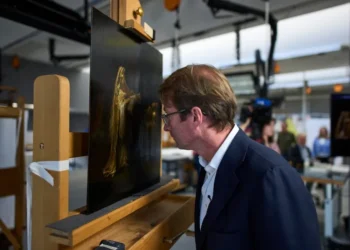
Advanced imaging and conservation research are reshaping scholarly understanding of Raphael’s Portrait of a Young Woman with a Unicorn, with technical examinations revealing multiple hidden compositional phases beneath the visible surface. The findings matter beyond art history: they illustrate how X-radiography, restoration science, and layered material analysis can reconstruct centuries of visual alterations and changing cultural interpretations. According to museum and conservation records, the work now stands as a rare example of how scientific methodology can recover lost stages in a painting’s evolution.
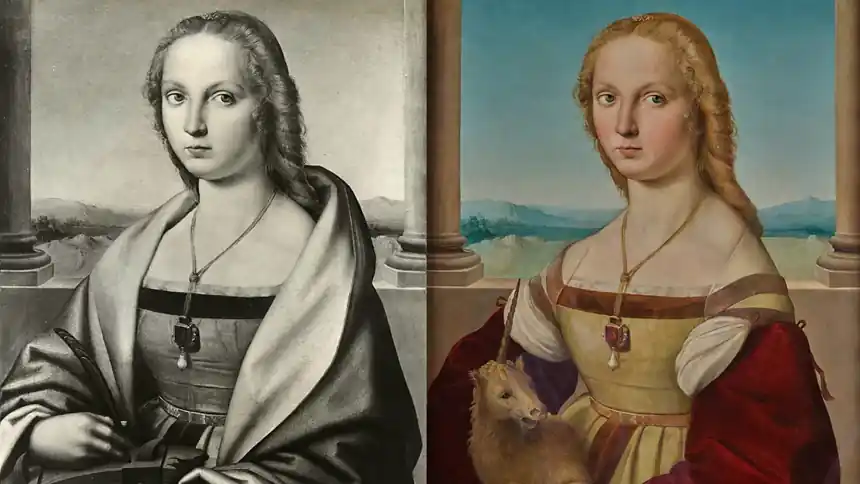
Rather than treating the portrait solely as a Renaissance masterpiece, researchers increasingly frame it as a methodological case in heritage science. Imaging conducted during major 20th-century restoration campaigns showed that later overpainting had concealed Raphael’s original unicorn motif and inserted attributes associated with Saint Catherine, including a wheel and cloak. Those discoveries established the painting as an important example of how non-invasive diagnostics can reveal hidden artistic decisions without damaging the original substrate.
Study Design and Data
The technical evidence comes primarily from sequential restoration campaigns carried out in the 1930s and later in 1959, when conservators used X-ray imaging and radiographic layer analysis to examine subsurface paint structures. These methods function as a form of material “stratigraphy,” allowing researchers to distinguish between original Renaissance pigment layers and later interventions added in the 17th century.

The dataset in this case is the painting itself: a multi-century object containing successive material revisions. Researchers compared pigment density, underdrawing traces, and compositional outlines to map the order of changes, including the replacement of religious iconography with the restored unicorn. Because the work had also been transferred from panel to canvas during conservation, the restoration history itself became part of the scientific record.
Key Findings
One of the most discussed technical findings is the reported presence of a small dog beneath the unicorn, visible in radiographic studies conducted after the first major restoration. In conservation science, this type of hidden earlier design is known as pentimento—an artist’s change in composition that remains detectable below the finished surface.
The sequence suggested by the imaging is methodologically significant: an initial dog form, later replaced by a unicorn by Raphael’s workshop or the artist himself, followed by much later overpainting that transformed the sitter into Saint Catherine. This layered chronology offers researchers an unusually clear reconstruction of artistic revision, symbolic substitution, and posthumous intervention over more than 400 years.
Limitations and Uncertainty
Despite decades of technical study, uncertainty remains over whether the lapdog was ever intended as a fully finished compositional element or merely an intermediate sketch stage. Recent curatorial research tied to the Metropolitan Museum of Art’s Raphael: Sublime Poetry exhibition notes that newer state-of-the-art analysis continues to revisit earlier restoration assumptions, underscoring that imaging interpretations can evolve as methods improve.
This distinction is scientifically important because radiography often detects density differences rather than complete iconographic certainty. As with many heritage-science investigations, the evidence supports probable reconstruction rather than absolute proof, and conclusions remain sensitive to future imaging advances.
■ Related News




Broader Scientific Context
The case highlights the growing role of conservation science as a research discipline that merges chemistry, imaging physics, material analysis, and art history. Techniques such as X-radiography, infrared reflectography, and pigment spectroscopy are increasingly used to investigate authorship, restoration chronology, and workshop practices in major museum collections.
In this sense, the Raphael portrait is less a static artwork than a long-term research object—one demonstrating how scientific tools can recover hidden information from layered historical materials. The Met’s current exhibition explicitly places recent scientific discoveries alongside art-historical interpretation, reflecting a broader institutional shift toward evidence-led museum research.