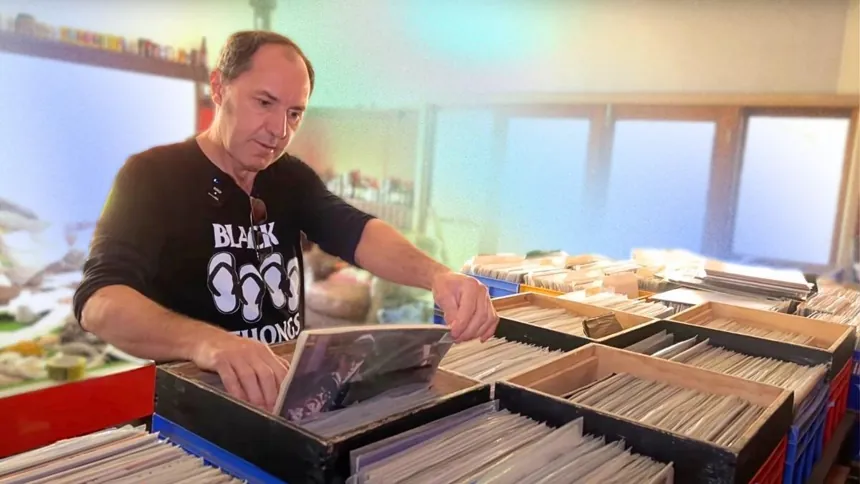
A former accountant who left the finance industry to pursue vinyl collecting now manages an inventory of more than 200,000 records, reflecting the continued strength of physical music culture despite decades of digital disruption.
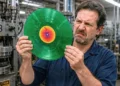
A feature published by Headphonesty profiled Australian record dealer Jon Ordon, whose decision to leave accounting in the early 1990s eventually led to the creation of a large-scale vinyl business spanning record stores, fairs, and collector networks across Australia.
Ordon’s story arrives amid sustained interest in vinyl records, a format that has experienced renewed demand over the past decade as collectors, audiophiles, and younger listeners continue embracing physical music ownership.

A Childhood Interest Became a Lifelong Obsession
According to Headphonesty, Ordon’s connection to vinyl began in 1980 when he purchased Scary Monsters (and Super Creeps) by David Bowie at age 12.
He later expanded from cassette tapes into LP collecting and developed a strong attachment to analog playback. Ordon described vinyl listening as a more immersive experience, citing the format’s sound characteristics and physical interaction as major reasons for his long-term interest.
His collecting habits gradually evolved into a buying-and-selling system. He often purchased records without knowing whether he would enjoy them, keeping favored albums while selling others. Over time, that approach became the foundation of his future business.
Leaving Accounting During the CD Boom
After leaving school, Ordon worked as a chartered accountant. However, music remained his primary interest.
Headphonesty reported that he left the profession in 1991 at age 21 and opened his first record store in West Ryde, Sydney. The move came during a period when compact discs were rapidly replacing vinyl as the dominant physical music format.
■ Related News

Family members and industry observers reportedly questioned the decision, with many viewing records as outdated technology. Ordon nevertheless believed there would remain a dedicated audience for vinyl collectors and enthusiasts.
That prediction ultimately aligned with broader industry trends. Vinyl, once considered a declining format, later returned as one of the music sector’s strongest physical-media categories.
Building a National Record Business
Following the launch of his first store, Ordon expanded into additional retail locations and later acquired established record businesses.
According to the report, inventory growth often came through the purchase of entire record collections, including large estates containing tens of thousands of albums. These acquisitions helped transform the scale of his operation while also exposing him to rare and hard-to-find releases.
Beyond storefront retail, Ordon became heavily involved in record fairs across Australia. The events allowed dealers and collectors to exchange information, discover new inventory sources, and build relationships within the vinyl community.
Headphonesty noted that this network-driven approach became a key part of his long-term business strategy, helping him identify valuable records and specialized collector markets.
More Than 200,000 Records and Still Collecting
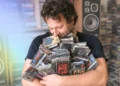
Today, Ordon operates from the Blue Mountains region of Australia, where his inventory of more than 200,000 records is housed in dedicated storage facilities. The collection includes everything from common catalog titles to highly sought-after collector pieces.
Rather than maintaining a traditional retail storefront, he continues traveling to record fairs and collector events across the country, selling inventory directly to enthusiasts and maintaining relationships within the vinyl community.
Despite managing one of Australia’s largest private record inventories, Ordon reportedly maintains a separate personal collection of nearly 3,000 albums that remain outside his commercial operation. Those records hold particular sentimental value and reflect decades of collecting history.
Vinyl Culture Continues Expanding
Ordon’s experience reflects a broader resurgence in record collecting that extends beyond nostalgia.
Industry coverage in recent years has highlighted continued growth in vinyl demand, with collectors increasingly viewing records as both cultural artifacts and long-term physical media ownership. Rising interest has also contributed to expanding collector communities, independent record businesses, and specialized music events.
Headphonesty reported that after more than three decades in the record trade, Ordon still identifies primarily as a collector rather than a retailer. His continued search for rare releases reflects the enduring appeal that vinyl maintains among dedicated music enthusiasts.