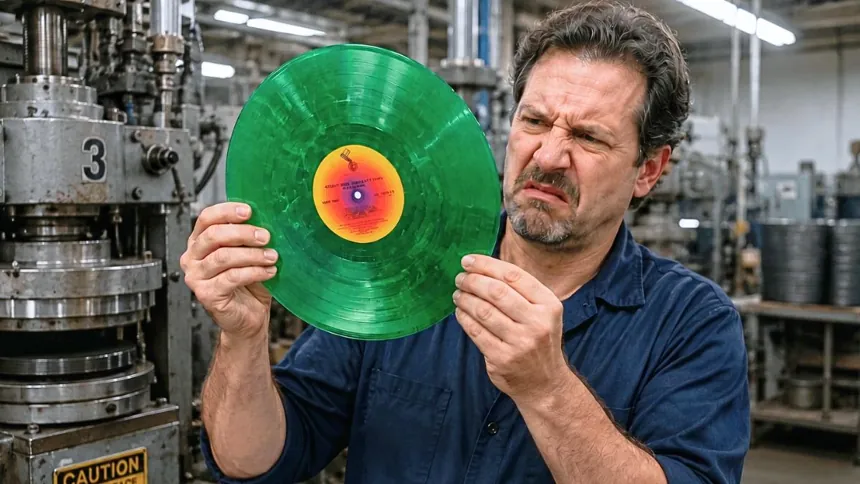
A pilot project involving Warner Music Group, GZ Media, and Abbey Road Studios has found that recycled vinyl can deliver sound quality close to conventional virgin PVC pressings, although blind listening tests indicated that fully recycled records were more likely to reveal audible surface noise under certain listening conditions.
The project examined whether unsold vinyl records could be recycled into new pressings without significantly compromising audio performance. According to findings released by the participating organizations, approximately 10,000 unsold records from Warner Music Group’s European inventory were collected and processed by Czech pressing manufacturer GZ Media. The records were shredded, micronized, and converted into new vinyl compounds containing varying levels of recycled material.
The initiative addresses a growing challenge within the vinyl industry, where demand continues to rise while large quantities of unsold inventory remain difficult to reuse within existing manufacturing systems.

“Vinyl demand is growing, but the industry was never designed to bring unsold records back into production,” Miriam Lessar, Vice President of Global Release Management at Warner Music Group, stated in comments included within the project report. “Waste is a design problem we have not solved yet.”
Blind Evaluation Compared Six Vinyl Formulations
To assess whether recycled content affected playback quality, the team produced a custom test record using six different material formulations. These included four recycled-content blends containing 10%, 25%, 50%, and 100% recycled vinyl, alongside a virgin PVC control pressing and GZ Media’s Eco Mix compound, which is manufactured from internal production scrap.
Each pressing contained identical audio content and was anonymized before evaluation. The records were then assessed through blind listening sessions conducted by a seven-member panel at Abbey Road Studios.
The test record was intentionally designed to expose surface-noise characteristics. Both sides contained 20-second silent passages intended to reveal background noise, clicks, and crackle that may not be noticeable during normal music playback.
Results showed relatively small overall differences among the six variants, with all scores falling within roughly half a point on a ten-point scale. However, consistent trends emerged during the evaluation.
■ Related News




The highest-rated pressing was the 25% recycled formulation, which marginally outperformed the virgin PVC control. By contrast, the fully recycled 100% variant received the lowest ratings and generated more reports of crackle, clicks, and background noise.
According to the report, these rankings remained stable even after sensitivity analysis that removed individual listeners from the results, suggesting that the outcome was not driven by a single participant’s preferences.
Music Content Influenced Perceived Noise Levels
One of the more notable findings involved the interaction between vinyl surface noise and musical content.
The test record featured different material on each side. Side A contained acoustic post-rock recordings with greater dynamic range and quieter passages, while Side B featured louder, more compressed rock music.
Listeners generally reported better results from Side B, where the stronger signal levels tended to mask low-level surface noise. Side A exposed more pressing artifacts because quieter sections left less music available to conceal background imperfections.
The findings suggest that recycled vinyl performance may vary depending on the type of music being pressed. Surface noise that remains largely unnoticed on heavily compressed recordings may become more apparent on recordings that include extended quiet passages or wider dynamic contrasts.
Miles Showell, mastering engineer at Abbey Road Studios, described the results as largely consistent across the various formulations, stating that recycled content appeared to have limited influence on overall playback quality within the scope of the pilot project.
Feedstock Selection Emerged as a Key Variable
Although the project began with roughly 10,000 warehouse records, only a small portion ultimately proved suitable for processing.
The pilot excluded colored vinyl releases, smaller vinyl formats, and older pressings produced before certain European regulatory standards. Of the five candidate titles initially selected, two colored-vinyl releases were eliminated during processing due to material-related issues.
As a result, the usable feedstock was reduced to three black-vinyl titles originating from different pressing facilities.
The report indicates that feedstock consistency may be one of the most significant challenges facing large-scale vinyl recycling efforts. GZ Media’s Eco Mix material, produced from known internal manufacturing scrap, ranked among the strongest-performing formulations and generated no operational difficulties during production.
By comparison, mixed-origin recycled material sourced from records manufactured at different facilities produced less predictable outcomes and proved more difficult to stabilize during processing.
The findings suggest that recycled vinyl may perform most consistently when manufacturers maintain tighter control over the composition of source materials.
Study Highlights Measurement and Independence Limitations
The report also acknowledged several limitations.
The evaluation relied primarily on expert listening rather than comprehensive instrumental measurements. While preliminary quality-control testing was conducted, the published findings did not include detailed signal-to-noise ratios, groove-level measurements, or complete spectral analyses that would allow independent laboratories to reproduce the results.
In addition, all seven listening-panel members were affiliated with organizations involved in the project, including Abbey Road Studios, GZ Media, and Warner Music Group Studio Services.
The blind-test design reduced the risk of direct evaluation bias, but the absence of independent participants remains a notable limitation when interpreting the findings.
Sustainability Goals Extend Beyond Individual Records
The report’s recommended path forward includes the use of mass-balance accounting systems, which track recycled material across overall factory production rather than guaranteeing that a specific record contains a precise percentage of recycled content.
Under this model, recycled content becomes a factory-level sustainability metric rather than a characteristic that can necessarily be verified within an individual disc.
Despite those limitations, the pilot demonstrated that lower-percentage recycled blends can achieve performance levels comparable to conventional vinyl formulations under controlled manufacturing conditions.
The results also indicate that source-material consistency may ultimately play a larger role in playback quality than recycled content percentage alone, particularly as the industry explores methods of reducing waste while maintaining acceptable audio standards.
Tags: Recycled Vinyl, Vinyl Records, Warner Music Group, GZ Media, Abbey Road Studios, PVC Pressing, Listening Tests, Audio Manufacturing