The Democratic Republic of the Congo’s outbreak of Ebola disease caused by the Bundibugyo virus has become the country’s largest Ebola epidemic on record, with sustained transmission, expanding geographic spread and rising fatalities prompting renewed concern among international health authorities.
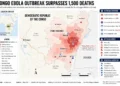
The World Health Organization (WHO) said the outbreak, first detected in Ituri Province, has spread over the past two months into five provinces—Ituri, North Kivu, South Kivu, Haut-Uélé and Tshopo—and now affects 49 health zones. Continued transmission, combined with armed conflict, population displacement and frequent cross-border movement, is complicating containment efforts and increasing the risk of regional spread.
As of July 30, 2026, health authorities had confirmed 3,605 cases and 1,587 deaths, representing a crude case fatality ratio of about 44%. During epidemiological week 30 alone, officials recorded 567 new confirmed cases and 296 deaths, the highest weekly totals since the outbreak began.

Outbreak Sets New National Record
According to WHO, the current epidemic has surpassed the Democratic Republic of the Congo’s previous largest Ebola outbreak, which occurred between 2018 and 2020 and recorded 3,317 confirmed cases.
Across all affected countries, 3,626 confirmed Bundibugyo virus disease cases have now been reported.
The Democratic Republic of the Congo accounts for 3,605 confirmed cases, including two patients later treated in Germany. Uganda reported 20 confirmed cases, while France recorded one imported infection involving a healthcare worker deployed to support the response.
A total of 1,589 deaths have been reported across all affected countries, including two in Uganda.
Health authorities have also recorded 654 recoveries, including 651 in the Democratic Republic of the Congo, 18 in Uganda, two in Germany and one in France.
■ Related News



Ituri Province Remains the Epicenter
WHO said Ituri Province continues to bear the overwhelming burden of the outbreak.
The province has recorded 3,176 confirmed cases, accounting for approximately 88% of all infections, and 1,311 deaths, representing about 83% of reported fatalities.
Among the most affected health zones are:
- Bunia
- Rwampara
- Mongbwalu
- Nizi
- Lita
- Nyankunde
Of the 49 affected health zones, 33 continued reporting confirmed infections during the previous seven days.
During that period, authorities documented 641 confirmed cases and 282 deaths, indicating sustained community transmission.
Health Workers Continue to Face Elevated Risks
Healthcare workers remain among those infected during the outbreak.
As of July 30, WHO reported:
- 151 confirmed infections among healthcare workers
- 44 deaths
- 68 recoveries
WHO said the figures highlight continuing challenges in infection prevention and control within healthcare facilities as well as ongoing exposure risks in surrounding communities.
Public health authorities have identified 17,863 contacts for monitoring, with 13,455 remaining under active follow-up.
Conflict and Displacement Hamper Containment
WHO said the outbreak is unfolding amid armed conflict, population displacement and limited access to healthcare, clean water and other essential services.
Attacks on healthcare facilities and insecurity have disrupted surveillance activities, restricted the movement of response teams and increased the likelihood of undetected transmission.
The agency said community-led response efforts supported by local leaders remain essential to improving outbreak control.
Response Efforts Continue
WHO said Congolese health authorities and international partners continue implementing a broad response that includes:
- Emergency coordination
- Disease surveillance
- Laboratory testing
- Infection prevention and control
- Clinical care
- Community engagement
- Logistics support
- Operational research
- Maintenance of essential health services
The response also forms part of a six-month regional preparedness framework designed to strengthen coordination across affected and neighboring countries.
WHO said further expansion of response activities will be necessary to outpace the epidemic.
Regional Preparedness Remains High
Outside the Democratic Republic of the Congo, neighboring countries continue strengthening surveillance and preparedness.
France confirmed that its imported Bundibugyo virus disease patient recovered and was discharged on July 4 after two consecutive negative PCR tests. Health authorities reported no secondary transmission.
Uganda officially declared its outbreak over on July 28 after completing 42 consecutive days without a locally transmitted confirmed case.
Despite that milestone, WHO warned Uganda remains vulnerable to additional imported infections while transmission continues in eastern Democratic Republic of the Congo.
WHO Maintains Very High Risk Assessment
WHO continues to classify the outbreak risk within the Democratic Republic of the Congo as very high because of sustained transmission and the expanding geographic footprint of the epidemic.
The agency rates the risk for Uganda as high, citing ongoing cross-border epidemiological links and previous Ebola activity along the eastern Democratic Republic of the Congo-western Uganda corridor.
Countries bordering affected areas are also considered at high risk because of trade, mining-related population movement and varying levels of preparedness.
WHO continues to assess the overall risk for the rest of Africa and globally as low.
An updated rapid risk assessment is expected before the International Health Regulations (IHR) Emergency Committee meets on Aug. 18.
WHO Advises Against Travel Restrictions
Despite the scale of the outbreak, WHO continues to advise against travel or trade restrictions affecting the Democratic Republic of the Congo.
Instead, the agency continues to emphasize:
- Early case detection
- Rapid laboratory confirmation
- Patient isolation
- Supportive clinical care
- Contact tracing
- Safe and dignified burials
- Community engagement
- Cross-border coordination
WHO noted that Bundibugyo virus disease is caused by the Bundibugyo virus, one of the Ebola virus species, with fruit bats believed to be the natural reservoir. Human infections are thought to begin through contact with infected wildlife before spreading through direct contact with infected bodily fluids or contaminated materials.
The agency also said there are currently no approved vaccines or specific treatments for Bundibugyo virus disease, although several vaccine and therapeutic candidates remain under scientific evaluation.
This report is based on reporting by the World Health Organization (WHO).