This report is based on reporting by The Associated Press.
A California fruit grower is distributing tens of thousands of pounds of white nectarines to the public after a legal dispute prevented him from selling this year’s harvest, highlighting broader questions about licensing agreements, exclusive fruit varieties, and the commercial relationships between growers and agricultural marketers.
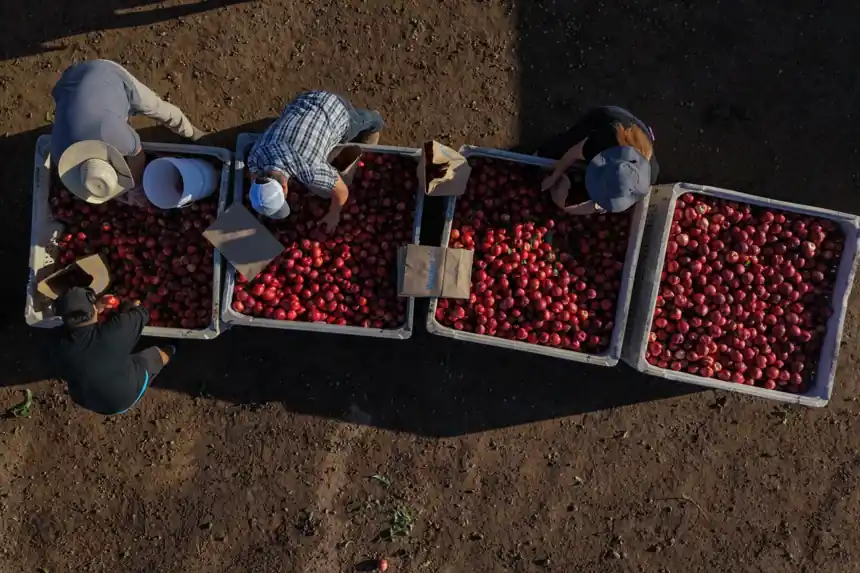
Since the start of the giveaway, Cesar Mora, a third-generation farmer based in Reedley in California’s Central Valley, said more than 100,000 pounds (45,359 kilograms) of nectarines have been shared with visitors rather than being left to spoil.

“It was really just a thought of not wasting a perfectly good product,” Mora said, adding that seeing people enjoy the fruit has provided some encouragement during a prolonged legal dispute.
Contract Dispute Prevents Commercial Sales
The conflict stems from a lawsuit filed in 2023 by Giumarra Brothers Fruit Co., which alleges Mora breached contractual agreements governing the production and marketing of a white nectarine variety known as Monalise.
According to court filings, Mora signed a sublicensing agreement with Giumarra in 2017 allowing him to grow the variety. A subsequent marketing agreement signed in 2019 required that the fruit be packed and sold through the company.
After Mora later sold the nectarines to another fruit packer, Giumarra sued him for breach of contract. The litigation has effectively prevented him from commercially selling the crop while the case proceeds. A trial is scheduled later this month.
In a statement provided through one of its attorneys, Giumarra said the dispute centers on two written agreements and is being resolved through the court system based on the facts of the case.
■ Related News




Mora has accused the company of unfair and fraudulent business practices, allegations that Giumarra disputes.
Exclusive Variety at the Center of the Case
The legal dispute focuses on Monalise, a white nectarine variety known for its sweeter and less tart flavor profile.
Court filings state that French plant breeding company Star Fruits Diffusion owns the rights to the variety, while Giumarra holds sublicensing rights for testing, production, and commercial sales. Star Fruits Diffusion did not respond to a request for comment in the original reporting.
Mora’s attorneys argue that Giumarra has not produced documentation regarding its licensing rights. Court records also indicate that Giumarra has stated Monalise is not protected by a U.S. plant patent.
Mora’s legal filings contend that Giumarra promoted the variety as an exclusive fruit expected to command premium prices because of its limited availability.
Court Allows Contract Claim to Proceed
In May, Fresno County Superior Court Judge Jon Skiles ruled that Giumarra’s breach of contract claim could continue.
According to the ruling, the sublicense agreement does not state that its validity depends on the existence of a patent covering the fruit variety. The judge also wrote that Giumarra does not need to prove the underlying licensing agreement with the plant breeder in order to pursue its contractual claims against Mora.
The ruling did not resolve the broader dispute, which remains scheduled for trial.
Growing Use of Proprietary Fruit Varieties
The case also reflects a broader trend within commercial agriculture as proprietary fruit varieties become increasingly common.
According to Bradley Rickard, a professor of food and agricultural economics at Cornell University, plant patents and licensing agreements increasingly allow breeders to collect royalties from fruit trees, harvested fruit, or both.
Universities and private breeders have long developed new fruit varieties. Well-known examples include the Rainier cherry, developed by Washington State University, and the Honeycrisp apple, introduced by the University of Minnesota. Both are now in the public domain and may be grown and marketed without exclusive licensing restrictions.
More recent varieties, however, are frequently commercialized through licensing agreements that grant exclusive production or marketing rights to selected growers or distributors.
Economic Impact on the Farm
Mora said the ongoing litigation has significantly affected his farm’s finances. While he continues growing peaches and plums outside the disputed agreements, he estimates losing roughly one-quarter of his income because he has been unable to market the nectarine crop.
Rather than allowing the fruit to go to waste, Mora opened his farm to the public, where large crowds have gathered to collect free nectarines. Community volunteers have also assisted with distributing the fruit, and supporters have contributed more than $17,000 through a GoFundMe campaign.
Mora said sharing the harvest with the public has been the most positive outcome during a legal battle that he says has made farming increasingly difficult.
Topics: California Agriculture | Nectarines | Contract Dispute | Fruit Licensing | Farming | Agricultural Business | Central Valley