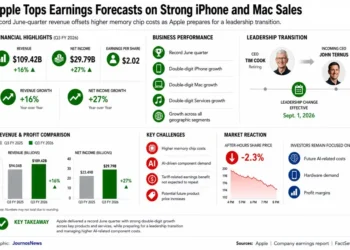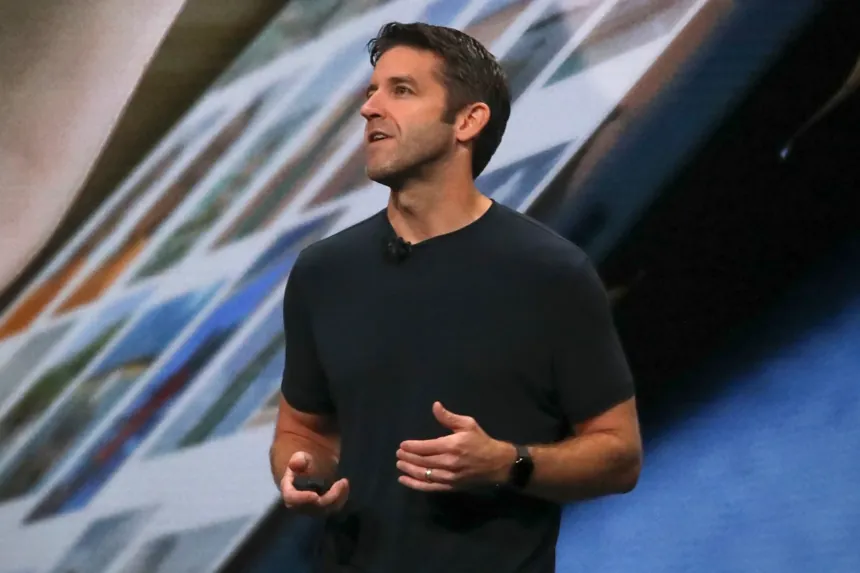
Apple has named longtime executive John Ternus as its next chief executive, marking a significant leadership transition as Tim Cook prepares to step down after more than a decade at the helm. The appointment, effective September 2026, places a hardware-focused leader in charge at a time when the company faces mounting pressure to accelerate its artificial intelligence strategy and sustain device-driven growth.
The leadership change is part of a planned succession process approved by Apple’s board, with Cook expected to remain involved as executive chairman. According to company disclosures and reporting by major financial outlets, the transition comes as Apple navigates intensifying competition in AI and shifting global supply chain dynamics.
Hardware Leadership Anchors Strategic Direction
Ternus, a 25-year Apple veteran, has overseen the development of core product lines including the iPhone, iPad, and Mac, as well as wearables such as the Apple Watch and AirPods. His elevation suggests Apple will maintain a product-centric strategy rooted in incremental hardware innovation rather than pivoting sharply toward new standalone AI platforms.

Analysts cited in financial reporting note that Apple’s leadership choice reflects continuity with its existing ecosystem approach, integrating software and services into established devices. This contrasts with some competitors pursuing AI-first product categories, signaling a more measured transition toward advanced technologies.
Market Reaction Reflects Cautious Investor Sentiment
Initial market response to the announcement was subdued, with Apple shares declining modestly following the leadership news, according to data referenced in financial coverage. Analysts interpret the reaction as reflecting investor caution over Apple’s positioning in the rapidly evolving AI landscape, where competitors have accelerated investment and product rollouts.
Market observers suggest that while Ternus brings deep operational and engineering experience, his relative lack of public-facing leadership in AI strategy may leave open questions about Apple’s competitive trajectory in emerging technologies.
Leadership Shift Comes at Strategic Inflection Point
The transition coincides with broader structural challenges for Apple, including geopolitical risks tied to manufacturing concentration in China and regulatory scrutiny across key markets. Industry data and analyst commentary indicate that supply chain resilience and diversification will remain central priorities under the new leadership.
At the same time, Apple continues to rely heavily on its flagship iPhone business, which has historically driven revenue growth. According to reporting from global financial outlets, Ternus is expected to build on this foundation while exploring new device categories that incorporate AI capabilities.

Strategic Outlook: Balancing Continuity and Innovation
Ternus’ appointment underscores a balance between continuity and the need for strategic adaptation. Having played a central role in Apple’s transition to in-house silicon and recent product updates, he is positioned to extend the company’s hardware-led model while addressing emerging technological demands.
Analysts note that Apple’s next phase of growth may depend on its ability to embed AI more deeply into its existing ecosystem rather than relying on disruptive standalone products. The company’s scale, installed user base, and integrated platform remain key competitive advantages, though execution in AI development will be closely watched.