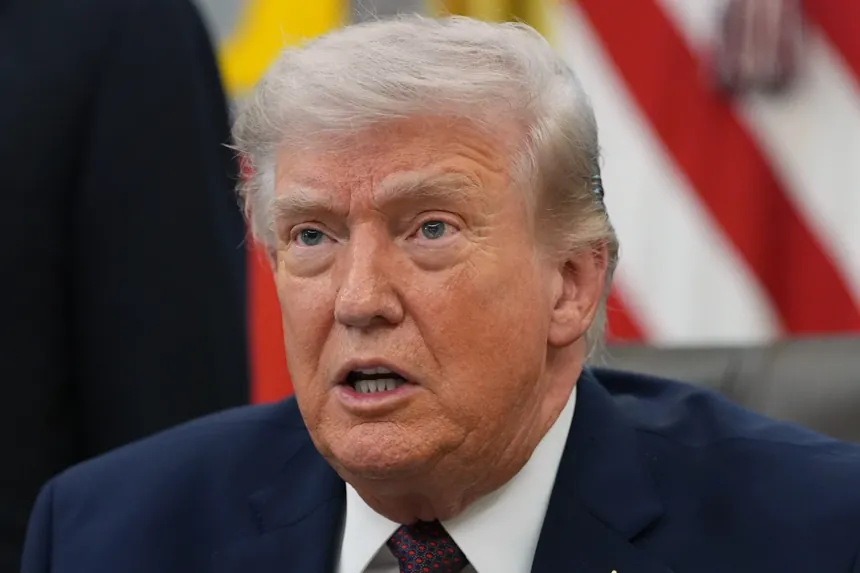
President Donald Trump’s decision to restore pay for unpaid Department of Homeland Security personnel through executive action has temporarily eased the operational pressure of the longest partial DHS shutdown in U.S. history, but it also underscores a deeper problem: the institutional fragmentation now defining the broader funding fight. As first reported by The Associated Press, the White House move bypasses Congress at a moment when Republican leaders are still struggling to align around a durable appropriations path.
The order, expected to cover employees beyond frontline law enforcement—including FEMA, Coast Guard support functions, and other non-enforcement staff—offers short-term relief to thousands of workers who continued reporting without pay. Yet the central dispute that triggered the 48-day lapse remains unresolved: whether immigration enforcement agencies should receive full uninterrupted funding under Trump’s border agenda.
What has emerged is no longer simply a shutdown story. It is a test of whether congressional Republicans can maintain legislative cohesion while separating politically explosive border operations from the rest of the homeland security apparatus.

Command Unity Gives Way to Tactical Fragmentation
The emerging Republican two-track plan reflects a pragmatic but politically fraught concession to congressional math. Senate Majority Leader John Thune and House Speaker Mike Johnson have now aligned behind a measure that would fund most DHS operations while postponing ICE and Border Patrol appropriations for a later party-line package.
That alignment marks a notable reversal after Johnson had publicly dismissed the Senate framework days earlier. His shift suggests leadership has accepted that a maximalist all-in-one approach lacked sufficient support, forcing a narrower “realm of the possible” strategy centered on keeping core security functions running.
But this tactical retreat introduces its own vulnerability: every deferred funding decision increases the number of legislative choke points ahead.
Border Enforcement Funding Becomes the Next Internal Fault Line
The unresolved status of ICE and Border Patrol funding now represents the more consequential political battlefield.
Conservative Republicans have already signaled resistance to any bill that restores broader DHS continuity while leaving immigration enforcement outside the first tranche. That resistance transforms what looked like a shutdown off-ramp into a new internal party stress test, with leadership forced to balance operational urgency against ideological demands from border hawks.




The strategic risk is clear: if House conservatives harden opposition, the current workaround may only postpone a more severe appropriations conflict tied directly to deportation policy, detention resources, and long-term border staffing.
That makes the June 1 budget deadline Trump reportedly wants far more than an administrative target—it becomes the next credibility test for Republican legislative discipline.
Operational Relief Masks Broader Institutional Exposure
The executive order may reduce immediate airport disruption and stabilize workforce morale after weeks of unpaid labor, particularly among transportation and emergency-response personnel. Similar backpay measures for TSA had already begun easing airport bottlenecks earlier in the week.
Still, executive stopgaps cannot substitute for durable appropriations authority.
Each unilateral intervention narrows the visible effects of shutdown politics while leaving the structural dispute untouched. In strategic terms, Congress is not resolving the DHS funding crisis so much as redistributing its pressure points—away from aviation delays and toward a more polarizing fight over immigration enforcement permanence.
That shift may prove more destabilizing because it moves the conflict from workforce hardship into the center of Trump’s national security agenda.
The Next Risk Is Legislative Credibility
The immediate crisis around missed paychecks may be easing, but the larger consequence is institutional: Congress now faces a credibility challenge over whether it can separate essential homeland security continuity from the political warfare surrounding border policy.
If the House fails to convert the Senate-backed framework into law quickly, Trump’s executive pay intervention may be remembered less as relief for federal workers and more as evidence that the legislative branch could no longer manage one of its core national security appropriations functions.
The shutdown’s next phase, therefore, is not about whether DHS workers are paid. It is about whether the border enforcement fight fractures the governing coalition needed to keep the broader security architecture intact.