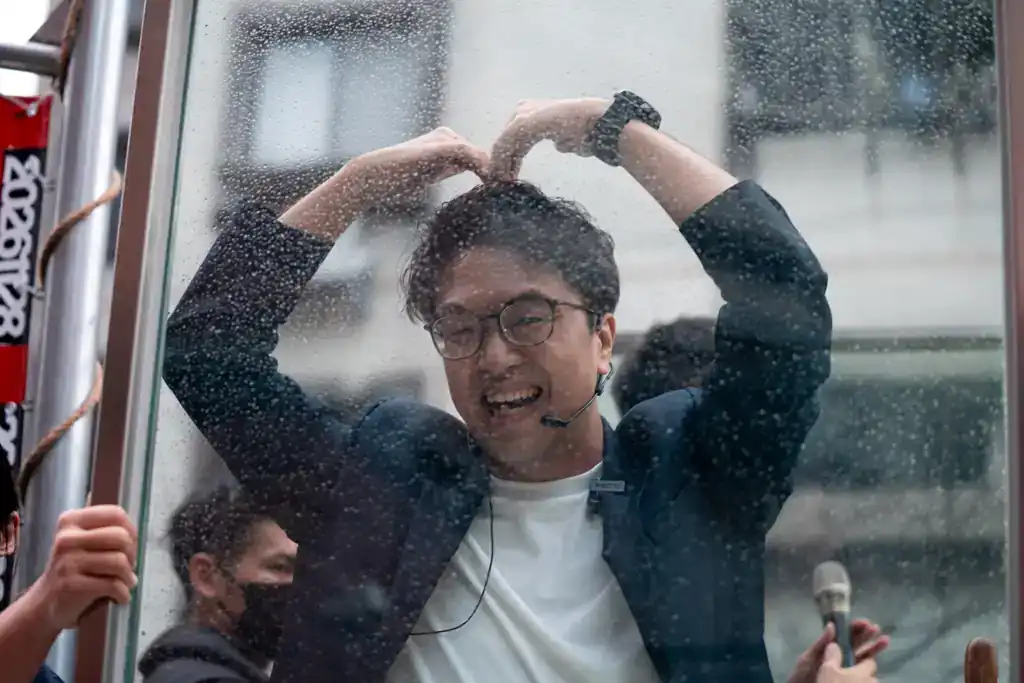
TAIPEI, Taiwan — Democratic Progressive Party mayoral candidate Puma Shen is challenging incumbent Taipei Mayor Chiang Wan-an in a closely watched contest ahead of Saturday’s local elections.
Shen, also known as Shen Pao-yang, has built his campaign around city governance, public services and quality-of-life issues. His public appearances, policy proposals and interactive campaigning style have attracted attention beyond the Democratic Progressive Party’s traditional support base.
He is running against Chiang, the Kuomintang incumbent seeking another term. The election will determine who leads Taiwan’s capital for the next four years.

Campaign focuses on everyday city concerns
Shen has largely kept cross-strait relations out of the center of his mayoral campaign, concentrating instead on issues affecting Taipei residents.
His proposals include expanding tree coverage and green spaces, improving support and resources for social workers, and accelerating government responses to child-protection cases.
He has also promoted a policy-focused approach that encourages public discussion of city issues. Supporters have responded to his direct engagement with voters and his calls to avoid personal attacks against political opponents.
The campaign’s following is known as the “Ocean Current,” a movement that initially attracted voters concerned about Chinese pressure on Taiwan. It has since expanded around Shen’s local policy proposals and public appearances.
Shen’s approach reflects a broader effort to present himself as a candidate focused on municipal administration rather than only on national political disputes.

Beijing has designated Shen a separatist
Shen previously became known for his research into Chinese influence operations and disinformation. He also co-founded Kuma Academy, an organization that provides civilian emergency preparedness and defense training.
His political profile has drawn sanctions from Beijing.
In October 2024, China’s Taiwan Affairs Office designated Shen a “diehard Taiwan independence separatist” and announced punitive measures against him and Kuma Academy. The restrictions included bans on entry to mainland China, Hong Kong and Macao, as well as limits on business cooperation involving organizations associated with Shen.
The designation and allegations reflect Beijing’s position. They do not independently establish the claims made against Shen.
Chinese authorities later extended their measures to businesses linked to Shen’s father. In June 2025, Beijing announced sanctions against Sicuens International.
On October 14, 2026, the Taiwan Affairs Office announced additional restrictions against VWAY. Chinese authorities alleged that the company had continued business dealings with mainland enterprises despite the earlier sanctions.
Shen rejected the accusations involving his family’s business dealings. Taiwan’s Mainland Affairs Council condemned the latest measures, describing them as an attempt to exert economic pressure and interfere in the island’s democratic elections.
Candidates offer different approaches to Taipei
Despite the attention surrounding Beijing’s sanctions, the mayoral contest has focused largely on local administration.
Shen has said he would maintain the Taipei-Shanghai Twin-City Forum if elected, provided exchanges had no political preconditions and delivered practical benefits.
Chiang has defended his administration’s record, pointing to completed infrastructure projects, Taipei’s international profile and increased family subsidies.
He has also promoted plans to develop the city as an artificial-intelligence hub, including expanded research and computing resources and development of the Beitou-Shilin Technology Park.
The candidates have therefore presented different priorities for the city, with Shen emphasizing policy accountability and public services while Chiang has highlighted his administration’s record and technology-development plans.
Election carries significance beyond city government
The vote could have wider political implications. The DPP has not held Taipei’s mayoralty since 1998, while the city has traditionally been a stronghold of the KMT.
A Shen victory would give the ruling party control of the capital and mark a significant change in Taipei’s political leadership.
Taiwan’s local elections will take place on November 28. Voters will choose mayors, county chiefs and other local representatives across the island.
The outcome will determine whether Shen’s campaign translates into control of the capital, while also testing the influence of local policy concerns in a political environment shaped by continuing tensions across the Taiwan Strait.
Source:
1. State Council Information Office of the People’s Republic of China / Taiwan Affairs Office — October 14, 2024
Primary source for Beijing’s designation of Shen and its announcement of restrictions involving him and Kuma Academy. The article attributes the designation and allegations to Chinese authorities rather than presenting them as established facts.
2. Taiwan Affairs Office — October 14–15, 2026
Official account of the announcement concerning VWAY and the allegations against Shen’s father. This is the Chinese government’s account of the sanctions, not independent verification of the alleged business activity.
3. Taiwan Mainland Affairs Council — October 14, 2026
Statement responding to Beijing’s sanctions against a company linked to Shen’s father. The Council accused Beijing of using economic pressure to interfere in Taiwan’s elections.
4. Taiwan Central Election Commission — 2026 Local Elections
Official election notice confirming November 28 as polling day. The Commission’s election guidance sets out the statutory restriction on publishing or discussing election polling data during the final 10 days before voting closes.