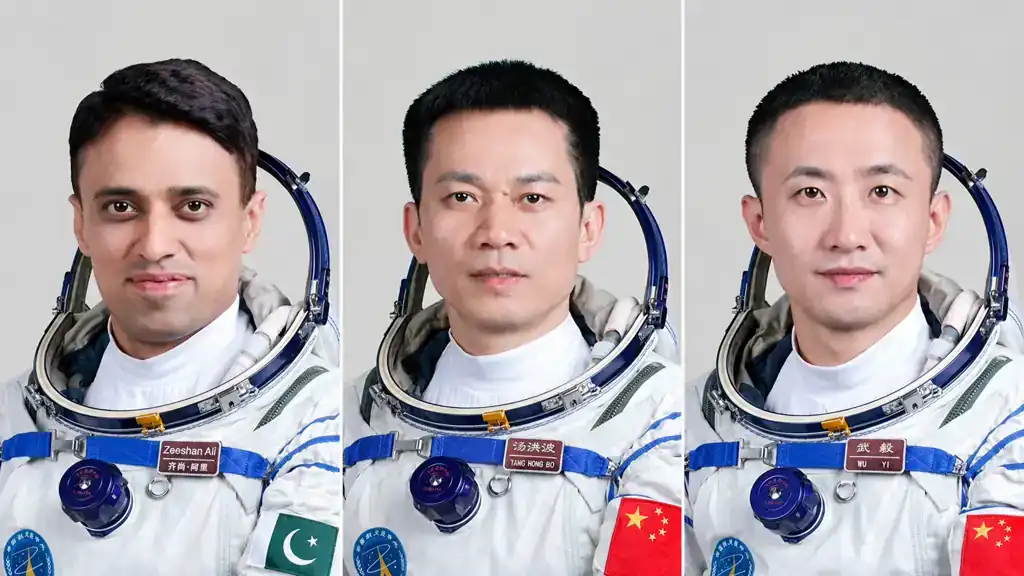
JIUQUAN, China — China launched the Shenzhou-24 spacecraft on November 25, carrying two Chinese astronauts and a Pakistani astronaut. The mission marks the first time China has sent foreign and Chinese astronauts into space together under its human spaceflight programmed.
The spacecraft lifted off at 8:18 a.m. Beijing time aboard a Long March-2F rocket from the Jiuquan Satellite Launch Center in northwestern China.
The China Manned Space Agency (CMSA) said the spacecraft separated from the rocket and entered its planned orbit. All three astronauts were in good condition after the launch, the agency reported.

The crew includes commander Tang Hongbo, flight engineer Wu Yi and Pakistani payload specialist Muhammad Zeeshan Ali. Ali’s participation also makes him the first foreign astronaut to visit China’s Tiangong space station.
Three astronauts begin the Shenzhou-24 mission
Tang has previously flown on the Shenzhou-12 and Shenzhou-17 missions. His latest flight will make him the first Chinese astronaut to visit the Tiangong station three times.
Wu, who belongs to China’s third group of astronauts, is making his first spaceflight. Ali is also travelling into space for the first time.
Ali will serve as a payload specialist during a short stay aboard the station. The CMSA said he will take part in routine crew activities and joint scientific experiments between China and Pakistan.
His duties include installing experimental equipment and conducting research in orbit.



China and Pakistan plan joint scientific experiments
The CMSA said the mission includes four joint research projects involving biotechnology and materials science.
One experiment will examine photosynthetic cyanobacteria and their potential uses in space environments. Ali is scheduled to take part in this research during his stay aboard the station.
The mission also provides an opportunity for Pakistani researchers to conduct experiments aboard China’s operational space station.
Ali will return to Earth aboard the Shenzhou-23 spacecraft after completing his short-duration assignment.
The Shenzhou-23 crew has already spent more than six months aboard the station. Its members will conduct an in-orbit handover with the incoming astronauts before returning home.
Mission continues China’s space station programmed
Shenzhou-24 is the eighth crewed flight during the application and development phase of China’s space station programmed. It is also the 41st mission in the country’s human spaceflight programmed.
Beyond the crew change, the mission will support the station’s routine operations and maintenance. The astronauts will also conduct scientific research, test new technologies and take part in educational and public outreach activities.
Chinese authorities said the spacecraft would follow a planned rapid rendezvous and docking procedure after reaching orbit.
The mission adds another crew rotation to China’s expanding space station programmed while supporting continued research in orbit.
Pakistan expands its human spaceflight cooperation with China
The joint mission follows an agreement signed by China and Pakistan in February 2025. The agreement established a process to select and train Pakistani astronauts for missions to the Chinese space station.
The selection process produced two Pakistani candidates. One was selected for the Shenzhou-24 mission, while the other remained a backup astronaut.
China has presented foreign astronaut participation as part of its wider effort to expand international cooperation in space. The CMSA said Shenzhou-24 marks the first joint flight involving Chinese and foreign astronauts in the history of its crewed space programmed.
For Pakistan, Ali’s flight marks a milestone in its human spaceflight ambitions. It also expands scientific cooperation between the two countries.
His participation gives Pakistani researchers an opportunity to conduct experiments in orbit and take part in research aboard the Tiangong space station.