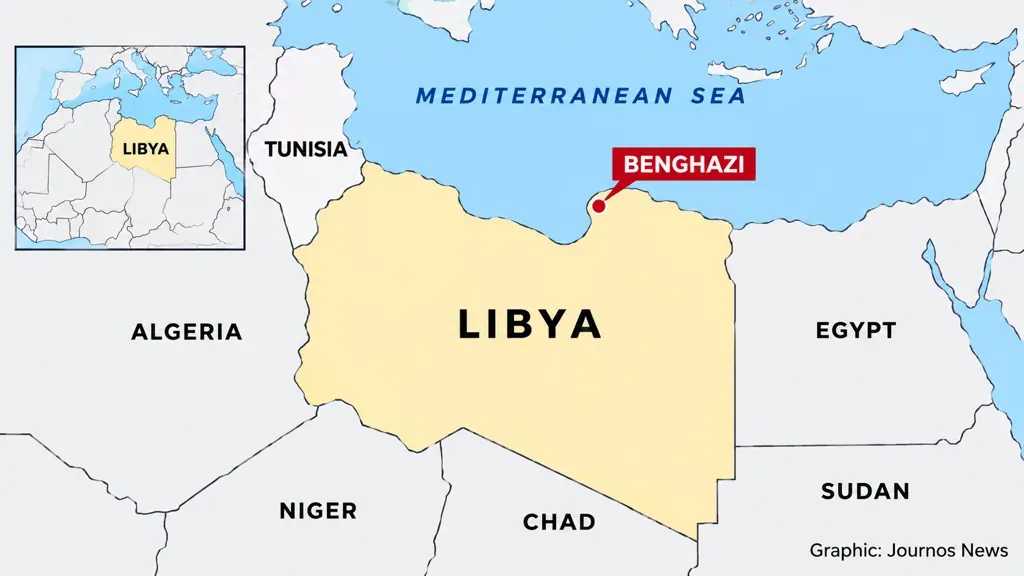
BENGHAZI, Libya — A Russian Navy corvette sank at a naval base in Benghazi after an attack involving Ukrainian sea drones, according to Ukraine’s Security Service and Libyan officials. The incident has brought the Russia-Ukraine conflict into the central Mediterranean and raised concerns about foreign military activity in Libya.
The vessel, identified as the Merkury, came under attack on November 22 while docked at Benghazi Naval Base. Eastern Libyan authorities initially reported an explosion and fire aboard the Russian warship. They suspected unmanned vehicles had caused the incident.
The eastern administration later announced a joint investigation with Moscow. The inquiry aims to establish what happened and identify those responsible.

Ukraine’s Security Service (SBU) claimed responsibility on November 23. It said Ukrainian defence forces used seven domestically produced unmanned surface vessels in the operation. According to the agency, another ship transported the drones to the area before launching them from a support vessel described as a “mother ship.”
The SBU said the attack destroyed the Merkury. The vessel was a Project 20380 corvette commissioned in 2023 and assigned to Russia’s Black Sea Fleet. The agency also said a Russian Ka-27 helicopter aboard the warship sank with it.
These details represent Ukraine’s official account. The available statements do not independently confirm every aspect of the operation.
Libyan officials report drone strikes and injuries
Two Libyan military officials affiliated with the eastern-based Libyan National Army provided an initial account of the attack.
They said preliminary findings indicated that several Ukrainian sea drones had launched from western Libya. According to the officials, forces intercepted and destroyed at least four drones, while two others struck the corvette.
■ Related News



The officials reported severe damage and a fire at the naval facility. They also said at least 10 people, including Libyan and Russian nationals, suffered minor injuries.
The officials spoke anonymously because they lacked authorisation to discuss the incident publicly.
Satellite images released after the attack showed the Merkury capsized and largely submerged at its berth. The images support Ukraine’s claim that the warship sank.
The eastern Libyan government said the vessel had stopped in Benghazi for fuel and supplies. It said the ship made the stop under a cooperation arrangement with Russia while returning to Russian territory.
The government condemned the attack as a violation of Libyan sovereignty. It also said it would pursue legal and diplomatic action against those responsible.
Ukraine identifies another Russian vessel as a target
The SBU also named the Russian dry-cargo ship MV Angara as a target of the operation. Ukraine described the vessel as a sanctioned ship used to transport Russian military equipment.
According to the SBU, the Merkury regularly escorted Russian naval convoys and protected the Angara. Ukrainian officials said both vessels supported Russian military logistics. They therefore described the ships as military targets.
This assessment reflects the Ukrainian government’s justification for the operation.
Libyan military authorities separately reported an attack on a commercial vessel off Benghazi. They said an unmanned boat struck the ship and naval forces rescued its crew.
However, the available Libyan statements do not identify that vessel as the MV Angara. The two incidents therefore cannot be conclusively linked.
Rival Libyan governments reject foreign military operations
The attack drew objections from both of Libya’s rival political administrations. Their responses highlighted concerns about foreign military activity in the country.
The internationally recognised Government of National Unity, based in Tripoli, criticised Ukrainian President Volodymyr Zelenskyy’s remarks about the operation. Its Foreign Ministry demanded an official explanation from Kyiv.
The ministry said foreign military operations in Libyan territory or territorial waters were unacceptable. It also warned against using the country’s ports and facilities to support conflicts involving other nations.
Eastern Libyan authorities also called for an international investigation. Committees of the country’s House of Representatives condemned the attacks. They warned that the incident threatened national sovereignty, civilian safety and maritime security.
United Nations calls for an independent investigation
The United Nations Support Mission in Libya (UNSMIL) expressed serious concern about the attacks at Benghazi port and off the city’s coast.
The mission called for an immediate, independent and transparent investigation. It urged all parties to exercise restraint and warned against spreading unverified information while the inquiry continued.
Russia had not issued a substantive public response to Ukraine’s claim in the official statements cited for this report. The eastern Libyan government’s announcement of a joint investigation with Moscow did not establish the inquiry’s findings or determine responsibility.
The incident marks a significant expansion of Ukraine’s reported maritime operations beyond the Black Sea. It also raises questions about foreign military deployments and activities in Libya.
The country has faced competing administrations and rival security structures since the 2011 overthrow of Muammar Gaddafi. These divisions have left Libya vulnerable to outside influence.
The investigations requested by Libyan authorities and the United Nations could help establish how the drones reached Benghazi and where they launched. Investigators must also determine the full extent of the damage to the warship and port facilities.