MOGADISHU, Somalia – Somali pirates have reportedly seized an Iranian fishing vessel off northeastern Somalia, raising concerns that the ship could be used to launch further attacks against commercial shipping.
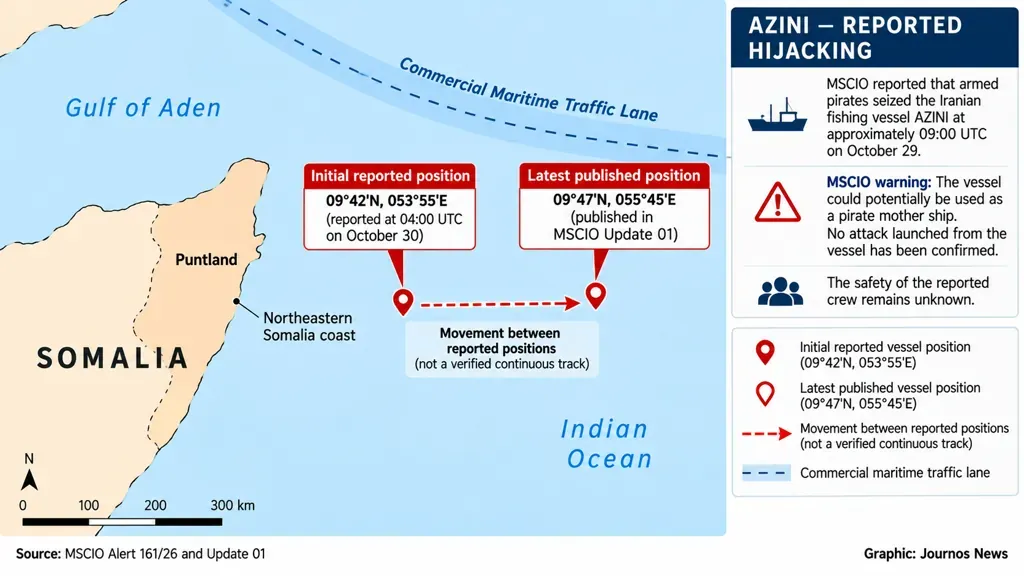
The vessel, identified as AZINI, was reportedly hijacked at about 09:00 UTC on October 29, according to the Maritime Security Center Indian Ocean (MSCIO).
In an alert issued on October 31, MSCIO said armed pirates had taken control of the vessel. It also reported that the crew’s safety remained unknown.

The maritime security centre later updated the vessel’s position to 09°47’N, 055°45’E, saying it was approaching a commercial maritime traffic lane.
MSCIO warned that pirates could potentially use AZINI as a mother ship for further attacks. However, the authority has not confirmed that the vessel has already supported another operation.
MSCIO warns of possible further attacks
MSCIO issued Alert 161/26 after receiving information about the reported hijacking.
Its initial alert placed the incident off northeastern Somalia at approximately 09:00 UTC on October 29. The vessel’s last reported position was 09°42’N, 053°55’E at 04:00 UTC on October 30.
The centre said armed pirates had reportedly seized the fishing vessel and that the crew’s safety was unknown.



In Update 01, MSCIO gave a newer reported position of 09°47’N, 055°45’E. It said the vessel was approaching a maritime traffic lane and repeated its warning about possible use as a mother ship.
The updated alert did not state the time of the latest position report. The coordinate should therefore be treated as the latest published position, not as a confirmed current location.
MSCIO advised vessels operating in the area to maintain heightened vigilance, follow Best Management Practices for Maritime Security (BMP-MS) and report suspicious activity.
The warning identifies a potential threat to commercial shipping. It does not name a specific merchant vessel as a target or announce a closure of any shipping route.
Puntland officer reports 12 attackers
A maritime security officer with the Puntland Maritime Police Force told the Associated Press that 12 pirates seized AZINI.
The vessel was carrying 21 Iranian crew members and two Somali security guards, according to the officer.
He spoke anonymously because he was not authorized to discuss the incident with the media.
A separate account attributed to Puntland security officials described eight armed men boarding the vessel initially. Four more reportedly joined them, bringing the total number of attackers to 12.
The accounts therefore describe different stages of the reported seizure rather than necessarily conflicting final totals.
The reported presence of two Somali guards also raises questions about the circumstances of the hijacking. Available information does not establish how the attackers approached the vessel, how they overcame the guards or whether anyone was injured.
Puntland authorities have not yet provided a publicly verified account that independently confirms the full sequence of events.
Crew safety remains unknown
The welfare of the 21 Iranian crew members and two Somali guards remains a major concern.
MSCIO has not confirmed whether the people aboard the vessel are safe. It has also not reported a rescue, release, injury or death.
The available public information does not establish whether the pirates have contacted the vessel’s owners, demanded a ransom or opened negotiations.
Nor has a direct statement from Iranian authorities confirming the crew’s identities or condition been established.
Until the relevant authorities provide confirmation, the reported number and nationalities of those aboard should remain attributed to the Puntland security officer.
Why the vessel could become a mother ship
A mother ship can allow pirates to operate farther from the coast than they could using small boats alone.
In a typical operation, a larger vessel carries attackers, supplies and smaller craft. Pirates can then launch those smaller boats against merchant ships operating farther offshore.
The arrangement can extend the range of pirate groups and give them more opportunities to approach commercial vessels.
MSCIO’s warning reflects concern that AZINI could serve this purpose. Its reported movement toward a maritime traffic lane makes the possibility important for shipping operators to monitor.
However, the centre has not confirmed that pirates have converted the fishing vessel into a mother ship or launched any attacks from it.
No specific commercial vessel has been identified as a target in the alert.
Operation Atalanta investigates
The European Union Naval Force’s Operation Atalanta is investigating the reported hijacking, according to MSCIO.
The operation works to deter, prevent and suppress piracy and armed robbery in its area of operations. It also supports maritime security and monitors fishing activity in the Horn of Africa and the western Indian Ocean.
MSCIO has not published details of any naval response to the AZINI incident. It has not confirmed that a naval vessel has intercepted, approached or taken control of the fishing vessel.
The investigation’s findings and the latest operational assessment remain outstanding.
A wider resurgence of Somali piracy
The seizure comes during a renewed period of piracy off Somalia.
Operation Atalanta’s October 16 update identified four piracy cases that had been closed: the tanker HONOUR 25, merchant vessel SWARD, tanker EUREKA and tanker SIBU 1.
The operation said the tanker ASANA remained under pirate control at that time.
The cases involved different vessels, locations and circumstances. They should not be treated as one coordinated operation.
The HONOUR 25 was hijacked in April. Puntland maritime forces recovered it on September 29. The International Maritime Organization later reported that five seafarers died during the rescue operation.
Pirates also seized the merchant vessel SWARD in April. They later abandoned it, and the vessel reached Mombasa safely.
The tanker EUREKA was hijacked while anchored off Yemen in May. Pirates later left the vessel, which ran aground near the Somali coast. Its crew were released.
The tanker SIBU 1 was seized in August in the Gulf of Aden, about 136 nautical miles east of Al Mukalla, Yemen. Puntland maritime forces recovered it on September 25. Operation Atalanta reported that the crew were safe and that suspected pirates had been arrested.
The ASANA, hijacked in July, remained under pirate control in the operation’s October 16 assessment.
These cases show that the recent piracy threat has involved successful hijackings, prolonged captivity, vessel recoveries and the release of crews. They also demonstrate why authorities distinguish between a reported attack, a confirmed seizure and a completed recovery.
The AZINI incident adds another reported hijacking to that security picture, but its outcome remains unknown.
Shipping risks require careful assessment
The possibility that pirates could use AZINI as a mother ship creates a concern for commercial vessels operating near the reported position.
However, the available alert does not identify a specific target or establish that an attack is imminent.
Shipping operators have been advised to maintain heightened vigilance, follow maritime security procedures and report suspicious activity.
The vessel’s reported movement toward a maritime traffic lane is an important development. Its actual position and movement after the published update remain unconfirmed.
The incident also needs to be assessed separately from other security threats in the region. Piracy off Somalia, attacks in the Gulf of Aden, threats around Bab el-Mandeb and incidents in the Strait of Hormuz involve different locations and actors. The available evidence does not establish that they form part of a single coordinated campaign.
Investigation and crew welfare remain the priorities
The immediate questions are whether the crew remain safe, where the vessel is now and whether pirates intend to use it for further attacks.
Confirmation from Puntland authorities, Operation Atalanta and Iranian officials would help establish the circumstances of the seizure and the condition of those aboard.
For now, MSCIO’s warning remains precautionary. It identifies a possible threat to commercial shipping, not a confirmed attack launched from AZINI.
The hijacking is another serious development in the return of Somali piracy. But the next assessment will depend on verified information about the vessel, its crew and the actions of those who seized it.
Reporting Credit: Journos News reviewed MSCIO Alert 161/26 and its first update, Operation Atalanta’s reporting on piracy incidents off Somalia, International Maritime Organization information on recovered vessels and crew casualties, and attributed accounts from Puntland maritime security officials.