NEW YORK, United States – U.S. stocks fell sharply on Friday, October 30, as investors reassessed the cost and potential returns of the artificial-intelligence boom. The S&P 500 lost 1.82%, its steepest daily decline since June. The technology-heavy Nasdaq Composite fell 2.86%, while the Dow Jones Industrial Average dropped 1.09%.
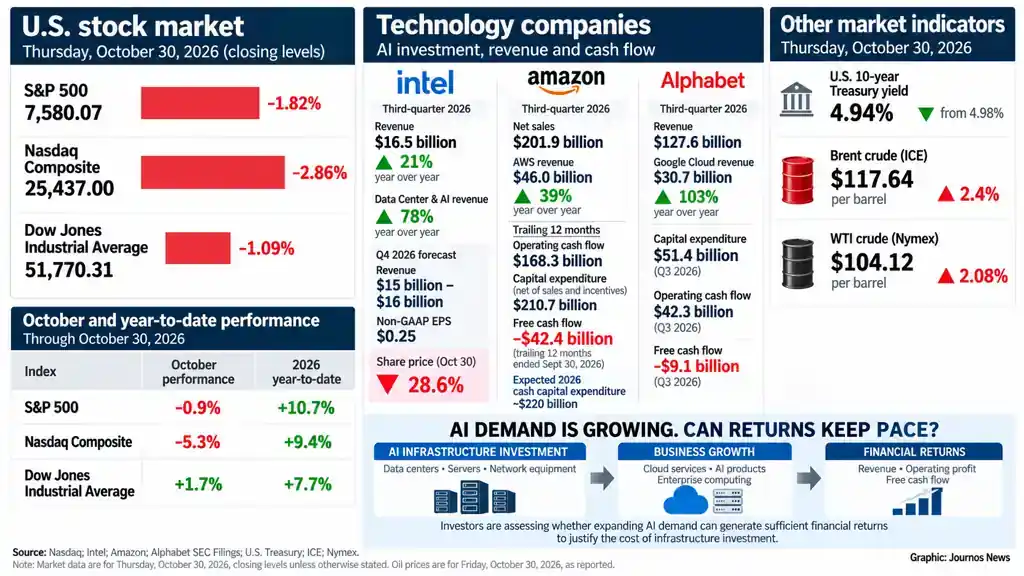
The S&P 500 closed at 7,580.07, down 140.32 points. The Nasdaq finished at 25,437.00, losing 747.72 points. The Dow ended at 51,770.31, down 572.25 points.
The selling followed a difficult week for major technology companies. Intel’s fourth-quarter forecast disappointed investors. Amazon’s results highlighted the pressure that heavy infrastructure investment was placing on free cash flow. Alphabet had already suffered a sharp share-price decline after reporting weaker-than-expected results and higher spending.

Together, the developments raised a question facing the technology sector: how quickly can companies turn enormous investments in AI computing capacity into sustainable profits?
The market decline did not establish that an AI investment bubble exists. Nor did it show that companies’ investments will fail. It reflected growing investor scrutiny of spending levels, cash generation, earnings forecasts and the time needed to recover infrastructure costs.
Intel’s forecast triggered a semiconductor sell-off
Intel shares plunged 28.6% on Friday, making the chipmaker one of the session’s largest market decliners. The fall followed its third-quarter results and a weaker outlook for the final quarter of 2026.
Intel reported third-quarter revenue of $16.5 billion, up 21% from a year earlier. Its non-GAAP earnings per share reached 52 cents, compared with 23 cents in the same quarter of 2025.
The company also reported stronger data-center demand. Revenue in its data-center and AI business increased 78% year over year. Management said demand for its Xeon server processors remained strong.
■ Related News




However, the outlook disappointed investors.
Intel forecast fourth-quarter revenue between $15 billion and $16 billion. It projected non-GAAP earnings per share of 25 cents. Its corresponding GAAP earnings forecast was 10 cents per share.
Chief Executive Lip-Bu Tan said the company faced continuing weakness in the personal-computer market. Intel expected the slowdown to persist through at least the first half of 2027.
The company also faced supply constraints. Its third-quarter filing identified shortages of memory, substrates and other critical components. These shortages limited its ability to meet demand for some data-center products.
At the same time, higher memory prices were putting pressure on more price-sensitive computer markets. Intel said lower client-product demand and a competitive market environment had reduced client revenue.
The results showed a business with improving revenue and stronger data-center demand. But the outlook raised concerns about its ability to convert demand into earnings and cash.
Intel’s decline spread across the semiconductor industry. The Philadelphia Semiconductor Index fell 7.2%, according to market reporting. Nvidia lost 4.2%, while Advanced Micro Devices fell 10.9%.
The losses extended beyond chip designers. Semiconductor equipment suppliers and other technology companies also came under pressure.
Amazon’s investment plans raised cash-flow questions
Amazon reported stronger third-quarter operating performance, but its cash-flow figures drew attention to the cost of expanding its infrastructure.
The company recorded net sales of $201.9 billion for the three months ended September 30, 2026. Revenue increased 12% from the same period a year earlier.
Operating income rose to $28.1 billion, compared with $17.4 billion in the third quarter of 2025. Amazon Web Services revenue increased 39% to $46 billion. AWS operating income reached $17.8 billion.
Those results showed substantial growth in Amazon’s cloud business, which provides computing capacity used by companies developing and operating AI systems.
However, the company’s investment spending had a significant effect on its cash generation.
For the 12 months ended September 30, Amazon generated $168.3 billion in operating cash flow. Its purchases of property and equipment, net of sales and incentives, reached $210.7 billion.
That left free cash flow at negative $42.4 billion. A year earlier, the company had reported positive free cash flow of $14.8 billion for the comparable 12-month period.
Amazon said the increase in property and equipment purchases primarily reflected investment in artificial intelligence.
The company continued to expect approximately $220 billion in cash capital expenditure for the full year 2026.
Capital expenditure is spending on long-term assets such as data centers, servers and network equipment. It is different from operating expenses, which include recurring costs of running a business.
Free cash flow measures operating cash flow after certain capital purchases. It therefore shows how much cash remains after those investments, not whether the investments will eventually produce a financial return.
Amazon’s figures illustrate the tension facing large technology companies. Its cloud business was expanding rapidly, but the cost of building infrastructure was exceeding the cash generated by operations over the trailing 12 months.
Investors must weigh the potential future revenue from that infrastructure against the immediate cash demands of building it.
Alphabet’s results added to investor concerns
Alphabet’s third-quarter results had already intensified pressure on technology shares before Friday’s trading session.
The Google parent reported revenue of $127.6 billion for the quarter ended September 30, up 25% from a year earlier. Google Cloud revenue increased 103% to $30.7 billion.
However, the company’s earnings and cash-flow figures disappointed investors.
Alphabet reported net income of $26.2 billion and earnings per share of $2.12. Its results fell short of market expectations, according to analyst estimates reported after the announcement.
Capital expenditure reached $51.4 billion in the third quarter. Operating cash flow was $42.3 billion, leaving free cash flow at negative $9.1 billion.
The company’s SEC filing showed that capital expenditure for the first nine months of 2026 reached $132 billion. That compared with $63.6 billion during the same period in 2025.
Alphabet said its capital investments primarily reflected technical infrastructure. These investments included servers, network equipment, data-center land and building construction.
The company also disclosed substantial financing activity. It issued $28.7 billion in senior unsecured notes during the third quarter for general corporate purposes.
Alphabet’s strong cloud growth showed that demand for AI infrastructure was producing commercial activity. But the earnings miss, negative free cash flow and rising infrastructure costs created a different picture for investors assessing the company’s overall performance.
The results highlighted the challenge of balancing growth in AI-related services with the cost of building the capacity behind them.
The scale of AI investment is changing the financial debate
Amazon and Alphabet provide two examples of the scale of investment taking place across the technology industry.
Amazon expects approximately $220 billion in cash capital expenditure during 2026. Alphabet spent $132 billion on capital expenditure during the first nine months of the year.
These figures are not directly comparable measures of AI spending. Both companies invest in infrastructure supporting several businesses, and their disclosures do not assign every dollar exclusively to AI.
They nevertheless show how rapidly infrastructure investment is expanding.
The financial returns are also not measured by capital expenditure alone. Companies must generate enough additional revenue and operating profit to cover the costs of equipment, construction, energy, maintenance and financing.
Data centers and computing systems can support cloud services, AI products, advertising, enterprise software and internal operations. Their returns may emerge over several years rather than in the quarter when companies purchase the equipment.
That creates uncertainty for investors. Spending now may support future growth, but the timing and size of those returns remain difficult to establish.
The question is not simply whether AI demand exists. It is whether companies can convert that demand into revenue and profits at a pace that justifies the investment.
Treasury yields fell as oil prices climbed
The wider financial environment also presented mixed signals.
The U.S. Treasury’s 10-year yield declined to 4.94% on Friday, from 4.98% on Thursday. Falling yields can reflect stronger demand for government bonds as investors seek safer assets.
Oil prices moved in the opposite direction.
Brent crude settled at $117.64 a barrel, up 2.4%. U.S. West Texas Intermediate crude rose 2.08% to $104.12.
The increase reflected concerns about potential supply disruptions and geopolitical tensions affecting oil markets.
Higher energy prices can add costs for businesses and consumers. They can also complicate the outlook for inflation and interest rates.
The combination of falling Treasury yields and rising oil prices showed that investors were responding to more than technology earnings. Market participants were also weighing economic conditions, energy supply risks and uncertainty about future borrowing costs.
October losses did not erase the market’s gains for 2026
Friday’s decline added to a difficult month for technology shares, but the major indexes did not all finish October lower.
The S&P 500 ended the month down approximately 0.9% from its September close. The Nasdaq Composite lost about 5.3% over the same period. The Dow remained higher, gaining approximately 1.7%.
The three indexes also remained positive for 2026 through October 30. The S&P 500 was up 10.7% year to date, the Nasdaq had gained 9.4%, and the Dow was up 7.7%.
The figures show that the October sell-off had not erased the broader market’s gains. However, the sharper monthly decline in the Nasdaq reflected the pressure on technology and growth shares.
Investors now face a more demanding test for the companies leading the AI investment cycle. Strong revenue growth and rising demand may support the case for continued infrastructure expansion. But spending must eventually translate into earnings and cash generation.
Friday’s sell-off showed that investors were paying closer attention to that gap. It did not settle whether the investments will deliver the expected returns.
Reporting Credit: Journos News reviewed third-quarter financial disclosures and SEC filings from Intel, Amazon and Alphabet, including their reported earnings, capital expenditure, cash-flow figures and forward guidance. The report also examined official Nasdaq index data, historical market-index records, U.S. Treasury yield information and published commodity-market settlement figures for October 30, 2026. Market interpretations and company-specific share-price reactions are attributed to secondary market reporting and are not presented as company-confirmed explanations for the broader market decline.