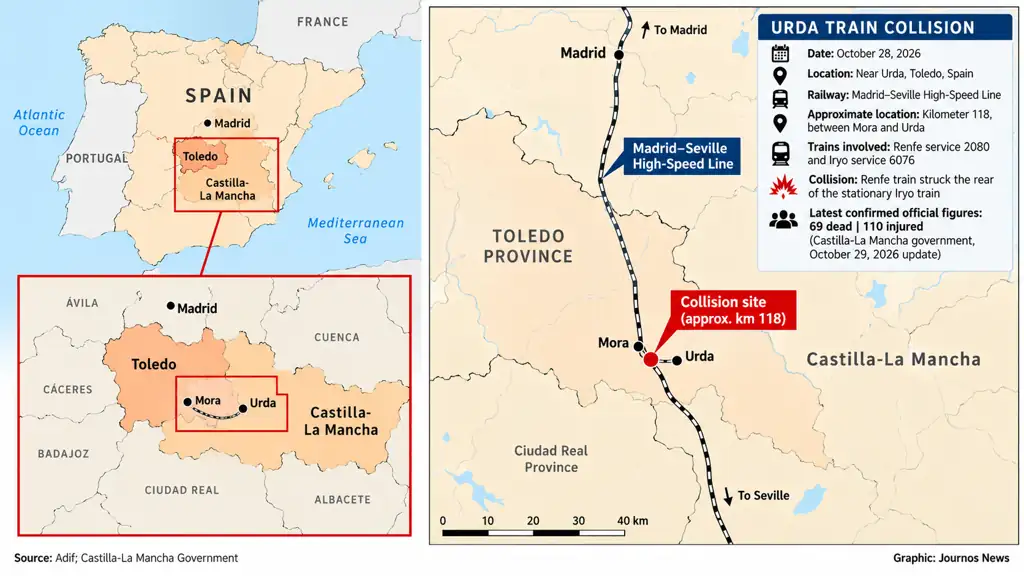
URDA, Spain – A high-speed train operated by Spain’s Renfe struck the rear of a stationary Iryo train near Urda, Toledo, on October 28, killing 69 people and injuring more than 100, according to the latest confirmed regional government update located for this report. The collision has raised urgent questions about railway safety systems, control-room decisions and the procedures used when signaling technology fails.
The crash happened at about 8:53 a.m. on the Madrid-Seville high-speed line, near kilometer 118 between Mora and Urda. Spain’s railway infrastructure manager, Adif, confirmed that the trains were traveling between Madrid and Seville when the collision occurred.
The trains involved were Renfe service 2080 and Iryo service 6076. The Renfe train struck the Iryo train from behind while the latter remained stopped on the line. The impact damaged several carriages and sent parts of the wreckage down an embankment.

The disaster has focused attention on a sequence that investigators must now reconstruct: a failure in the LZB train-protection system, the response from Adif’s control center and the decision to allow the Renfe train to resume its journey.
Transport Minister Óscar Puente has described the initial sequence as involving a computer communications failure and an authorization to resume normal movement. But that account is not a final technical finding. Investigators must establish what happened, what information railway staff had at the time and whether the operating procedures provided enough protection against a collision.
The confirmed toll and the investigation
The regional government of Castilla-La Mancha reported 69 deaths on October 29. It also reported 110 injured people, of whom 60 had been discharged from hospital and 50 remained hospitalized at the time of the update. Fifteen injured passengers had initially been classified in the most serious category.
The casualty figures require careful handling. An early entry in the railway investigation authority’s public case record briefly listed 74 deaths before the figure was corrected to 69. The regional government and Spain’s transport ministry did not confirm the higher number. The 69 figure is therefore the latest confirmed official toll located for this report, rather than an assurance that no later update has been issued.
The accident has been assigned investigation case number 146/2026. The technical investigation authority dispatched investigators to the site on the day of the collision. Its published initial description identifies the trains, time and location, but does not establish a technical cause or assign responsibility.
■ Related News

The Guardia Civil and judicial authorities are also examining the circumstances. Their work is separate from the independent technical investigation. The technical inquiry aims to establish how the accident happened and what safety lessons can prevent another disaster. A judicial investigation may examine whether any conduct breached the law.
Neither process should be treated as complete while evidence remains under examination.
What the LZB failure means
The LZB system is a train-protection technology used on parts of Spain’s high-speed railway network. It communicates movement authorities and speed restrictions to trains, helping drivers maintain safe separation and obey operating limits.
According to the transport minister’s initial account, a computer communications failure affected the LZB system near Urda at about 8:30 a.m. The failure automatically stopped trains in the affected section.
Puente said the failure affected a stretch of about 63 kilometers. With the system unavailable, Adif’s control center took responsibility for managing train movements under alternative operating procedures.
The distinction between the two systems involved in the wider safety discussion is important. LZB was the protection system operating on the affected section. ERTMS, the European Rail Traffic Management System, is a separate technology intended to provide a common framework for railway signaling and train control across Europe.
Spain has been working to introduce ERTMS on parts of its high-speed network. The transport minister said the LZB system was being replaced because the technology was no longer manufactured, not because its normal operation was inherently unsafe.
The available public information does not establish that the planned transition to ERTMS caused the Urda collision. Nor does it show that the LZB failure alone made a collision unavoidable. The investigation must examine how staff managed train movements after the system stopped working.
The decision to resume the Renfe train’s journey
Puente’s initial reconstruction placed the decision to authorize the Renfe train to resume its journey at about 8:36 a.m., several minutes after the LZB failure.
He said the train received permission to move normally even though the Iryo train remained stopped farther along the line. He also said the infrastructure’s signaling conditions included an occupied track circuit and a red signal.
These statements raise central questions for the investigation. What did the control-room operator know about the Iryo train’s position? Had the control center received a clear report that the Iryo train could not move? What information appeared on the operator’s screens? And what checks did the applicable rules require before another train could proceed?
The answers matter because a signaling failure does not automatically explain why two trains ended up on the same stretch of track.
Railway procedures generally provide alternative methods for managing traffic when automatic protection systems become unavailable. Depending on the system and operating rules, these procedures can require restricted movement, direct authorization and additional checks. Investigators must establish the exact rules that applied on this section and whether staff followed them.
The minister’s account is an important part of the public record, but it does not replace the examination of event recorders, control-room data, communications and the applicable operating instructions.
What happened to the Iryo train?
The Iryo train remained stopped near the entrance to Urda station. The reason it could not resume its journey, and the precise information it communicated to Adif, are key questions.
Reports based on published accounts of communications between the train and the control center describe attempts to restart the system and restore movement. They also indicate that the Iryo driver informed the control center that the train remained unable to proceed.
However, the recordings and their complete context need independent authentication. Investigators must establish the exact time of each call, the identity and role of each person speaking, and whether the available recordings provide a complete account.
The central issue is not simply whether a driver or controller made a particular statement. Investigators must determine what each person knew, when they knew it and what the rules required them to do with that information.
A clear reconstruction will also need to explain why the control center allowed the Renfe train to continue while the Iryo train remained on the line. It must establish whether the system offered sufficient safeguards to prevent an incorrect movement authorization.
Could staffing or maintenance have played a role?
Railway unions have raised concerns about staffing, workload and infrastructure maintenance. These issues deserve investigation, particularly after a failure involving a major signaling system and a control center responsible for managing train movements.
But an allegation about staffing is not proof that staffing caused the crash. Investigators need records showing how many controllers were on duty, their assigned responsibilities, the workload at the time and whether the control center had the resources required to manage the disruption.
The same standard applies to maintenance.
A proper review would examine LZB maintenance records, previous fault reports, repair histories, software and communications logs, and any documented problems affecting the system before October 28. It should also establish whether Adif identified earlier failures and whether it addressed them.
The Madrid-Seville line’s infrastructure investment and maintenance history also require scrutiny. But claims that underinvestment, privatization or an aging system caused the collision must wait for evidence connecting those conditions to the events at Urda.
The responsibilities of the main organizations also differ. Adif manages railway infrastructure and traffic control. Renfe and Iryo operate passenger services and manage their trains and staff. The transport ministry oversees national railway policy and the wider regulatory framework. Investigators must identify which decisions belonged to each organization and whether any failures contributed to the accident.
How the January Adamuz disaster was different
The Urda collision was Spain’s second major high-speed train disaster of 2026. On January 18, an Iryo train derailed near Adamuz in Córdoba and collided with an approaching Renfe Alvia train traveling in the opposite direction. The January crash killed 46 people.
The two accidents involved different sequences.
At Adamuz, the last three carriages of the Iryo train derailed and entered the space of the adjacent track. An oncoming Alvia train then collided with the derailed carriages. The early technical investigation identified evidence of a possible rail fracture before the Iryo train passed over the affected section.
By April, the preliminary investigation had strengthened the rail-fracture hypothesis and reported no identified abnormalities in the trains. The investigators still described their conclusions as provisional, pending further work.
Urda involved a different reported sequence: a signaling-system failure stopped trains, after which the Renfe train struck the stationary Iryo train from behind. The initial public explanation has focused on the failure of LZB and the subsequent movement authorization.
The Adamuz findings cannot establish the cause of the Urda crash. A track defect in one accident does not prove an infrastructure defect in another. Likewise, the reported control-room decisions at Urda do not explain what happened at Adamuz.
The comparison does, however, underline the need for investigators to examine infrastructure, train protection, operating procedures and maintenance as separate but connected parts of railway safety.
What investigators still need to establish
The Urda investigation must go beyond identifying the immediate sequence of events. It needs to establish why the LZB system failed, how the control center responded and whether the alternative procedures protected trains from conflicting movement instructions.
That work requires several forms of evidence:
- Train data: Event recorders, speed records, braking data and the technical condition of both trains.
- Signaling records: LZB system logs, track-circuit information, signal states and communications-system records.
- Control-center evidence: Recorded calls, dispatch instructions, screen data, shift records and the timeline of decisions.
- Operating rules: The procedures in force after the LZB failure and the safeguards required before trains could resume movement.
- Maintenance history: Previous faults, inspections, repairs and outstanding technical issues involving the affected equipment.
- Staffing and workload: The number of personnel on duty, their responsibilities and the demands placed on the control center during the incident.
Investigators should also establish whether any earlier LZB failures followed a similar pattern and whether railway operators had reported problems with the alternative procedures.
Until these records have been examined and the findings published, the public cannot reliably determine whether the collision resulted from an individual decision, a failure in the operating process, a technical weakness or a combination of factors.
Railway safety requires more than identifying one mistake
The Urda disaster has placed Spain’s railway safety arrangements under intense scrutiny. The immediate questions concern the LZB failure, the information available to the control center and the authorization that allowed the Renfe train to resume its journey.
But a complete investigation must also examine the safeguards around those decisions. A reliable railway system must protect passengers even when technology fails, communications become difficult or staff face unexpected operating conditions.
The investigation must establish whether those protections worked at Urda. It must also identify any weaknesses that require changes to equipment, procedures, staffing or oversight.
For now, the cause remains under investigation. The evidence must determine whether human decisions, technical failures or wider management problems contributed to the collision. Assigning blame before that work is complete would go beyond what the verified record supports.
Reporting Credit: Adif — official network incident notice dated October 28, 2026, identifying the collision between Renfe and Iryo trains near kilometer 118 between Mora and Urda, and the continuing interruption of Madrid-Andalusia high-speed services. Renfe — official accident statements dated October 28, 2026, confirming the affected AVE service, activation of its family assistance plan and passenger support arrangements. Government of Castilla-La Mancha — emergency and casualty updates dated October 28–29, 2026, including the confirmed regional toll of 69 deaths and 110 injured. Spain’s Ministry of Transport and Sustainable Mobility — public statements by Transport Minister Óscar Puente concerning the preliminary LZB failure and control-center sequence. AITAT — investigation case 146/2026, opened after the October 28 collision. For comparison, the Spanish Ministry of Transport and Sustainable Mobility and the railway accident investigation authority — initial investigation material concerning the January 18, 2026 Adamuz collision. Principal primary-source country: Spain.