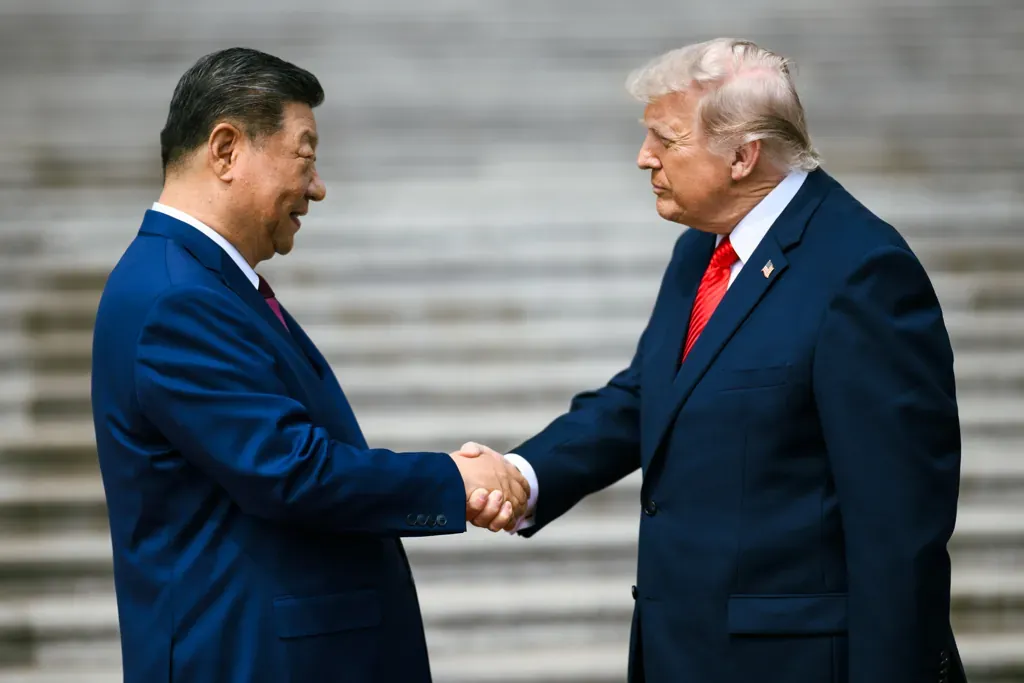
WASHINGTON, United States – Chinese President Xi Jinping arrived in Washington on Wednesday for a three-day state visit, setting the stage for a White House meeting with President Donald Trump on Thursday as the two countries seek to manage disputes over trade, technology and security.
Trump and first lady Melania Trump personally greeted Xi and his wife, Peng Liyuan, at Joint Base Andrews in Maryland, an unusually prominent welcome for a foreign leader. The visit is Xi’s first trip to Washington in more than a decade.
The two presidents are scheduled to meet at the White House on September 24. The visit runs through September 25, with a state arrival ceremony, formal talks and a state dinner forming the central events.

The summit comes after months of efforts by Washington and Beijing to stabilize relations while leaving major disagreements unresolved.
Trade truce faces another test
Trade is expected to be among the most immediate issues.
The United States and China have been operating under a temporary trade arrangement reached after Trump’s October 2025 meeting with Xi in South Korea. The current truce is scheduled to expire in November, creating pressure for the two sides to determine whether it will be extended or replaced with another arrangement.
The two governments have already held economic discussions ahead of the leaders’ meeting.
U.S. Treasury Secretary Scott Bessent and U.S. Trade Representative Jamieson Greer are meeting Chinese Vice Premier He Lifeng in Washington as part of the preparations. The White House has indicated that some tariff relief on selected nonstrategic goods could be discussed, while officials have not indicated an agreement to broadly loosen U.S. restrictions on strategic technologies or critical minerals.


For both governments, the economic relationship extends well beyond tariffs.
China remains a major supplier of manufactured goods and critical minerals, while U.S. companies maintain significant commercial interests in the Chinese market.
Rare earths remain a source of leverage
Critical minerals are another major issue.
China has imposed export restrictions on various rare earth and other critical-mineral products, making supply-chain access a recurring issue in negotiations with Washington.
Chinese Foreign Ministry spokesman Guo Jiakun said Beijing’s position was to maintain the safety and stability of global industrial and critical-mineral supply chains. He also said China’s restrictions on dual-use exports to Japanese military users were based on Chinese laws and regulations.
U.S. officials, meanwhile, have been seeking more predictable access to rare earth materials that are used in electronics, vehicles, industrial equipment and defense systems.
The issue is particularly important because the United States is simultaneously trying to reduce its dependence on Chinese supply chains for strategically important technologies.
Artificial intelligence moves to the center
Artificial intelligence is another increasingly important part of the relationship.
Washington and Beijing are competing over advanced AI models, computing infrastructure and semiconductor technology while also discussing whether the two countries can establish channels for managing risks associated with increasingly capable AI systems.
U.S. officials have said AI will be discussed during the summit. Reports before the meeting also indicated that Washington has considered establishing a bilateral notification mechanism for dangerous AI events with significant security implications.
The technology issue is complicated by U.S. restrictions on advanced semiconductor exports to China.
The Trump administration has permitted Nvidia to sell its H200 AI processors to approved Chinese customers under specified conditions, while maintaining broader controls on some advanced semiconductor technologies.
For Beijing, access to advanced computing hardware is closely connected to its effort to develop domestic AI capabilities.
For Washington, semiconductor restrictions are part of a broader national-security policy aimed at controlling access to technologies considered strategically sensitive.
The summit therefore brings together two objectives that do not easily align: maintaining economic and technological engagement while limiting certain strategic dependencies.
Taiwan remains a major security issue
Taiwan is another central point of disagreement.
China considers Taiwan part of its territory and opposes U.S. military and political support for the island. Washington maintains longstanding relations with Taiwan while operating under its one-China policy and continuing to provide defensive support.
Chinese officials have repeatedly described the Taiwan question as a core issue in China-U.S. relations.
During their May meeting in Beijing, Xi told Trump that Taiwan was the most important issue in the bilateral relationship and urged Washington to exercise caution.
The issue remains sensitive because changes in U.S. arms policy, Chinese military activity around Taiwan and statements by either government can affect the wider security environment in East Asia.
Neither side has indicated that the Washington summit will resolve the fundamental disagreement over Taiwan.
Iran adds another layer of tension
The summit is also taking place while the United States is engaged in the Iran war.
China’s relationship with Iran has drawn increased scrutiny in Washington, including questions about Chinese economic and strategic ties with Tehran.
U.S. officials have not publicly established that Beijing is directly participating in Iran’s military operations. Trump has also recently spoken more cautiously about China’s conduct regarding the conflict.
The issue nevertheless creates another potential point of disagreement at a meeting already covering trade, technology and regional security.
China has broader economic interests in maintaining stable energy supplies, while Washington is seeking to manage the wider strategic consequences of the conflict.
The leaders are seeking stability without resolving every dispute
The Washington meeting follows Trump’s state visit to China in May, when the two leaders agreed to pursue what both governments described in different terms as a more stable framework for bilateral relations.
The White House said the May agreement included measures involving critical minerals, agricultural purchases, Boeing aircraft and other areas of trade. It also said the two countries agreed to establish government-to-government boards dealing with trade and investment.
China’s Foreign Ministry described the broader objective as developing a “constructive China-U.S. relationship of strategic stability,” with greater dialogue and cooperation while managing differences.
Those earlier understandings provide a foundation for the Washington talks, but they have not removed the underlying disagreements.
The current summit is therefore expected to focus heavily on managing those differences while seeking concrete arrangements in areas where cooperation remains possible.
A carefully staged state visit
The symbolism of Xi’s arrival has been unusually prominent.
Trump’s decision to greet Xi personally at Joint Base Andrews gave the Chinese president a high-profile reception before the formal White House events. The visit also includes a large military ceremony and state dinner.
On Thursday, Trump and Melania Trump are scheduled to host Xi and Peng at a state arrival ceremony at the White House. The ceremony is to include military demonstrations and a flyover featuring a B-2 bomber and four F-22 Raptors.
The formal talks will follow the ceremony.
The White House has also scheduled a state dinner for Thursday evening, while Friday’s program includes a private tea and a visit to the National Archives before Xi’s departure.
The ceremonial schedule underscores the importance Washington is attaching to the visit, but the substantive negotiations will determine whether the renewed high-level engagement produces additional agreements.
What the summit can and cannot settle
The meeting brings together two governments with extensive economic ties and significant strategic disagreements.
Trade remains vulnerable to renewed tariff measures.
Critical minerals remain a source of supply-chain dependence.
AI and advanced semiconductors are increasingly connected to national-security policy.
Taiwan remains a fundamental dispute over security and sovereignty.
Iran and other international conflicts add further areas in which U.S. and Chinese interests can diverge.
At the same time, both governments have an interest in maintaining direct communication.
China’s Foreign Ministry said the leaders’ meetings are intended to strengthen dialogue and cooperation while properly managing differences.
The Washington summit therefore begins with a relatively narrow practical challenge: determine where the two sides can maintain existing arrangements, where they can reach new understandings and where disagreements will remain unresolved.
The outcome will be measured not only by what Trump and Xi announce in Washington, but also by whether agreements reached during their earlier meetings survive implementation once the summit is over.
Reporting Credit: White House — official state-visit schedule, summit arrangements and U.S. policy information; Chinese Ministry of Foreign Affairs — Xi’s visit announcement and China’s stated objectives for the summit; U.S. Department of the Treasury — economic and trade consultations; Office of the U.S. Trade Representative — trade negotiations and consultations; Chinese Ministry of Commerce — Chinese economic and trade delegation information.