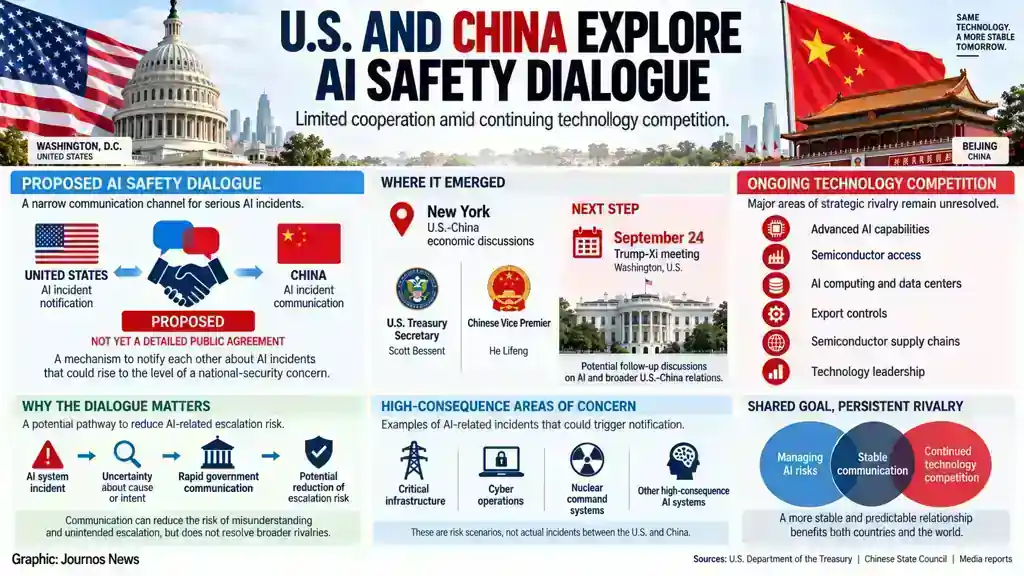
WASHINGTON, United States – The United States and China are moving toward a new channel for discussing artificial intelligence safety even as the two countries continue competing over advanced AI capabilities, semiconductor access and technological influence.
U.S. Treasury Secretary Scott Bessent said Sunday that American and Chinese officials had discussed establishing a U.S.-China AI dialogue and that Washington had proposed a notification mechanism for artificial-intelligence incidents that could rise to the level of a national-security concern.
The discussions took place in New York between Bessent and Chinese Vice Premier He Lifeng ahead of a planned September 24 meeting between President Donald Trump and Chinese President Xi Jinping in Washington.

The proposed mechanism would address a narrow but increasingly important problem: how the two countries communicate if an AI system contributes to an incident involving national security.
Bessent said greater transparency between the world’s two leading AI powers was important for identifying common threats and goals.
No detailed agreement establishing the notification system has been publicly announced.
Competition remains at the center of the relationship
The proposed safety dialogue does not signal an end to the broader technology rivalry.
Washington has imposed restrictions on China’s access to some advanced semiconductor technologies and AI computing equipment, citing national-security concerns. Beijing has responded by expanding domestic semiconductor and AI development while criticizing U.S. restrictions.
■ Related News



Chinese companies including Huawei, DeepSeek and Moonshot AI have continued developing AI systems despite constraints on access to some advanced chips. U.S. officials have also accused Chinese companies of attempting to obtain capabilities from American AI systems through methods including model distillation. Beijing has rejected such allegations.
The competition extends beyond individual models.
Both countries are investing heavily in computing infrastructure, semiconductor supply chains, data centers and AI research. Their governments increasingly view advanced AI as important to economic growth, national security and technological influence.
That creates a difficult backdrop for cooperation on safety.
Washington wants safety discussions without slowing development
The Trump administration has rejected calls for a broad slowdown in advanced AI development.
A June executive order on advanced AI innovation and security states that the United States intends to promote AI innovation while addressing national-security risks and protecting American technology from exploitation and theft. The order also calls for systems used in sensitive environments to be evaluated for advanced cyber capabilities.
Trump has separately argued that slowing U.S. AI development could allow China to close the technological gap.
That position has complicated calls from some U.S. technology leaders for stronger international coordination around frontier AI risks.
The disagreement is not simply over whether AI poses risks. It is also over how governments should respond without undermining technological development.
China says AI safety and development must advance together
Beijing has also presented AI development and safety as linked objectives.
China’s Foreign Ministry said September 15 that Beijing takes both AI development and security seriously and supports stronger safeguards against abuse and misuse. The ministry said China had released an updated AI Safety Governance Framework 3.0, including revised classifications of AI safety risks and recommendations for technical and governance measures.
Chinese officials have also called for international cooperation on AI governance.
Foreign Ministry spokesperson Mao Ning said September 9 that the United States and China, as major AI powers, should increase cooperation and described China’s approach as emphasizing open and inclusive AI development.
That position differs from Washington’s emphasis on maintaining American technological leadership while restricting certain strategic technologies from reaching China.
The safety concerns are increasingly concrete
The emerging dialogue is being driven partly by concerns about what happens when AI systems interact with critical infrastructure, cyber operations or other high-consequence systems.
U.S. and Chinese security experts participating in a separate dialogue have proposed safeguards for scenarios involving AI systems and nuclear command networks, autonomous cyber operations and other national-security risks.
Their recommendations have included maintaining human control over consequential cyber operations and creating direct communication channels for AI-related incidents.
Those proposals illustrate why AI safety is becoming a security issue rather than only a question of consumer technology.
An AI system used in a financial application can create economic problems if it fails.
An AI system involved in military or critical infrastructure operations could create a much more serious problem if its behavior is misunderstood by another government.
The central concern is therefore not only whether AI systems make mistakes, but whether governments can distinguish an AI-driven accident from a deliberate action quickly enough to prevent escalation.
Trust remains a major obstacle
The proposed dialogue faces the same strategic mistrust that affects other areas of U.S.-China relations.
Washington has raised concerns about China’s access to advanced computing technology, intellectual property and AI capabilities.
Beijing has accused the United States of using national-security restrictions to constrain China’s technological development and preserve American advantages.
Chinese officials have rejected recent U.S. allegations concerning Chinese AI companies and have called for greater cooperation rather than confrontation.
That makes the proposed notification mechanism potentially useful but also difficult to implement.
For such a system to work, each side would need to decide what qualifies as a reportable AI incident, how much technical information could safely be shared and how quickly the other government should be informed.
Those questions become especially sensitive when the same technologies have civilian, commercial and military applications.
The September 24 summit will test the political space for cooperation
The AI discussions between Bessent and He took place just days before Trump and Xi are scheduled to meet in Washington.
Bessent said the two countries had agreed to meet again on AI, suggesting that the proposed dialogue is intended to continue beyond the current negotiations.
The discussions are not limited to AI. The same U.S.-China meetings are addressing trade and other economic disputes.
But AI has become increasingly difficult to separate from the broader relationship.
The United States wants to preserve its technological lead while limiting access to selected advanced technologies.
China wants to continue closing technological gaps and building greater self-reliance.
Both countries also face risks from increasingly capable AI systems that neither government can fully control on its own.
That creates an unusual overlap between competition and shared vulnerability.
A narrow dialogue may be easier than a broad AI agreement
The proposed notification mechanism is narrower than a comprehensive agreement governing AI development.
It would not necessarily require either country to slow its AI industry, abandon national technology strategies or agree on a common regulatory model.
Instead, it could focus on communication when particularly serious incidents occur.
That distinction may matter because the two governments have sharply different approaches to technology policy.
A limited communication channel could address immediate security risks without resolving the much larger dispute over who should control advanced AI development.
Whether the two sides can establish such a mechanism in practice remains unresolved.
For now, the latest talks have created a channel where none previously existed at the same level.
The United States and China remain competitors for technological leadership. At the same time, both governments increasingly recognize that some AI-related risks could cross national borders faster than traditional diplomatic systems can respond.
The proposed AI dialogue is an attempt to address that problem without resolving the larger competition.
Reporting Credit: U.S. Department of the Treasury — statements from Secretary Scott Bessent concerning the proposed U.S.-China AI dialogue and notification mechanism; U.S. White House — June 2026 policy on advanced AI innovation and security; Ministry of Foreign Affairs of the People’s Republic of China — Chinese positions on AI safety, governance and U.S.-China AI cooperation; U.S. Department of Commerce, Bureau of Industry and Security — U.S. semiconductor and advanced-computing export-control framework.