BEIJING, China – China’s long-running effort to build large oil inventories is helping cushion the global market from the supply disruption caused by the Iran war, even as the strategy is beginning to face its own limits.
The effect has come through two related moves: China entered the conflict with unusually large crude inventories, then sharply reduced imports as oil flows through the Middle East were disrupted.
The result has been an unusual adjustment in the world’s largest crude-importing country. Instead of competing aggressively for every available barrel, Chinese refiners have been able to draw on accumulated stocks while importing substantially less oil.

That reduction in Chinese demand has removed some pressure from an already constrained global market.
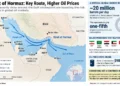
The International Energy Agency said oil flows through the Strait of Hormuz averaged only 7.6 million barrels a day in August, about 13.1 million barrels a day below pre-war levels. Yet the overall global supply deficit has been considerably smaller than the headline loss through the waterway because of additional production, alternative shipping routes, emergency stock releases and weaker demand.
China entered the crisis with an unusually large buffer
China spent years accumulating crude inventories while international oil prices were relatively low.
The U.S. Energy Information Administration estimated China’s strategic oil inventories at about 1.54 billion barrels in the first quarter of 2026. By the second quarter, the estimate had declined to about 1.49 billion barrels, still far above the estimated level at the end of 2025.
The estimates include government-held stocks as well as inventories held by Chinese national oil companies and other storage considered strategically significant. China does not publicly disclose a complete national oil-reserve figure, so outside estimates necessarily carry uncertainty.
■ Related News



The scale of those inventories gave Beijing room to respond to the disruption without immediately replacing every lost import with purchases on the international market.
China had also been importing at exceptionally high levels before the conflict. The EIA says the country imported a record 11.6 million barrels a day in 2025, including an average of about 12 million barrels a day during the second half of that year and through February 2026.
That earlier buying helped build the inventory cushion that is now being drawn down.
Imports fell sharply after the Middle East supply shock
China’s crude imports averaged only 8.1 million barrels a day in the second quarter, according to the EIA. That was 32% below the first quarter and the lowest quarterly level in years. Imports in May and June fell below 8 million barrels a day for the first time since 2016.
The decline was larger than the reduction in refinery processing, indicating that some of the shortfall was being covered by inventories.
The EIA estimated that Chinese crude imports fell by about 3.9 million barrels a day between the first and second quarters, while refinery processing declined by about 2.2 million barrels a day.
That difference matters to the global market. Every barrel that China can obtain from existing stocks is a barrel that does not need to be purchased immediately from a market already struggling with disrupted Middle Eastern exports.
The IEA estimates that 65% of the 105 million-barrel decline in non-OECD crude inventories during the first six months of the conflict came from above-ground tanks in China.
The strategy has helped limit the size of the price shock
Oil prices have nevertheless risen sharply during the conflict.
The IEA said benchmark prices had moved higher again in September as renewed fighting disrupted Middle Eastern exports. Brent crude was around $100 a barrel in mid-September, according to market data cited by the Associated Press, compared with an average of roughly $69 a barrel in 2025.
But the market has not experienced the most extreme scenarios initially feared when the conflict began.
The difference is not attributable to China alone. The IEA identifies several offsets, including increased production outside the Gulf, alternative export routes through Saudi Arabia and the United Arab Emirates, emergency releases by IEA members and a substantial decline in global oil demand.
China’s lower imports have nevertheless been an important part of that adjustment.
The EIA explicitly concluded that China’s reduced crude purchases lowered global demand and softened the upward price effect created by disrupted flows through the Strait of Hormuz.
China is now beginning to draw more heavily on its stocks
The buffer is not unlimited.
Chinese crude imports began recovering in August. Chinese customs data showed imports of about 37.9 million tonnes during the month, a 6.2% increase from July, although the figure remained more than 23% below the level a year earlier, according to reporting based on Chinese trade data.
At the same time, refinery activity has increased the pressure on inventories.
Reuters calculated that Chinese refineries processed about 640,000 barrels a day more crude in August than was available from imports and domestic production, indicating another monthly inventory draw. It was the third inventory draw in four months.
China’s domestic oil production provides only a partial offset. The National Bureau of Statistics reported crude production of 18.43 million tonnes in August, up 0.8% from a year earlier. Refinery processing, however, was down 6.9% year on year for the month.
The pattern suggests that Beijing is still using its accumulated stocks to manage the disruption, but the direction of inventories will become increasingly important if Middle Eastern supply remains constrained.
The next test is how long China can stay out of the market
China’s strategy has given the global oil market an important demand-side buffer, but it also creates a future problem.
If Chinese imports return rapidly toward pre-war levels while Gulf supply remains impaired, China would again compete with other major buyers for available crude. That could add pressure to prices at a time when global inventories are already being depleted.
The IEA said observed global oil inventories had fallen by about 507 million barrels since the conflict began, while global inventories were drawing at an estimated rate of 2.8 million barrels a day over the preceding six months. The agency warned that continued disruption could require higher prices and further demand reductions to restore market balance.
China therefore occupies an unusual position in the current oil crisis. Its stockpiling policy has reduced the immediate need for imports and helped moderate one source of upward pressure on prices. But continued withdrawals from those stocks cannot permanently replace disrupted international supply.
The longer the conflict continues, the more important the distinction becomes between having oil in storage and having reliable access to new production and transportation capacity.
For the global market, China’s reserves have bought time. They have not eliminated the underlying supply problem.
Reporting Credit: U.S. Energy Information Administration — estimates of China’s crude imports, strategic oil inventories and the effect of reduced Chinese demand on global oil markets; International Energy Agency — global oil supply-demand balances, Strait of Hormuz flows, inventory changes and emergency stock releases; National Bureau of Statistics of China — August 2026 crude oil production and refinery-processing data.