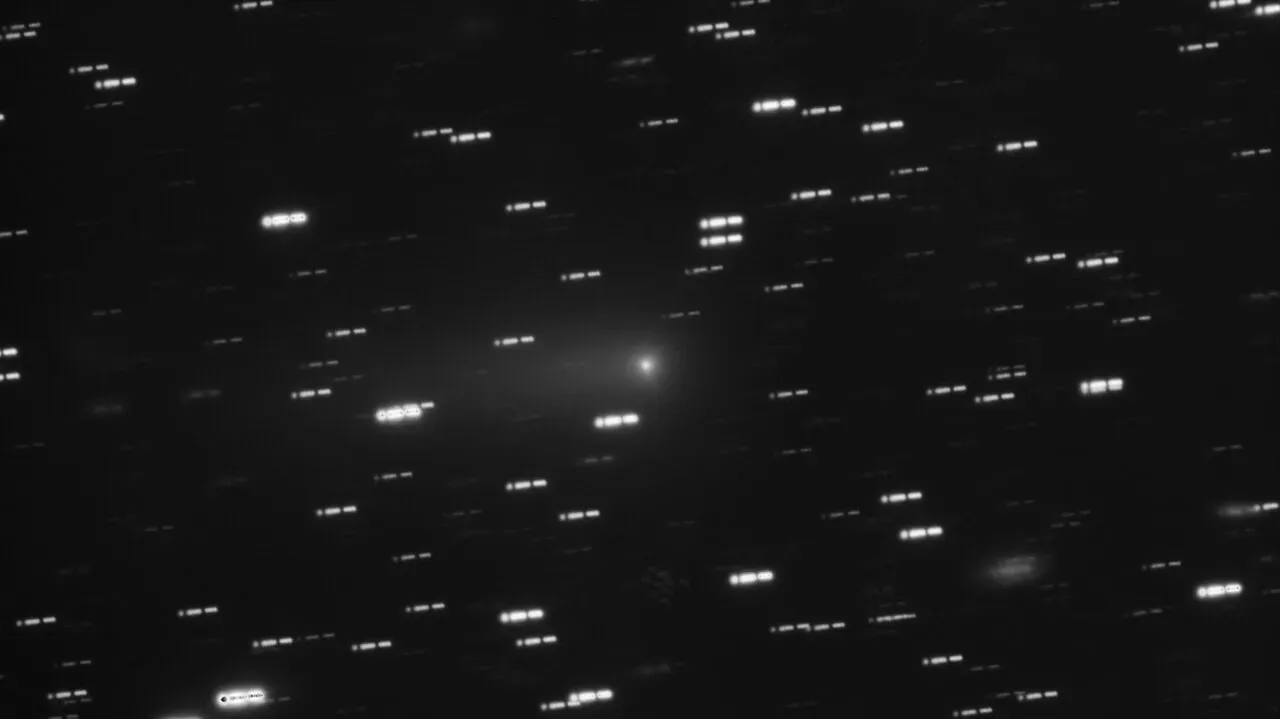
SANTIAGO, Chile — Astronomers studying the interstellar comet 3I/ATLAS have found unusually high levels of methanol in its surrounding gas, adding to evidence that the object formed under chemical conditions unlike those that produced most comets in our Solar System.
Observations made with the Atacama Large Millimeter/submillimeter Array (ALMA) detected strong methanol signatures in the comet’s coma and found an exceptionally high ratio of methanol to hydrogen cyanide. The measured ratios of about 124 and 79 on two observation dates rank among the highest recorded for comets observed at radio wavelengths.
The finding provides another chemical clue from an object that originated outside the Solar System. Because 3I/ATLAS formed around another star before entering interstellar space, its composition offers astronomers a rare opportunity to compare planetary-building material from another system with the comets found around the Sun.

Methanol stands out in the comet’s chemistry
The researchers detected methanol, or CH₃OH, together with hydrogen cyanide, or HCN, as 3I/ATLAS approached the Sun in 2025.
When sunlight warms a comet, frozen material sublimates and produces a cloud of gas and dust around the nucleus. Spectroscopic observations of that coma allow astronomers to identify individual molecules and estimate how they are being released.
In 3I/ATLAS, methanol was particularly prominent relative to HCN. The researchers found CH₃OH/HCN production-rate ratios of 124⁺³⁰₋₃₄ and 79⁺¹¹₋₁₄, depending on the observation date. Only the unusual Solar System comet C/2016 R2 (PanSTARRS) has shown a higher enrichment in comparable radio observations.
The result does not mean methanol is unique to 3I/ATLAS. Methanol is commonly detected in comets and can form on icy dust grains in interstellar environments. What makes 3I/ATLAS unusual is the relative abundance revealed by its molecular fingerprint.
Icy grains may be releasing additional methanol
The ALMA observations also provided information about where the molecules appear to originate.



The distribution of methanol suggested that at least some of its production may occur away from the nucleus, within the comet’s coma. Statistical analysis indicated production from coma sources more than about 258 kilometers from the nucleus at 99% confidence, although the researchers could not completely rule out direct production from the nucleus because of limitations in the observations.
The researchers suggest that icy grains surrounding the nucleus may act as miniature cometary sources, releasing methanol as they are warmed by sunlight.
Hydrogen cyanide behaved differently. Its distribution was consistent with direct sublimation from the nucleus, providing a contrast with the more extended methanol production.
The distinction gives astronomers a more detailed picture of how different molecules are stored and released as an interstellar comet approaches the Sun.
The chemistry points to a different birthplace
The unusually high methanol-to-HCN ratio suggests that the ices incorporated into 3I/ATLAS formed under conditions different from those experienced by most known Solar System comets.
Those conditions could reflect differences in temperature, chemistry or the availability of molecular ingredients in the planetary system where 3I/ATLAS originated. The observations cannot identify its parent star or reconstruct its entire formation history, but they provide measurable evidence that its chemical environment differed from the Solar System’s.
Earlier observations have already shown other unusual characteristics. The James Webb Space Telescope found a coma strongly dominated by carbon dioxide when 3I/ATLAS was still far from the Sun. Later observations also revealed unusual gas-outflow behavior.
Separate observations with the IRAM 30-meter telescope detected methanol, carbon monoxide, formaldehyde, methyl cyanide and other molecules, while finding that several molecular abundances were at the upper end of ranges measured in Solar System comets.
A rare chemical sample from another planetary system
3I/ATLAS is only the third confirmed interstellar object observed passing through the Solar System. It was discovered in July 2025 by the ATLAS survey in Chile.
Unlike spacecraft missions that return samples from bodies within our planetary system, observations of 3I/ATLAS allow astronomers to study material that formed around another star without physically traveling to another planetary system.
Its chemical composition therefore serves as a kind of remote sample of planetary formation elsewhere in the galaxy.
The latest measurements do not establish exactly where 3I/ATLAS originated or what type of planetary system produced it. They instead add methanol enrichment to a growing list of characteristics that distinguish the interstellar comet from many of its Solar System counterparts.
As astronomers continue analyzing observations from different instruments, the unusual chemistry of 3I/ATLAS could help refine models of how icy bodies form and evolve around other stars.
Reporting Credit: National Radio Astronomy Observatory and ALMA — methanol and hydrogen-cyanide observations; NASA Technical Reports Server — accepted research manuscript and observational results; IRAM — independent molecular observations and compositional analysis.