Last updated: September 4, 2026 | 00:00 UTC
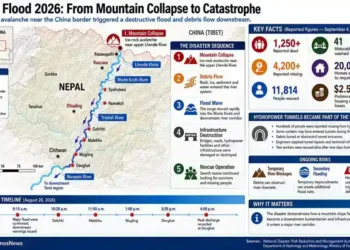
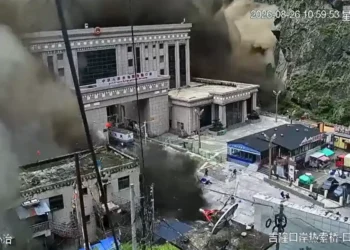
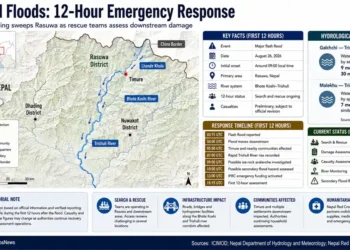
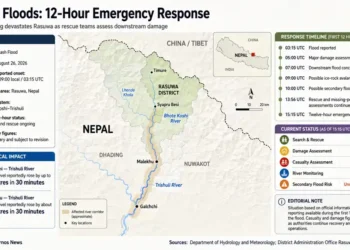
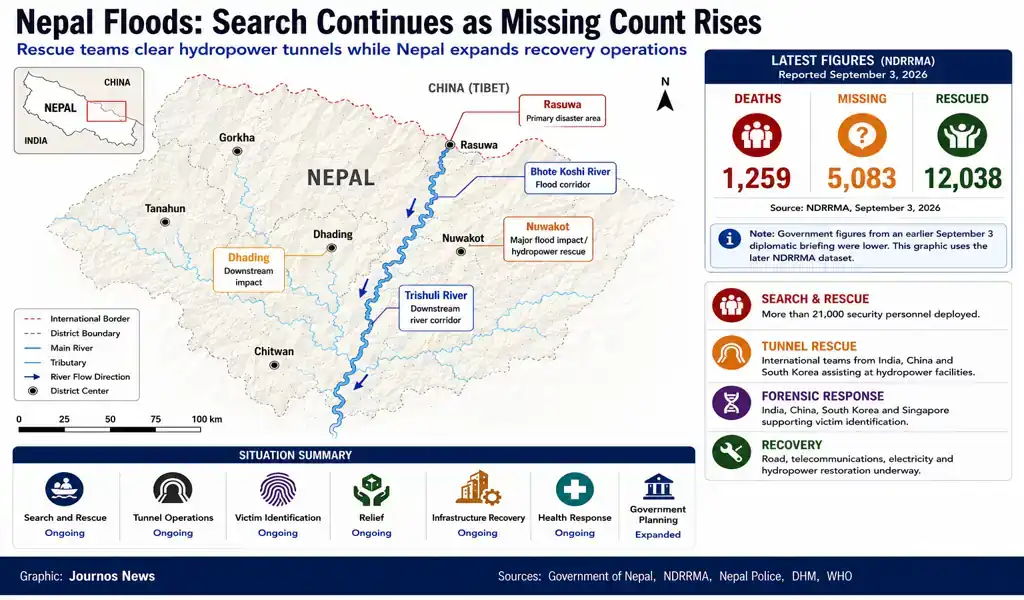
Nepal continues a large-scale search, rescue, recovery and relief operation after the August 26 Bhote Koshi flash flood and debris-flow disaster affected communities along the Bhote Koshi and Trishuli river corridors.
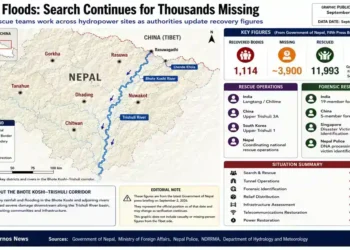
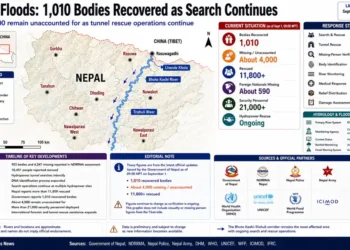
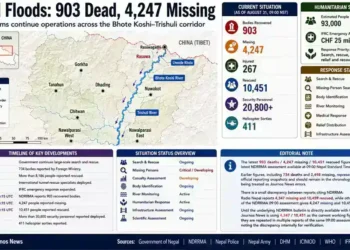
The Government of Nepal reported on September 3 that 1,204 bodies had been recovered, about 4,200 people remained missing and 11,993 people had been rescued. The government said those figures were still being verified as search and identification operations continued.

A later September 3 report citing the National Disaster Risk Reduction and Management Authority put the death toll at 1,259, with 5,083 people missing and 12,038 rescued. The different figures reflect continuing operational updates and should not be treated as a single reconciled dataset.
Search operations remain focused on flood-affected settlements, river corridors and hydropower facilities where workers are believed to remain missing. Specialized teams from India, China, South Korea and other partners continue supporting Nepal’s response.
Major Developments We’re Following
- Nepal’s September 3 government briefing reported 1,204 bodies recovered, about 4,200 missing and 11,993 rescued.
- A later NDRRMA update reported by Nepal News put the figures at 1,259 deaths, 5,083 missing and 12,038 rescued.
- More than 21,000 security personnel remain involved in search, rescue and relief operations.
- International tunnel-rescue teams from India, China and South Korea continue working at affected hydropower facilities.
- Rescue teams continue clearing debris from the Upper Trishuli 3A tunnel, where access remains heavily obstructed by rocks, mud and collapsed structures.
- Nepal’s Cabinet accepted a $5 million Asian Development Bank grant for emergency rescue and relief operations.
- The government has begun shifting attention toward relocation, essential-service restoration and longer-term recovery while search operations continue.
What We Know
- Disaster: Bhote Koshi flash flood and debris-flow event
- Initial event: August 26, 2026
- Primary affected corridor: Bhote Koshi–Trishuli river system
- Severely affected areas: Rasuwa, Nuwakot and Dhading
- Other affected districts: Gorkha, Chitwan and Tanahun
- Government figure, September 3: 1,204 bodies recovered
- Later NDRRMA figure reported September 3: 1,259 deaths
- Government figure, September 3: About 4,200 missing
- Later NDRRMA figure reported September 3: 5,083 missing
- Government figure, September 3: 11,993 rescued
- Later NDRRMA figure reported September 3: 12,038 rescued
- Security personnel deployed: More than 21,000
- Tunnel rescue: Ongoing
- Forensic identification: Ongoing
- Infrastructure assessment: Ongoing
- Relief operations: Ongoing
- Community relocation: Underway
The Government of Nepal said casualty and missing-person figures remain subject to verification.
What We Don’t Know
- The final death toll has not been established.
- Authorities have not yet produced one fully reconciled national missing-person figure.
- The exact number of people remaining inside hydropower facilities is unclear.
- The full extent of damage to homes, roads, bridges and hydropower infrastructure remains under assessment.
- The final economic cost of the disaster remains unknown.
- The number of displaced people requiring long-term relocation has not yet been fully established.
Public Safety Information
The Department of Hydrology and Meteorology continues operating Nepal’s weather, rainfall, river-monitoring and flood early-warning systems. Its official website lists real-time hydrological monitoring and flood forecasting services.
The World Health Organization says damaged water and sanitation systems, displacement and disrupted health services increase the risk of communicable disease and other health problems in affected communities. Emergency medical teams have been deployed, while health authorities continue supporting trauma care and essential services.


People in affected areas should follow current instructions from Nepali authorities and emergency agencies.
Live Updates
September 3, 00:00 UTC — Search Operations Continue Into Another Day
Nepal’s search and rescue operation continued as authorities worked to locate people missing after the August 26 Bhote Koshi flood.
The Government of Nepal said more than 21,000 security personnel had been mobilized for search, rescue and relief work. Specialized international teams were also supporting difficult tunnel-rescue operations.
September 3, 01:00 UTC — Tunnel Rescue Remains a Central Priority
Search teams continued operations at hydropower facilities affected by the flood.
Nepal’s government said Indian, Chinese and South Korean tunnel-rescue teams were working alongside the Nepali Army at Langtang, Chilime, Upper Trishuli 3A and Upper Trishuli 1.
September 3, 02:00 UTC — Forensic Teams Continue Identification Work
Forensic specialists continued helping Nepal identify recovered human remains.
The government said teams from India, China, Singapore and South Korea were supporting Nepal Police with DNA testing and victim identification.
September 3, 03:00 UTC — Government Continues Assessment of Infrastructure Damage
Nepal continued assessing damage to homes, roads, bridges, hydropower facilities and other critical infrastructure.
The government said the full extent of the damage remained unclear while teams gained access to more affected areas.
September 3, 04:00 UTC — DHM Continues River and Rainfall Monitoring
Nepal’s Department of Hydrology and Meteorology continued operating its flood forecasting and early-warning systems.
The department’s monitoring network provides rainfall, river-level and hydrological information used by authorities during flood emergencies.
September 3, 05:00 UTC — Government Briefs Diplomatic Community
Foreign Minister Shisir Khanal briefed diplomats and international organizations on the disaster response.
He said Nepal had recovered 1,204 bodies, with about 4,200 people missing and 11,993 rescued at the time of the briefing. He stressed that the figures remained subject to verification.
September 3, 06:00 UTC — Nepal Says More Than 21,000 Personnel Are Mobilized
The government said Nepal Army, Nepal Police and Armed Police Force personnel were continuing search, rescue, evacuation and relief operations.
Authorities said more than 21,000 security personnel had been mobilized, alongside volunteers, medical teams, local authorities and international specialists.
September 3, 07:00 UTC — International Rescue Teams Continue Specialized Work
Nepal said tunnel-rescue teams from India, China and South Korea continued operations at separate hydropower sites.
Chinese personnel were working at Upper Trishuli 3A, Indian teams at Langtang and Chilime, and South Korean personnel at Upper Trishuli 1.
September 3, 08:00 UTC — Government Reports Foreign Nationals Among Missing
Nepal’s government said about 590 foreign nationals from 34 countries remained missing according to its September 3 diplomatic briefing.
Authorities continued working with foreign missions and families to verify identities and locations.
September 3, 09:00 UTC — Nepal Continues Medical Response
Medical teams continued treating injured people while authorities worked to maintain essential health services in affected districts.
WHO said the disaster damaged health facilities and disrupted access to hospitals, while emergency medical teams had been deployed from Kathmandu.
September 3, 10:00 UTC — Government Begins Wider Recovery Planning
Nepal’s government said it was taking measures to relocate affected communities and restore essential services.
Authorities are also preparing a broader post-disaster assessment to establish recovery and reconstruction requirements.
September 3, 11:00 UTC — Nepal Requests Continued International Support
The government said it had requested specialized equipment including LiDAR systems, emergency bridges, DNA-testing equipment, drones, transport equipment and human-remains storage supplies.
Some equipment had already arrived while additional assistance remained in transit.
September 3, 12:00 UTC — NDRRMA Updates Death Toll to 1,259
Nepal News reported that NDRRMA had raised the reported death toll to 1,259.
The same update put the number of missing people at 5,083 and the number rescued at 12,038. Search, rescue and relief operations remained active.
September 3, 13:00 UTC — Search Teams Face Severe Tunnel Blockages
Nepal News reported that rescuers at Upper Trishuli 3A had cleared only part of a heavily obstructed tunnel entrance.
A 93-member team led by the Nepal Army was using excavators, compressors and breakers. Rescuers had penetrated roughly 15 to 20 metres, while additional boulders continued to obstruct access.
September 3, 14:00 UTC — Nepal Army Maintains Large Search Deployment
More than 9,300 Nepal Army personnel were reported deployed across flood-affected districts.
The army was supporting search, rescue, emergency medical work and debris clearance at hydropower facilities and isolated communities.
September 3, 15:00 UTC — Nepal Police Reports Thousands Deployed
Nepal News reported that 7,912 Nepal Police personnel were participating in search, rescue, recovery and relief operations.
Police teams were also working to locate missing people, recover bodies and support affected communities.
September 3, 16:00 UTC — Major Roads Remain Disrupted
Nepal Police reported continued disruption on major roads in affected areas.
The Prithvi Highway remained blocked at Krishnabhir, while parts of the Trishuli–Mailung–Syaphrubesi road were also closed because of flood damage. Some routes had reopened partially under controlled traffic conditions.
September 3, 17:00 UTC — Cabinet Approves $5 Million Emergency Grant
Nepal’s Cabinet accepted a $5 million Asian Development Bank grant for emergency rescue and relief operations following the Bhote Koshi flood.
The government also approved additional relief and recovery measures for affected individuals, industries and businesses.
September 3, 18:00 UTC — National Mourning Announced
The government decided to observe September 7 as a national day of mourning for victims of the August 26 Bhote Koshi flood.
The national flag will be flown at half-mast at government offices and Nepali diplomatic missions.
September 3, 19:00 UTC — Government Plans Business Recovery Measures
Nepal’s Cabinet approved relief, tax and customs concessions and other measures intended to help flood-affected individuals, industries and businesses resume operations.
The measures form part of the government’s broader recovery response.
September 3, 20:00 UTC — Ncell Reports Extensive Network Damage
Ncell reported major damage to telecommunications infrastructure in the flood-affected region.
The company said a mobile tower in Timure, Rasuwa, was destroyed and more than 60 kilometres of optical-fiber infrastructure were damaged. It also announced free voice, data and SMS services for more than 300,000 customers in affected areas.
September 3, 21:00 UTC — WHO Warns of Continuing Health Risks
WHO said damaged water and sanitation systems, displacement and disrupted medical services could increase the risk of diarrhoeal and respiratory illnesses and other health problems.
Health authorities and partners continue supporting trauma care, emergency response capacity and essential health services.
September 3, 22:00 UTC — Reuters Reports Widespread Destruction Along Trishuli Valley
Reuters reported extensive destruction across parts of the Trishuli River valley, including areas around Nuwakot.
Its reporting from the area described rescue teams working around large boulders and mud at hydropower facilities, while substantial sections of settlements had been buried or destroyed.
September 3, 23:00 UTC — Search and Recovery Remain Active
Nepal continued search and recovery operations across river corridors, damaged settlements and hydropower facilities.
The latest reported NDRRMA figures remained 1,259 deaths, 5,083 missing and 12,038 rescued, while the government continued to reconcile information from different operational sources.
September 4, 00:00 UTC — Current Situation
Nepal remains in an active search, recovery, relief and early-reconstruction phase.
The latest government diplomatic briefing reported 1,204 bodies recovered, about 4,200 missing and 11,993 rescued. A later NDRRMA update reported through Nepal News put the figures at 1,259 deaths, 5,083 missing and 12,038 rescued.
The figures have changed as authorities continue recovering remains and reconciling records. JournosNews should therefore identify the issuing authority and update time whenever these figures change rather than combine datasets into a single unsupported total.
Emergency Response
Nepal Army, Nepal Police and Armed Police Force personnel continue search, rescue, recovery and relief operations.
International specialists from India, China, South Korea and other partners are supporting tunnel rescue, forensic identification and other technical operations.
Health Response
WHO reports that six districts have been affected and that approximately 10,000 households require immediate relief.
Three health posts were fully damaged, one hospital was partially damaged and access to two hospitals was affected. Emergency Medical Teams have been deployed to affected districts.
Infrastructure Recovery
Roads, bridges, telecommunications networks, electricity systems and hydropower facilities suffered major damage.
The government is assessing infrastructure losses while restoration work continues.
Weather and Flood Monitoring
Nepal’s Department of Hydrology and Meteorology continues monitoring rainfall and river conditions through its national hydrological network.
The agency maintains flood forecasting and early-warning services for current river and rainfall conditions.
What Changed During This 24-Hour Window
Recovered bodies: Government briefing — 1,204; later NDRRMA report — 1,259
Missing: Government briefing — about 4,200; later NDRRMA report — 5,083
Rescued: Government briefing — 11,993; later NDRRMA report — 12,038
Security personnel: More than 21,000
Tunnel rescue: Continuing
Forensic identification: Continuing
Medical response: Continuing
Road restoration: Continuing
Telecommunications restoration: Continuing
Relief operations: Continuing
Recovery planning: Expanded
International assistance: Continuing
Sources / References
Primary and official sources used for this tracker include:
- Government of Nepal — Nepal National Portal
- Ministry of Foreign Affairs of Nepal
- Department of Hydrology and Meteorology
- National Disaster Risk Reduction and Management Authority
- Nepal Army
- Nepal Police
- Armed Police Force
- World Health Organization Nepal
Supporting reporting was used only where it provided additional information or independently reported operational developments.